What was the shortest war in history?
The Anglo-Zanzibar War of 1896. From the first shots to the ceasefire, it lasted somewhere between 38 and 45 minutes, depending on the source.
38–45min
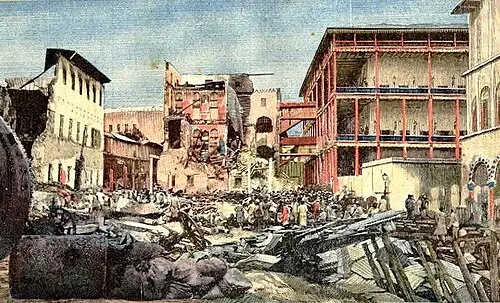
On the morning of August 27, 1896, off the east coast of Africa, a line of British warships opened fire on the waterfront palace of Zanzibar. The palace was soon in flames, and within about 40 minutes the guns had fallen silent.
Guinness World Records lists this Anglo-Zanzibar War as the shortest war on record. Yet its exact length varies from source to source: 38 minutes, 40, or 45. Why was it so short, and why can nobody agree on the number?
A sudden death and an unapproved sultan
Zanzibar is a group of islands that is now part of Tanzania. In the 19th century it was ruled by a sultan and thrived as a hub of Indian Ocean trade. In 1890 it became a British protectorate, under an arrangement that a new sultan could take the throne only with the agreement of the British consul.
On August 25, 1896, Sultan Hamad bin Thuwaini, who had been on good terms with Britain, died suddenly. Amid whispers that he had been poisoned, a member of the royal family, Khalid bin Barghash, moved into the palace without British approval and declared himself sultan. The British wanted another royal, Hamud bin Muhammed, on the throne.
The British consul, Basil Cave, warned Khalid to leave the palace. Khalid refused. Some 2,800 men armed with rifles and artillery are said to have gathered to defend him.
An ultimatum: 9 a.m.
Royal Navy warships kept arriving in the harbor. On the afternoon of the 26th, the cruiser HMS St George arrived carrying Rear Admiral Harry Rawson, and five warships lined up right in front of the palace. Rawson issued an ultimatum: haul down the flag and leave the palace by 9 a.m. on the 27th.
On the morning of the 27th, Khalid’s reply was that he had no intention of lowering his flag. At 9:00 the order to open fire was given, and at 9:02 the ships’ guns began firing. Much of the palace was built of wood, and it quickly caught fire.
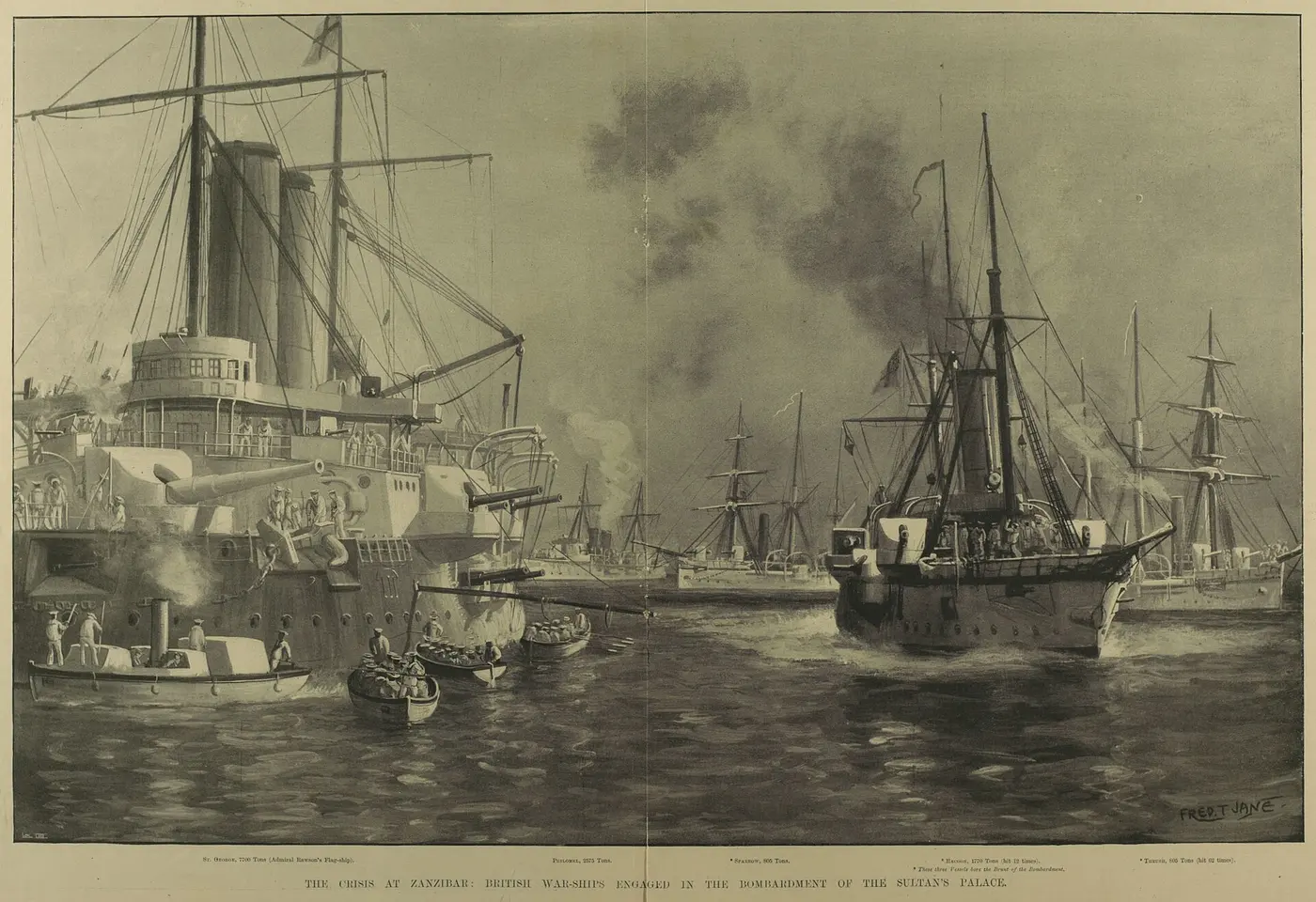

The only thing resembling a Zanzibari navy was the sultan’s royal yacht, the Glasgow. She fired at the flagship St George and was promptly sunk by return fire. Her crew was rescued.
Why the minutes don’t add up
At around 9:40 the shelling stopped, and the flag flying over the palace was brought down. Khalid had already slipped out of the palace during the bombardment and taken refuge in the nearby German consulate.
The disagreement over the length of the war comes down to what you count. Did it begin at 9:00, when the order was given, or at 9:02, with the first shot? Did it end at 9:40, or at 9:45? Even the logbooks of the British ships record the ceasefire at times ranging from 9:35 to 9:45. The often-quoted 38 minutes runs from 9:02 to 9:40, while Guinness World Records gives 9:00 to 9:45.
Short, but not bloodless
The war may have been brief, but its toll was not light. Around 500 people on the Zanzibari side, civilians included, were killed or wounded, and many are said to have died in the burning palace. British casualties amounted to a single seriously wounded sailor, who later recovered.
That afternoon, Hamud, Britain’s choice, became the new sultan. A few months later, at Britain’s urging, he abolished slavery. According to the British historian Ian Hernon, Khalid’s supporters were even made to pay reparations covering the cost of the shells that had been fired at them.

Khalid was sheltered by the Germans, and in October he escaped on a German warship to German East Africa on the mainland. In 1916, during World War I, he was captured by British forces and sent into exile in the Seychelles and on St Helena. He was eventually allowed to return to East Africa and died in Mombasa, Kenya, in 1927.