Did Londoners really hold fairs on the frozen Thames?
Yes. From the 17th century to the early 19th, “frost fairs” with stalls and games were held on the ice of the frozen River Thames in London.
−1.2°C
The River Thames, which runs through the heart of London, almost never freezes these days, even in the depths of winter. Between the 17th and early 19th centuries, however, it froze again and again. And on the ice, Londoners held lively markets known as frost fairs.
According to the London Museum, the surface of the river froze over 24 times between the early 1600s and 1814, sometimes staying frozen for weeks.
A town on the ice
The first event officially recorded as a frost fair took place in the winter of 1607–08, when people played football and bowled between the traders’ booths. Once the river was solid, it became a broad open space in the middle of a crowded city, and Londoners made the most of it.
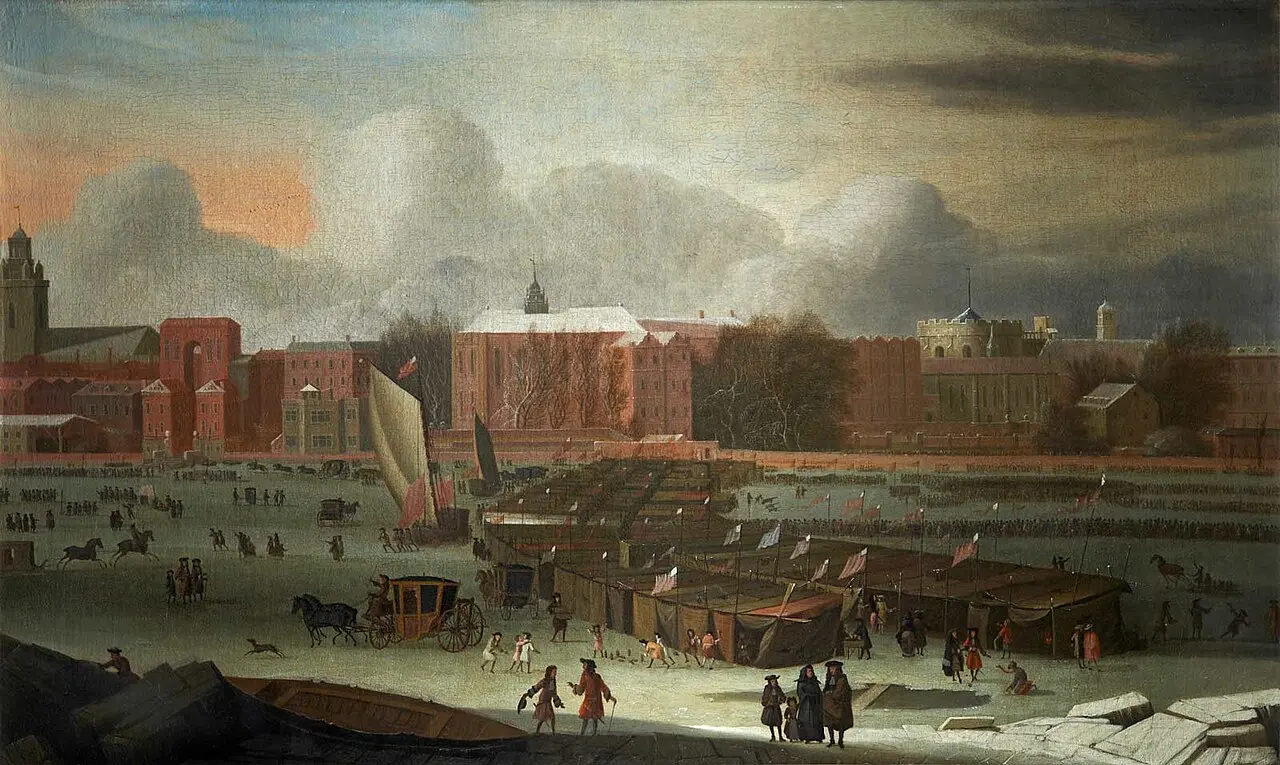
The most celebrated fair came in the winter of 1683–84. The river stayed frozen for about two months, and tents and stalls were laid out across the ice like streets. There were barbers, shoemakers, booksellers, and sellers of food and drink, along with fox hunting and nine-pin bowling. The ice was thick enough for animals to be roasted over open fires.
One of the biggest draws was the printers on the ice, who sold souvenir cards printed with customers’ names. King Charles II visited the fair too, and a card bearing his name and those of other royals, dated January 31, 1684, and printed “on the ice,” survives in the London Museum’s collection.

The coldest winter on record
Numbers confirm just how cold that winter was. The Central England Temperature series, maintained by the UK Met Office, goes back to 1659 and is the longest instrumental temperature record in the world. In it, the winter from December 1683 to February 1684 averaged −1.2°C (29.8°F), the lowest of any winter in more than 360 years of records. The average winter in 1991–2020 was about 4.7°C (40.5°F), nearly 6°C warmer.
Europe was then in the period known as the Little Ice Age. The London Museum notes that countries in the Northern Hemisphere, Britain included, saw cooler weather from the early 1300s to the mid-1800s, with global temperatures thought to have dropped by about 0.5°C.
A bridge that helped the river freeze
Cold alone does not explain it, though. The Thames was then wider and shallower than it is today, so its water flowed more slowly and froze more easily.
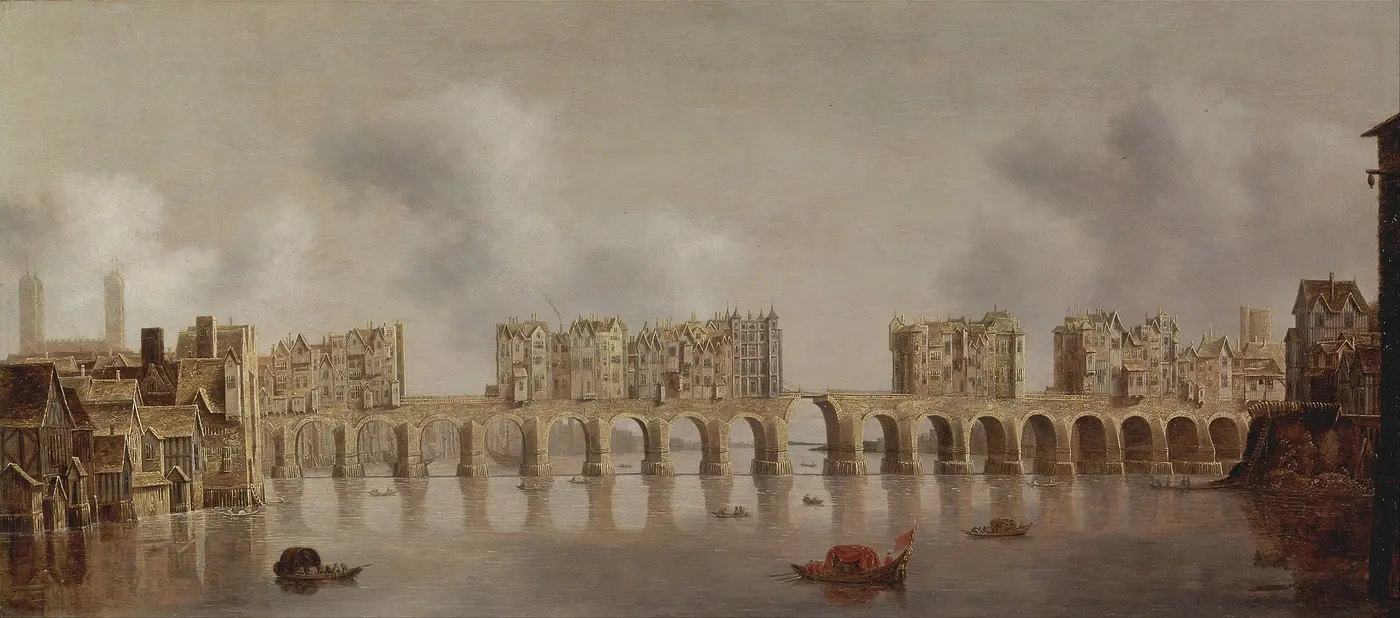
An even bigger part was played by Old London Bridge. This stone bridge, which stood from 1209 to 1832, rested on chunky piers with 19 narrow arches packed closely side by side. When ice and debris jammed those arches, the bridge acted almost like a dam, slowing the river even further.

The last frost fair, 1814
The final frost fair was held in late January and early February 1814. A print in the London Museum’s collection is titled, in part, “View of the Thames off Three Cranes Wharf when frozen, Monday 31st January to Saturday 5th February 1814, on which a fair was held attended by many hundred persons.” Printing shops once again sold keepsakes for a few pennies, and makeshift taverns sold gin, rum and wine, and one of them was reportedly called the City of Moscow, the city Napoleon had marched into, disastrously, just two years earlier. There were even reports of an elephant being led across the ice.
In 1831 a new London Bridge opened, with five wide arches, and the old bridge was pulled down. Over the rest of the 19th century the Thames was dredged and embankments were built along more of its banks. The river became too deep and too fast-flowing to freeze over completely again. By the second half of the century the Little Ice Age had ended, and extremely cold winters were becoming rarer.