Who was the mysterious print artist Sharaku?
The leading theory says he was Saitō Jūrobei, a Noh actor in the service of the lord of Awa (today’s Tokushima). Edo-period notes and a temple death register back it up, but there is still no proof that settles it.
10months
Huge faces, bulging eyes, hands thrust forward. Once you have seen an actor print by Tōshūsai Sharaku, it is hard to forget. Sharaku appeared out of nowhere in the fifth month of 1794, in the Edo period (1603–1868), when 28 of his portraits of kabuki actors, set against shimmering dark backgrounds, went on sale all at once. Over the next ten months or so he produced more than 140 designs. Then, after the New Year of 1795, he disappeared.
Almost nothing written at the time tells us who he was. That is why “the identity of Sharaku” became one of the great puzzles of Japanese art history.
More than 140 prints in ten months
According to the Japanese encyclopedia Nipponica, 142 of Sharaku’s prints survive (scholars count anywhere from 142 to 145), and every one was published by Tsutaya Jūzaburō, one of the leading publishers of the day. They fall into four periods, matched to the dates of the plays they show.
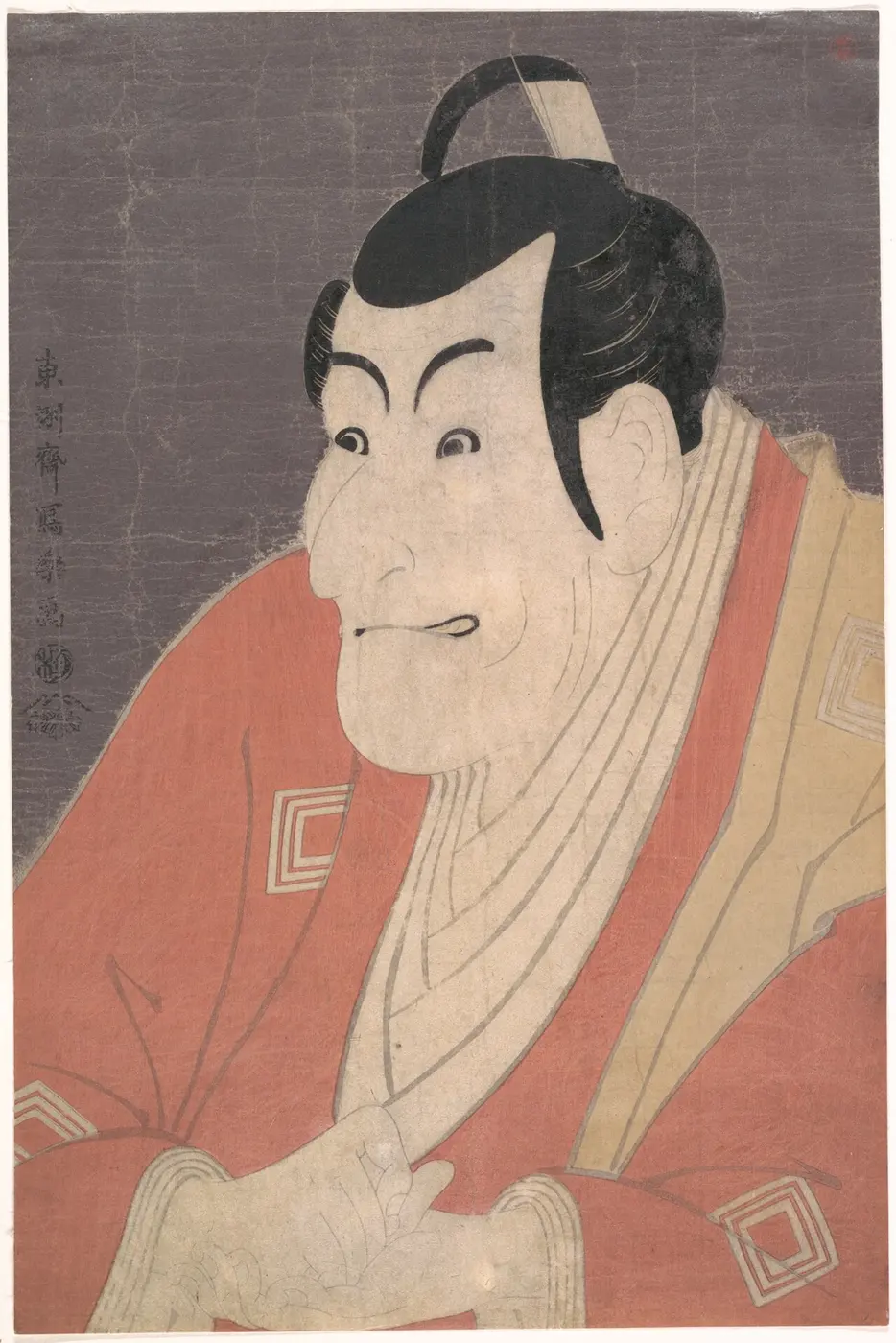
The first 28 are the most admired. All are large ōkubi-e, or “big-head pictures,” showing actors from the chest up, and their backgrounds were printed with powdered mica on a dark ground, a costly technique that makes them glint. From the second period on, full-length figures took over. The number of prints peaked in the third period, but the quality, critics say, fell off quickly. Even the signature shrank from “Tōshūsai Sharaku” to plain “Sharaku.”
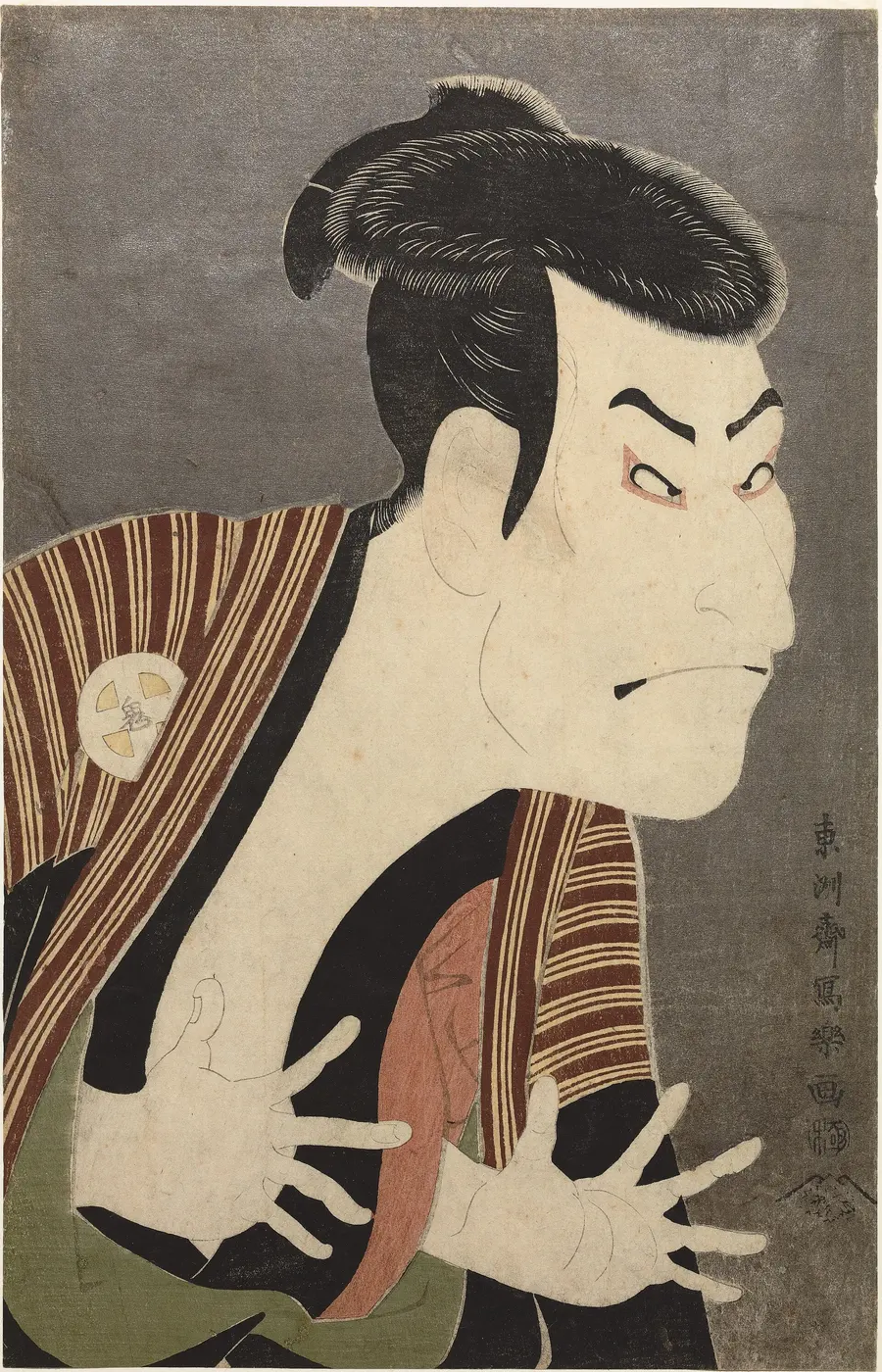

How did the public react? Ukiyo-e ruikō, a record of print artists begun by the writer Ōta Nanpo, says that Sharaku drew actors’ likenesses but tried so hard to show the truth that he drew them as they should not be drawn, so his work did not last and stopped within a year or two. He caught every quirk of an actor’s face, and audiences did not care for it.
“Commonly called Saitō Jūrobei”
Clues to Sharaku’s identity turn up only later, in notes added to handwritten copies of Ukiyo-e ruikō. In 1821 the popular author Shikitei Sanba noted that Sharaku had lived in Hatchōbori, a district of Edo. Then in 1844 the scholar Saitō Gesshin wrote: “Commonly called Saitō Jūrobei. Lived in Hatchōbori in Edo. A Noh actor of the lord of Awa.” The lord of Awa was the head of the Hachisuka family, who ruled what is now Tokushima Prefecture on the island of Shikoku. Sharaku, in other words, was a Noh performer kept by the Tokushima domain.
For a long time, few believed it. No one could confirm that a Saitō Jūrobei had ever existed, nor explain why a Noh actor would design prints, and the note was written almost 50 years after Sharaku vanished.
So theories multiplied. A list compiled by the literary scholar Nakano Mitsutoshi runs to more than 20 candidates, among them Katsushika Hokusai, Kitagawa Utamaro, Maruyama Ōkyo, Tani Bunchō, the writers Santō Kyōden and Jippensha Ikku, and even the publisher Tsutaya himself. Another idea, recently revived by a television drama, holds that “Sharaku” was a team of artists working for Tsutaya.
A real Noh actor
The tide began to turn in the second half of the 20th century. Saitō Jūrobei’s name was found in the Hachisuka family’s registers of retainers, and the print researcher Uchida Chizuko found him listed in a directory of Noh performers published in 1810. In 1976 Nakano announced that Edo hōgakuwake, a directory of Edo’s artists and writers arranged by neighborhood, records a man calling himself “Sharakusai” living at Jizōbashi, a bridge in Hatchōbori.
An even stronger piece of evidence came to light in 1997. The death register of Hōkōji, a Buddhist temple now in Koshigaya, Saitama Prefecture, which stood in Tsukiji, Edo, during the Edo period, records that “Saitō Jūrobei of Jizōbashi in Hatchōbori, in the service of the lord of Awa” died on the seventh day of the third month of 1820, aged 58. The discovery was made by members of the Sharaku Society, a nonprofit group. A Saitō Jūrobei who served the Awa domain and lived at Jizōbashi had really existed.

Still only the leading theory
Today the Saitō Jūrobei theory is the most widely accepted, and Japanese reference works present it first among several.
Yet no record has been found that shows Jūrobei ever drew a picture. Some small contradictions also remain. Nipponica notes that Edo hōgakuwake marks the Sharakusai of Jizōbashi as having died before 1818, while the temple register gives 1820.
Why would a Noh actor design prints, and why stop after ten months? Uchida has pointed out that the domain’s Noh actors served on a roughly yearly rotation, which left them periods off the stage, but that does not answer every question. We now have a likely name and an address. The face of the man who drew those faces is still out of sight.