Did Hiroshige’s snowy Kanbara really look like that?
Probably not. The snow scene is thought to be imaginary: Kanbara has a mild climate and almost never gets snow like that.
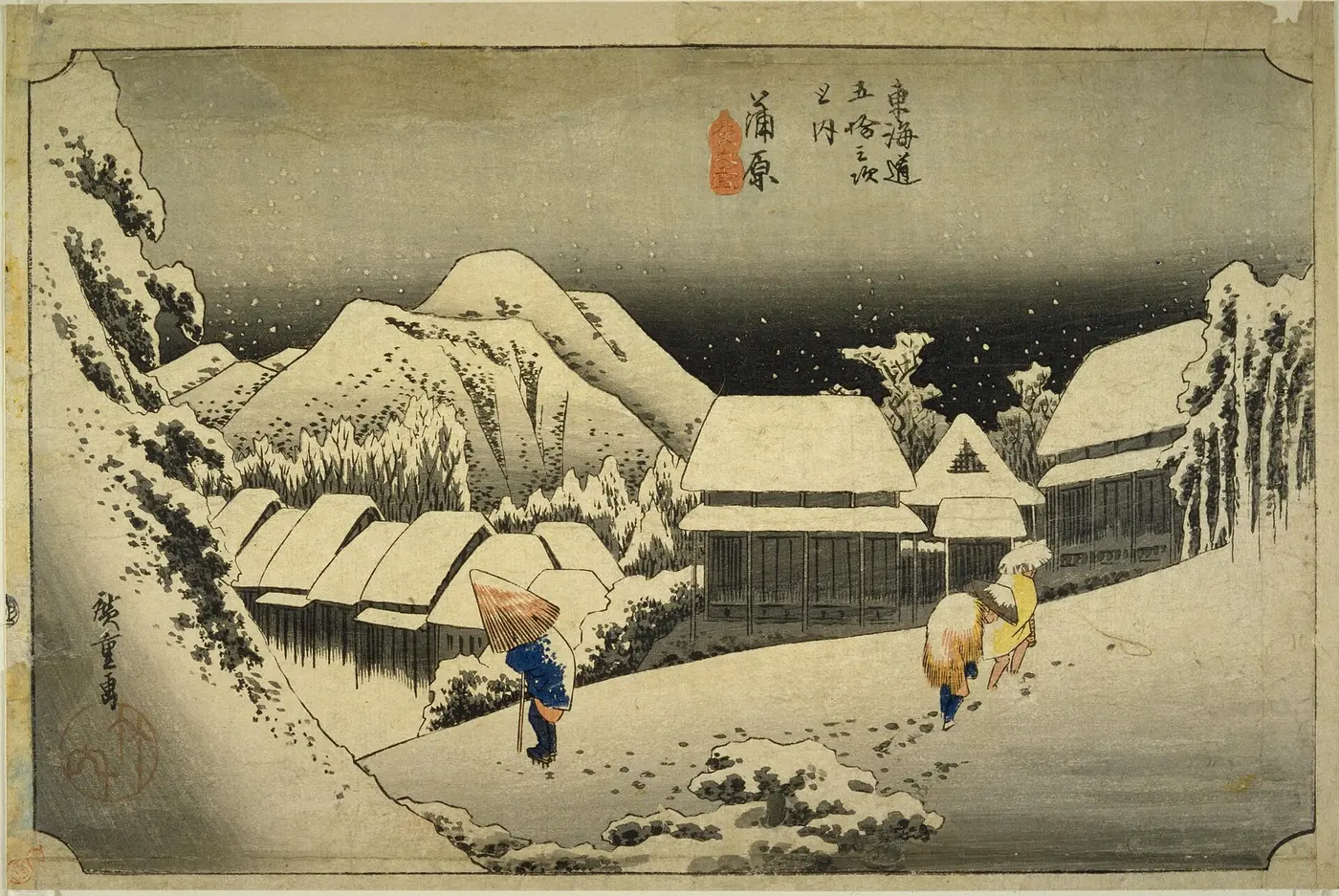
Snow falls without a sound. The hills and rooftops lie under a thick white blanket, and travelers in straw hats and straw raincoats trudge up and down a slope with their heads bowed. “Night Snow at Kanbara,” from Utagawa Hiroshige’s woodblock print series “Fifty-three Stations of the Tōkaidō,” is one of the best-known snow scenes in all of ukiyo-e.
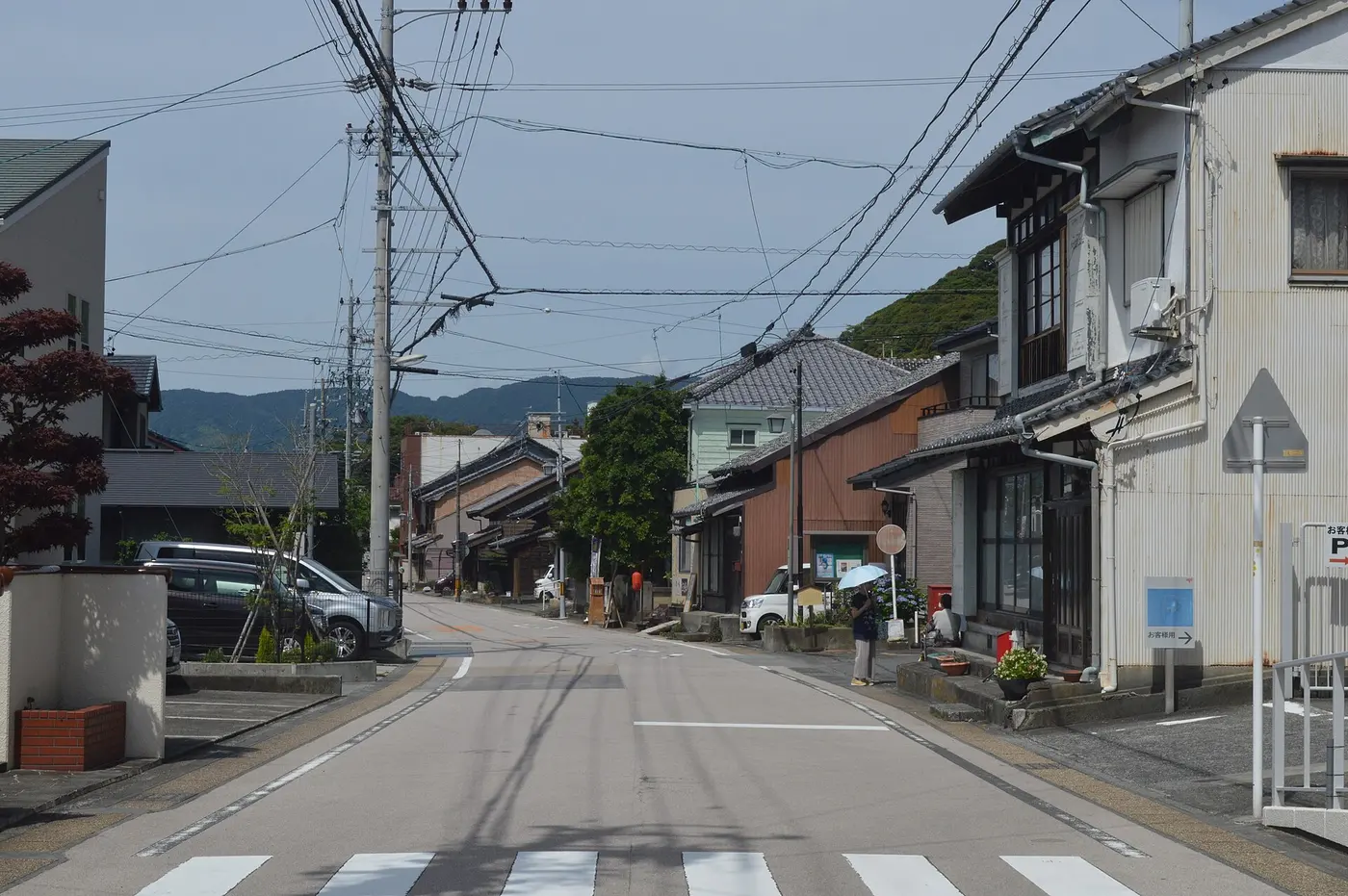
But Kanbara, the town in the picture, is today part of Shimizu Ward in the city of Shizuoka, on Suruga Bay on Japan’s Pacific coast. It is a mild place where snow rarely settles even in midwinter.
The 15th stop on the Tōkaidō
The Tōkaidō was the great highway between Edo (today’s Tokyo) and Kyoto. Hiroshige’s series shows its 53 post towns plus the starting and finishing points, the Nihonbashi bridge in Edo and the Sanjō bridge in Kyoto, in 55 landscape prints. Published by Hōeidō around 1833, it sold well and became Hiroshige’s signature work.
Kanbara was the 15th post town from Edo, which makes it the 16th print in the series. At the upper right are the words “Tōkaidō Gojūsan-tsugi no uchi” (“from the Fifty-three Stations of the Tōkaidō”) and “Kanbara,” along with the title “Yoru no yuki” (“Night Snow”). At the lower left are Hiroshige’s signature and a seal reading “Takeuchi,” the family name of the publisher Takeuchi Magohachi, who ran Hōeidō.
The composition is carefully balanced. A house facing the viewer stands at the center, and the slope of the road cutting diagonally across the picture is held in check by the cliff on the left. The diagonals create a sense of movement, yet the whole scene feels calm and stable.
No white pigment was used for the snow. Its whiteness is simply the bare paper, left unprinted, while gradations of black ink create the darkness of the night.

A town with very little snow
The Japan Meteorological Agency’s Shizuoka observatory, in the same city as Kanbara, records an average January temperature of 6.9°C (44°F) for the period 1991–2020. Snow falls on about four days a year, but the average total depth of snowfall over a year rounds to zero centimeters. Snow piling up on roofs and hills as it does in the print is practically unheard of.
Commentators on the print point out that it does not snow in Kanbara and that no spot there matches the landscape in the picture. The Metropolitan Museum of Art in New York describes the scene as imaginary.
Why add the snow?
So why did Hiroshige cover a snowless town in snow? No one knows for sure, but there are a few explanations.
One is that it added variety to the series. “Fifty-three Stations of the Tōkaidō” mixes sunny scenes with rain and moonlit nights, and some accounts say the publisher wanted a striking snow scene among the 55 prints, so Kanbara got its snow.
Another is that Hiroshige did not necessarily draw what he saw. The traditional story is that in 1832 he traveled the Tōkaidō with an official procession taking horses from the shogunate to the imperial court, and based the series on sketches from that trip. But that story comes from the testimony of one of his pupils, and its truth is uncertain. The Metropolitan Museum notes that, according to records, Hiroshige passed through Kanbara in summer. It has also been pointed out that many of the prints, especially those of stations west of Shizuoka, draw on an illustrated Edo-period travel guide, the Tōkaidō Meisho Zue.

A snow scene fit for a stamp
Whatever the reason, “Night Snow at Kanbara” became one of the most popular prints of the series. In 1960, it was chosen for a 30-yen Japanese stamp issued for International Letter Writing Week. In the same series, “Kameyama: Clear Weather after Snow,” showing a post town in present-day Mie Prefecture, is also celebrated as a masterpiece of snow.
A snow scene in a town without snow: perhaps it is less a picture of one place than of what a traveler imagines winter on the Tōkaidō to be.