Did Hokusai really move house more than 90 times?
According to a biography from 1893, he moved 93 times in his life, once supposedly three times in a single day.
93
Katsushika Hokusai, the artist behind the famous print known as The Great Wave, was born in 1760 in the Honjo district of Edo (present-day Tokyo). He kept painting for some 70 years, until his death in 1849 at the age of 90 by the traditional Japanese count, in which a person is one year old at birth.
Almost every account of Hokusai mentions that he moved house 93 times. Did he really move that often? And where does that number come from?
“Ninety-three moves in his lifetime”
The source is Katsushika Hokusai Den (A Biography of Katsushika Hokusai), published in 1893 by Iijima Kyoshin. More than 40 years after Hokusai’s death, Iijima sought out people who had known the artist, as well as publishers he had worked with, and pieced together his life from their recollections.
The biography states that Hokusai had a habit of moving, that he moved “ninety-three times in his lifetime,” and that on one occasion he reportedly moved to three different places in a single day. Iijima then lists many addresses found in Hokusai’s letters and other records, from neighborhoods across Edo to the port town of Uraga, in what is now Kanagawa Prefecture.
Encyclopedias today generally repeat the figure of 93. But the biography presents it as hearsay, and there is no record of each individual move, so the exact number cannot be checked.
Moving instead of cleaning
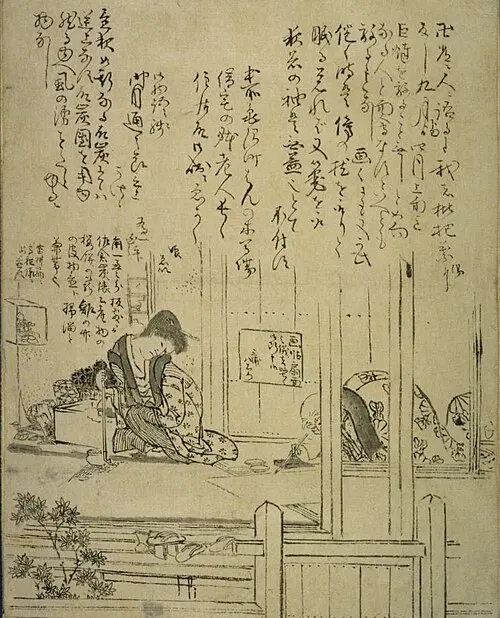
Why did he move so often? The biography collects several recollections. According to them, Hokusai was too idle to clean. He wore shabby old clothes and let bamboo-sheath food wrappers and charcoal sacks pile up around him, and when the mess became unbearable, he simply moved somewhere else.
One visitor recalled Hokusai pointing his brush at a corner of the room and asking his daughter Ei, “There was a spider’s web here until last night. Where has it gone?” That one exchange, the visitor said, told you everything about how the two of them kept house. When Hokusai lived in the Ishiwara district, his meals were brought in from the cheap eatery next door, so there was not even a rice tub in the house.

Aiming for a hundred
An acquaintance named Umehiko once advised Hokusai that moving was expensive, and that if his home got too dirty, he could simply pay someone to clean it. Hokusai smiled, the biography says, and replied with a story. A man named Teramachi Hyakuan, who served the shogun’s government, had vowed to move a hundred times in his life, calling himself Hyakuan (“hundred hermitages”), and had already moved more than 90 times. Hokusai said he would follow Hyakuan’s example, move a hundred times, and only then choose the place where he would die.
According to Iijima, Hyakuan did reach his hundred moves before he died. Hokusai died after 93, seven short.
All that moving even became a point of pride. At 75, Hokusai boasted that he had moved 56 times without ever being caught in a fire, which in Edo, a city notorious for its fires, was remarkable. He even wrote out charms against fire and gave them to people. Then, around 1839, his home finally burned down, and he lost his few clothes and belongings. He fled the house, the story goes, clutching only his brush.
A man of many names
Hokusai changed his name almost as often as his address. He started out as Shunrō, and went on to call himself Sōri, Hokusai, Taito, Iitsu, Gakyō Rōjin (“old man mad about painting”) and Manji, among others. “Hokusai” was just one of these, used from 1798. Japanese encyclopedias put the number of name changes at anywhere from twenty-odd to about 30.
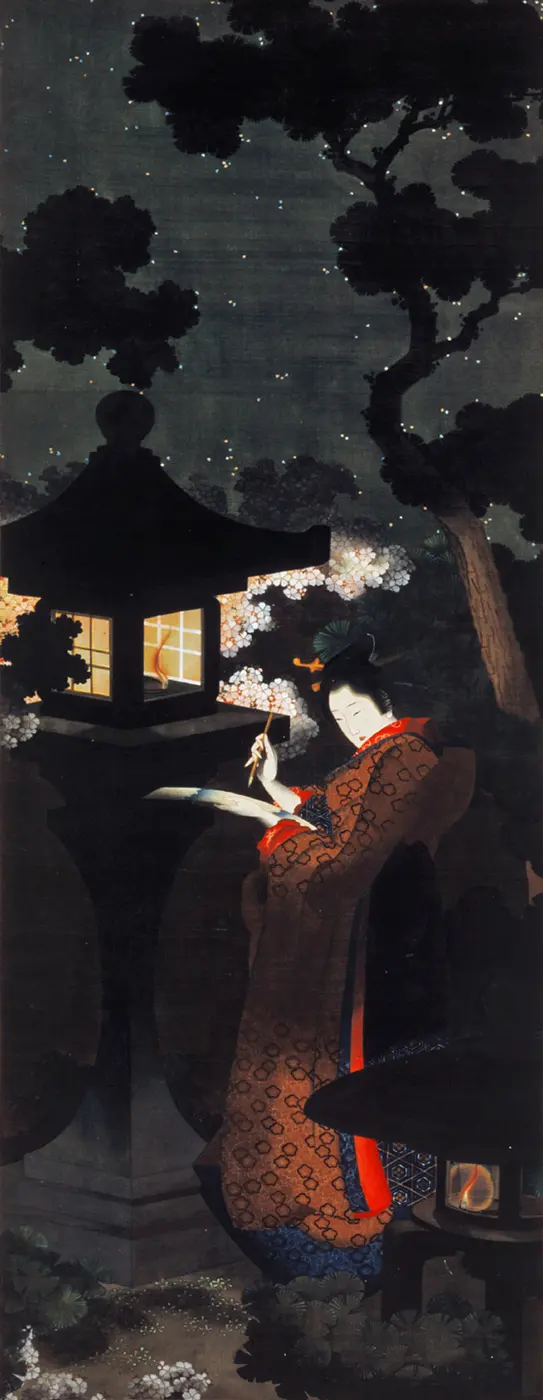
In his later years Hokusai lived with his daughter Ei, a fine painter herself who worked under the name Ōi. According to the biography, Hokusai told people that when it came to pictures of beautiful women, he could not match her. The biography admits that the origin of her name is unknown, but mentions a theory: “Ōi” sounds like “Ōi!,” the Japanese equivalent of “Hey!”, and it may have come from a popular song with the line “Hey, hey, father dear.”