Is the Chōjū-giga Japan’s oldest manga?
It is often called the root of manga, but it is a set of 12th- and 13th-century picture scrolls with no words and no known story. Calling it the first manga is a modern idea.
44m
A frog, mouth wide open, has just thrown a rabbit, which lands on its back with its feet in the air. The scene comes from the Chōjū jinbutsu giga, or “Scrolls of Frolicking Animals and Humans,” usually shortened to Chōjū-giga. The scrolls belong to Kōzanji, a temple in the hills outside Kyoto, and are a National Treasure of Japan.
The scrolls are often described as Japan’s oldest manga. Even the Kyoto National Museum, in its 2014 newsletter, called them a work regarded as the root of “manga.” Is that true? Look closer, and this famous artwork turns out to be full of unanswered questions.
Four scrolls, not one
The Chōjū-giga consists of four scrolls, usually labeled A to D in English. According to Kōzanji, the first scroll alone is about 11.5 m (38 feet) long, and the four together run to about 44 m (144 feet). All are drawn in ink line alone, with no color.
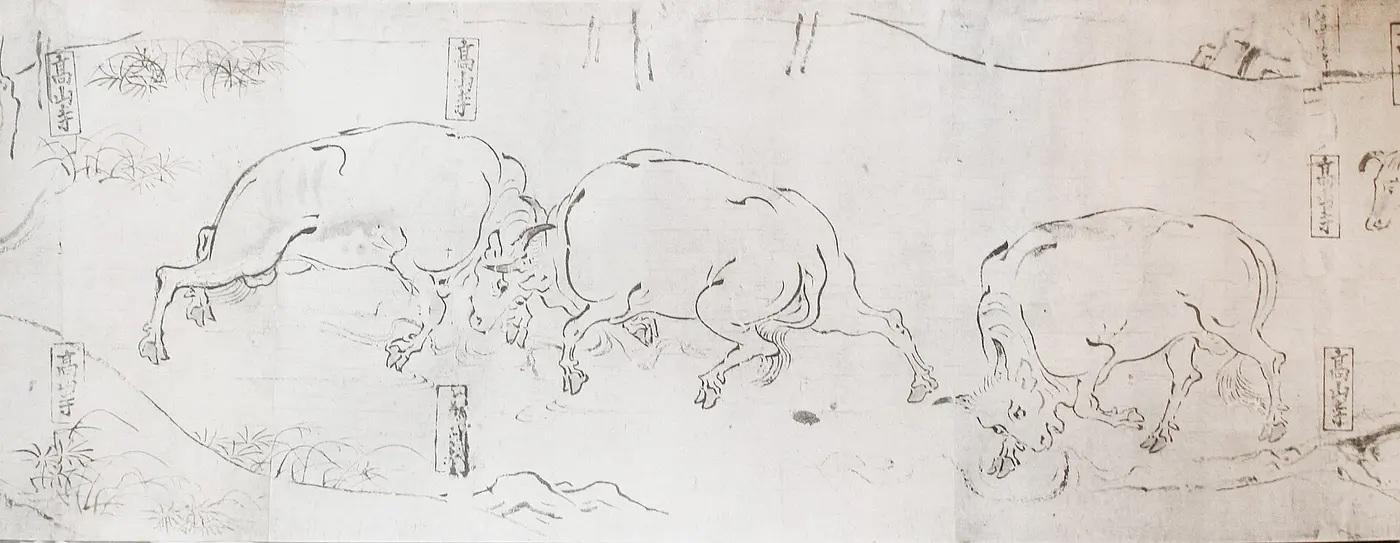
They were not made as a set. According to the Japanese encyclopedia Nipponica, Scroll A shows monkeys, rabbits and frogs imitating human pastimes; B shows creatures real and imaginary, from oxen to dragons; C shows people playing games, then animals at play; and D shows monks and laymen amusing themselves. Brushwork and date differ from scroll to scroll. A and B are thought to date from the mid-12th century, late in the Heian period (794–1185), while C and D belong to the following Kamakura period. According to a Japanese history dictionary published by Yamakawa, the remains of scrolls by different hands were put together in roughly their present form around 1570.
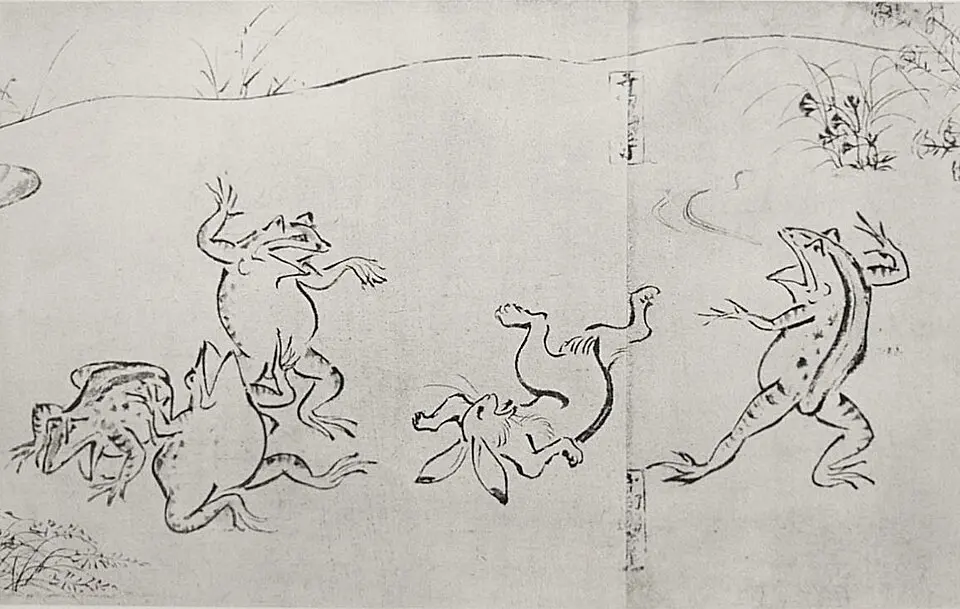

Even Scroll A, the most famous, changes style halfway through. According to Japan’s Agency for Cultural Affairs, it was probably once two scrolls that were damaged, and what survived was mounted as one. Fragments cut from it are kept elsewhere, including the Tokyo National Museum.
A restoration from 2009 to 2013 turned up a surprise. According to the Kyoto National Museum, Scroll C had been made by taking sheets painted on both sides, splitting the paper into two thin layers, and joining them into one scroll. The human scenes in its first half and the animal scenes in its second half were once the front and back of the same sheets.
Did the Toba Archbishop draw them?
The name traditionally attached to the scrolls is Kakuyū (1053–1140), a Buddhist monk who eventually became head of the Tendai school. Because he lived at a temple inside the Toba Palace south of Kyoto, he was known as Toba Sōjō, the Toba Archbishop.
Kakuyū does seem to have been a gifted artist. Kokon chomonjū, a 13th-century collection of tales, calls him the finest painter of recent times and says he excelled at satire. In the Edo period (1603–1868), humorous sketches were even called Toba-e, “Toba pictures,” after him.
But there is no direct evidence that he drew the Chōjū-giga, and since the four scrolls come from different periods and hands, a single artist is unlikely. Nipponica says the attribution to Kakuyū is now all but rejected. Kōzanji itself says the artist is unknown and suggests the scrolls belong to a tradition of playful, off-the-cuff drawings made by Tendai monks.
Pictures without words
Most Japanese picture scrolls alternate images with passages of text that tell the story. The Chōjū-giga has no text at all. As a result, says Nipponica, what the pictures mean is unclear, and no interpretation is settled.
Is the line from the victorious frog’s mouth a shout, or a breath? There is no way to ask. If it looks like a comic-book motion line, that may be because we grew up reading comics.
Scroll B does not even seem to tell a story. The Yamakawa dictionary describes it as something like a book of model drawings.

A modern family tree
When did the scrolls become the ancestor of manga? The word manga itself appears in the Edo period, most famously in the Hokusai Manga sketchbooks (first volume 1814), but according to Nipponica it then meant something closer to “sketches.” The word only caught on with the general public in the early Shōwa era, from the late 1920s.
A few years earlier, in 1924, the cartoonist Hosokibara Seiki published A History of Japanese Manga, which began the story of Japanese comics with the Chōjū-giga.
“Oldest” is shaky, too. Older caricatures survive. According to the encyclopedia Sekai Daihyakka Jiten, a caricature of a man, labeled with the characters daidairon, was doodled in the margin of an 8th-century sutra copy kept in the Shōsōin, the imperial storehouse in Nara.
With no panels, no speech balloons and no known plot, the Chōjū-giga is hard to call manga in today’s sense. Still, the fun of animals behaving like people, caught in lively, sweeping lines, has not faded in 800 years. Think of it less as the first manga than as one of manga’s distant ancestors.