Do Saturn’s rings ever disappear?
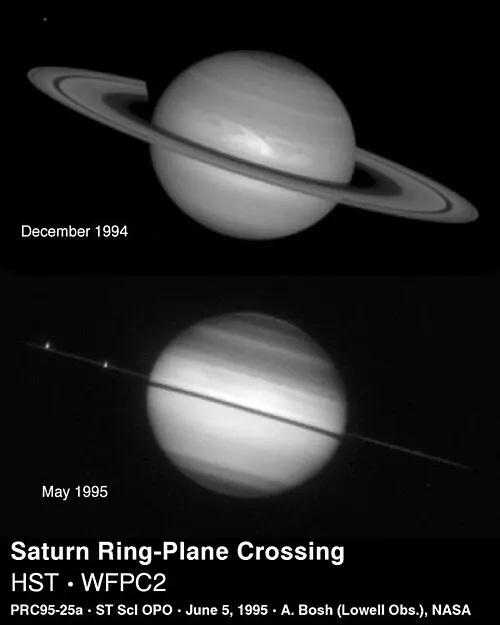
From our point of view, yes. The rings are so thin that when they turn edge-on to Earth, they all but vanish. It happens roughly every 15 years, most recently in 2025.
15years
Saturn’s rings, visible even through a small telescope, are among the most popular sights in the night sky. But there are times when they all but disappear. The National Astronomical Observatory of Japan (NAOJ) calls this the “disappearance” of the rings, and the most recent one came in 2025.
The rings don’t really go anywhere, of course. They seem to vanish because of how thin they are and the angle from which we see them.
Paper-thin rings, and then some
According to NASA, Saturn’s ring system extends up to 282,000 km (175,000 miles) from the planet, yet the main rings are typically only about 10 meters (30 feet) thick. They aren’t a solid sheet but countless particles of ice orbiting the planet, and relative to their width, they are far thinner than a sheet of paper.
Because Saturn’s axis is tilted, the angle at which we see the rings changes slowly over the 29.5 years it takes Saturn to orbit the Sun. NAOJ lists three situations in which the rings become hard to see: when Earth lines up with the plane of the rings, so we see them edge-on; when the Sun lines up with the ring plane, so no sunlight falls on their faces; and when Earth and the Sun are on opposite sides of the ring plane, so we are looking at the unlit side. These situations come around twice per orbit, roughly every 15 years. NAOJ’s table of past and future events shows that the actual gap alternates between about 13½ and 15½ years.
The 2025 disappearance
According to NAOJ, in 2025 Earth crossed from the north side of the rings to the south side on March 24 (Japan time), and the Sun followed on May 7. From March to mid-April, though, Saturn was too close to the Sun in the sky to observe. Then, around November 25, Earth again came close to the ring plane, and the rings looked extremely thin in the evening sky. The next time Earth crosses the ring plane will be between October 2038 and July 2039, and it will happen three times.

Galileo’s bewilderment
The first person to be thrown by this was the Italian scientist Galileo Galilei. In 1610, turning his homemade telescope on Saturn, he concluded that it was a triple body: a large star with a smaller one stuck to each side. Through his modest instrument, that is what the rings looked like.
But after the summer of 1612, the two side stars disappeared. In a letter dated December 1, 1612, to Mark Welser of Augsburg, Germany, Galileo wrote that he did not know what to make of “so strange a metamorphosis.” Had the two smaller stars been consumed like sunspots? Had they vanished and suddenly fled? Had Saturn “devoured his own children”? Or had the lenses been deceiving him all along?
Saturn takes its name from the Roman god Saturnus, identified with the Greek Cronus, who in myth swallowed his children one after another for fear that they would overthrow him. Galileo’s famous line was one of a string of questions playing on that story. Even so, he predicted in the same letter that he had no doubt the two stars would return, and they did. According to NAOJ, by 1616 Galileo was seeing Saturn with what looked like ears or handles. But he never managed to explain them.
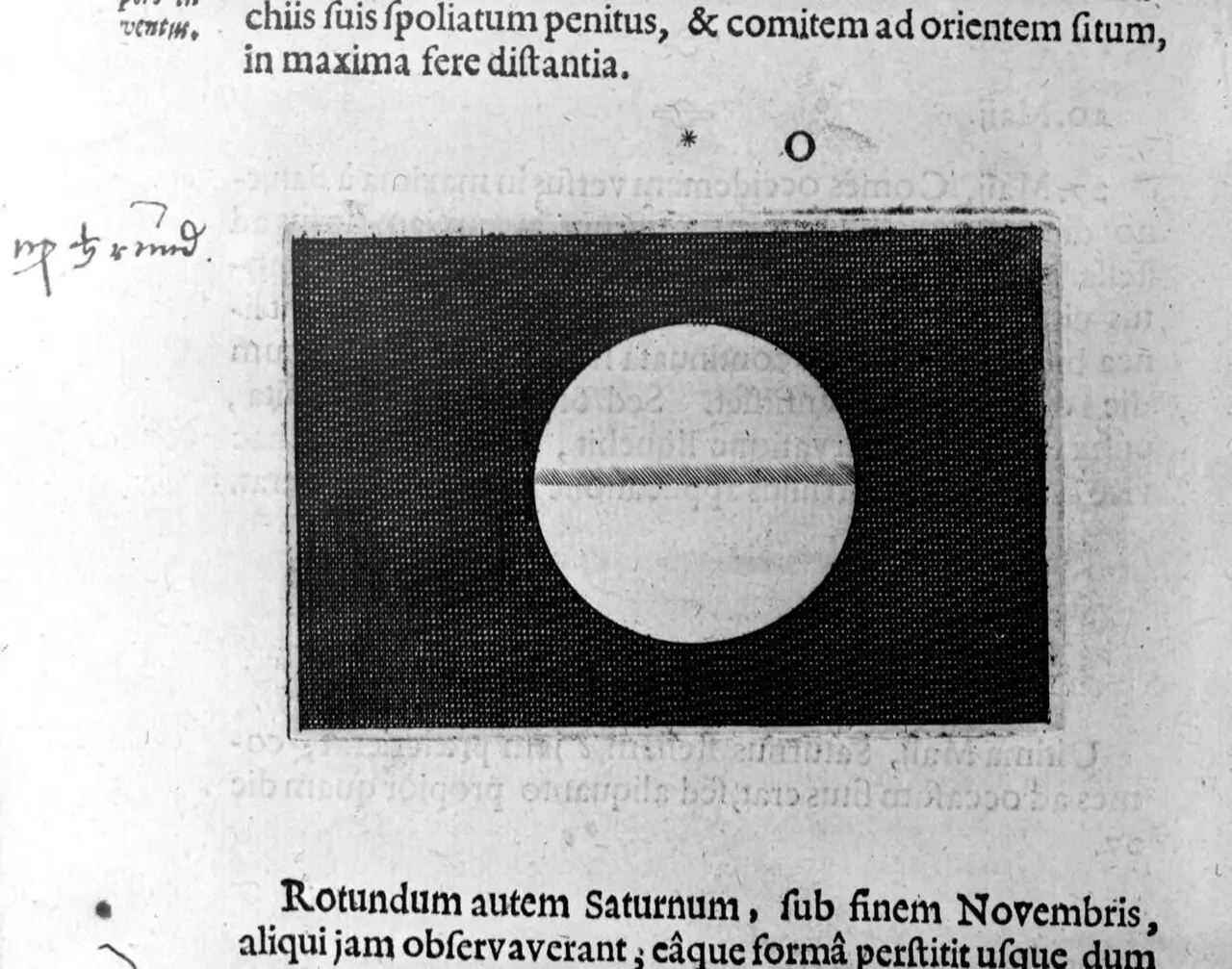

The mystery was solved by the Dutch scientist Christiaan Huygens. After observing the ring disappearance of 1655–56, he announced in his 1659 book Systema Saturnium that Saturn “is surrounded by a thin, flat ring, nowhere touching, inclined to the ecliptic.” Because the idea correctly predicted later disappearances, the ring explanation took hold.
When the rings really will vanish
There is, however, research suggesting that the rings themselves will eventually disappear, and this has nothing to do with viewing angles. In December 2018, NASA highlighted a study showing that icy particles from the rings are being pulled into Saturn along its magnetic field lines by gravity. This “ring rain” drains enough material to fill an Olympic swimming pool every half hour, and at that rate the rings could be gone in under 300 million years. It is a completely different story from the disappearing act that comes around every 15 years, and a far more patient one.