Why can you see the dark part of a crescent Moon?
Because sunlight reflected off Earth is lighting up the Moon’s night side. The glow is called earthshine.
Just after sunset, a thin crescent Moon hangs in the western sky. Look closely and you’ll see that the bright sliver isn’t the only part that shines. The rest of the disk, which should be dark, glows a dim ashen gray.
That soft light is called earthshine. As the name says, what lights up the dark part of the Moon is our own planet.
A “full Earth” in the lunar sky
The Moon makes no light of its own; it shines by reflecting sunlight. When we see a crescent, most of the side facing us is in lunar night. But that night sky has something very bright hanging in it: Earth.
Earth and the Moon go through opposite phases. When the Moon looks like a thin crescent from here, Earth seen from the Moon is nearly full. According to NASA, Earth lights up the lunar night about 50 times more brightly than a full Moon lights up ours. That light falls on the Moon’s night side, bounces back, and reaches our eyes. Earthshine is sunlight that has traveled from the Sun to Earth, from Earth to the Moon, and back to Earth again.
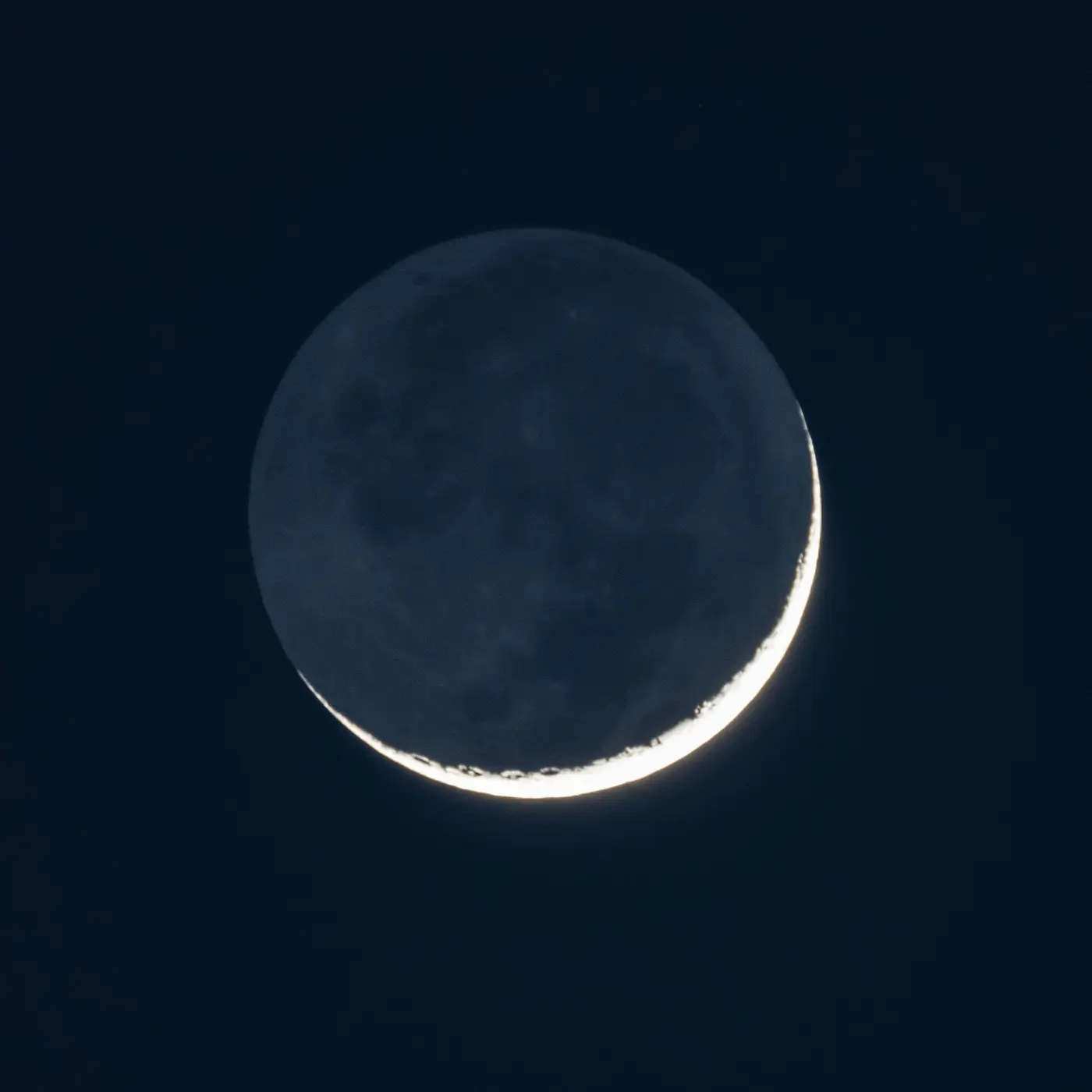

According to the Japanese encyclopedia Nipponica, earthshine is easiest to see on the slim Moons of the few days on either side of new Moon, in the evening or before dawn. As the Moon waxes, the Earth seen from the Moon wanes and the sunlit crescent grows dazzling, so by the time the Moon nears half, the glow has faded from view.
The new Moon with the old Moon in her arms
In English, a crescent showing earthshine has long been described as “the new Moon with the old Moon in her arms.” The thin, bright new Moon seems to be cradling the dim, round old one.
The phrase comes from the old Scottish ballad “Sir Patrick Spens,” about a ship sent out to sea in winter on the king’s orders and lost in a storm. In the ballad, the sight of that Moon is an omen of foul weather. The English poet Samuel Taylor Coleridge placed the lines at the head of his 1802 poem “Dejection: An Ode”: “Late, late yestreen I saw the new Moon, / With the old Moon in her arms; / And I fear, I fear, my Master dear! / We shall have a deadly storm.”
Leonardo solves the puzzle
The first person known to have written down the true explanation was Leonardo da Vinci. According to a 2005 NASA feature, a page in his notebook known as the Codex Leicester, from around 1510, is titled “Of the Moon,” and there Leonardo explains that the faint glow comes from sunlight reflecting off Earth’s oceans and striking the Moon.
In the English translation of his notebooks by the art historian Jean Paul Richter, Leonardo dismisses the idea that the Moon has a light of its own. The dim light between the horns of the new Moon, he writes, comes from our seas, lit by the setting Sun. The sea does for the dark side of the Moon what the full Moon does for us after sunset. And if you want to see how much brighter the shaded part is than the sky behind it, he adds, hide the bright part with your hand.
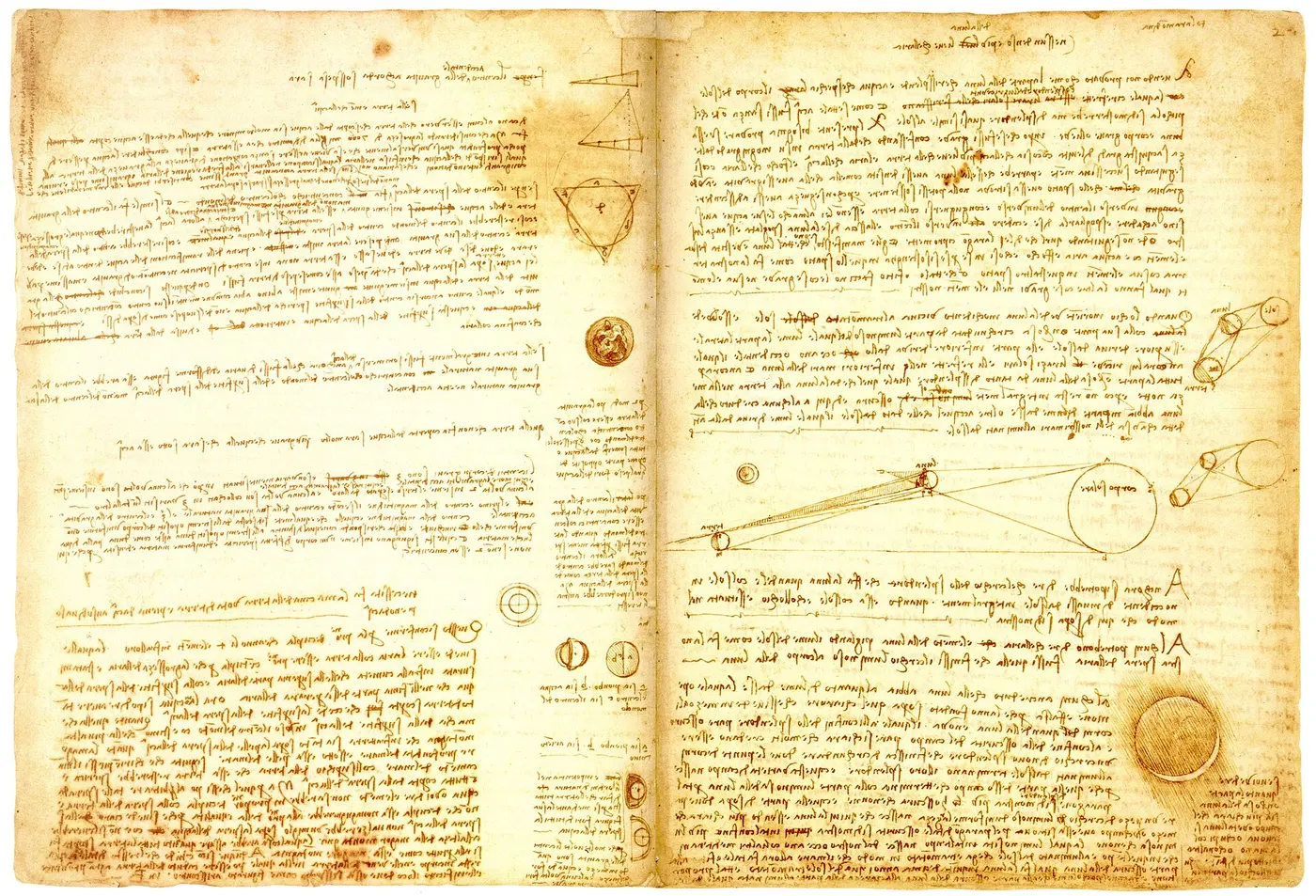

He didn’t get everything right. Leonardo believed the Moon had seas of its own, and according to NASA, Earth’s light comes mainly from its clouds, not its oceans. Even so, NASA says, Leonardo understood the basics well.
But his notebooks were never published in his lifetime, and astronomers knew nothing of them. Richter notes that, as a result, the discovery came to be credited to Michael Maestlin and Johannes Kepler, a century later. In a book published in 1604, Kepler presented the explanation of earthshine given by Maestlin, his former teacher. In 1610, Galileo Galilei argued in Sidereus Nuncius that the glow was sunlight reflected by Earth.
Using the Moon as a mirror
How bright earthshine looks depends on how much sunlight Earth reflects, which makes it a tool for studying our own planet. In the 1920s, the French astronomer André Danjon measured the brightness of earthshine to estimate how reflective Earth is.
In modern times, a team at Big Bear Solar Observatory in California revived the method. According to a 2021 announcement from the American Geophysical Union, Earth reflects about 30 percent of the sunlight that falls on it. Observing earthshine from 1998 to 2017, the team found that Earth was reflecting about half a watt less light per square meter than 20 years earlier, a drop of about 0.5 percent, mostly in the last three years. A decline in bright, low clouds over the eastern Pacific appears to be the reason. “The albedo drop was such a surprise to us,” said the study’s lead author, Philip Goode of the New Jersey Institute of Technology.