Are the morning star and the evening star the same?
Both are Venus. West of the Sun, it shines in the east before dawn; east of the Sun, it shines in the west after sunset.
In the evening, while the western sky still holds some light, a single star often blazes into view before any other. Or, before dawn, one bright point lingers in the paling eastern sky long after the rest have faded. English calls them the evening star and the morning star; Japanese has long called them yoi no myōjō and ake no myōjō, the “bright star of the evening” and the “bright star of the dawn.”
Two names make them sound like two different stars. In fact, both are the same object: the planet Venus.
Both are Venus
Apart from the Sun and the Moon, Venus is the brightest object in the sky. At its brightest it reaches magnitude −4.9, more than 100 times as bright as a first-magnitude star, the class that includes the brightest stars of the night sky. It shines so brightly because it is close to us and wrapped in thick clouds that reflect sunlight very well.
So why does the same planet appear sometimes at dawn and sometimes at dusk? Because Venus orbits the Sun inside Earth’s orbit. From our point of view it always stays near the Sun, swinging out to one side of it and then the other.
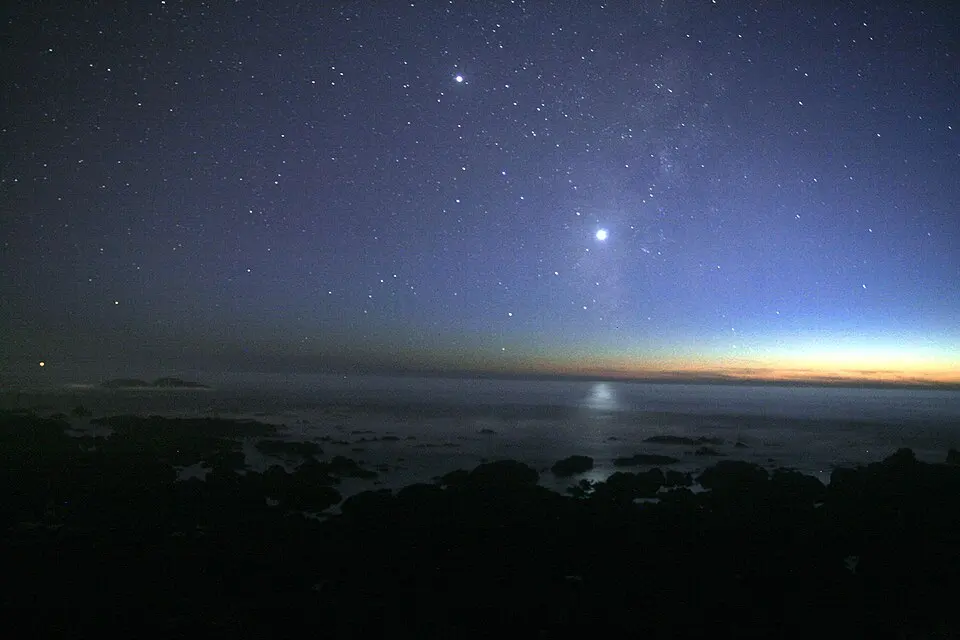
When Venus is west of the Sun, it rises in the east ahead of the Sun and appears before dawn as the morning star. When it is east of the Sun, it is still in the western sky after the Sun has set, and appears at dusk as the evening star.

Never in the midnight sky
Venus never strays far from the Sun. Even at its greatest separation, as seen from Earth, it is only about 47 degrees away. So it never rides high in the midnight sky; it can be seen only around dawn or dusk.
The morning star and the evening star take turns. The positions of Venus and Earth go through a full cycle in about 584 days, or roughly a year and seven months, and in each cycle Venus has one spell as the evening star and one as the morning star. Five of these 584-day cycles add up almost exactly to eight Earth years, so the pattern of Venus’s appearances repeats nearly identically every eight years.
Look through binoculars or a telescope and you will also see that Venus has phases, like the Moon. When it is at its brightest, it appears as a slim crescent.
Ancient peoples thought they were two stars
Realizing the two were one and the same was no easy matter. The ancient Greeks called the morning star Phosphoros, “bringer of light,” and the evening star Hesperos, and treated them as separate gods. Later it became known that they were the same body. Pythagoras, in the sixth century BCE, is sometimes credited with the discovery, but who was really first is unclear. The Romans called the morning star Lucifer in Latin.
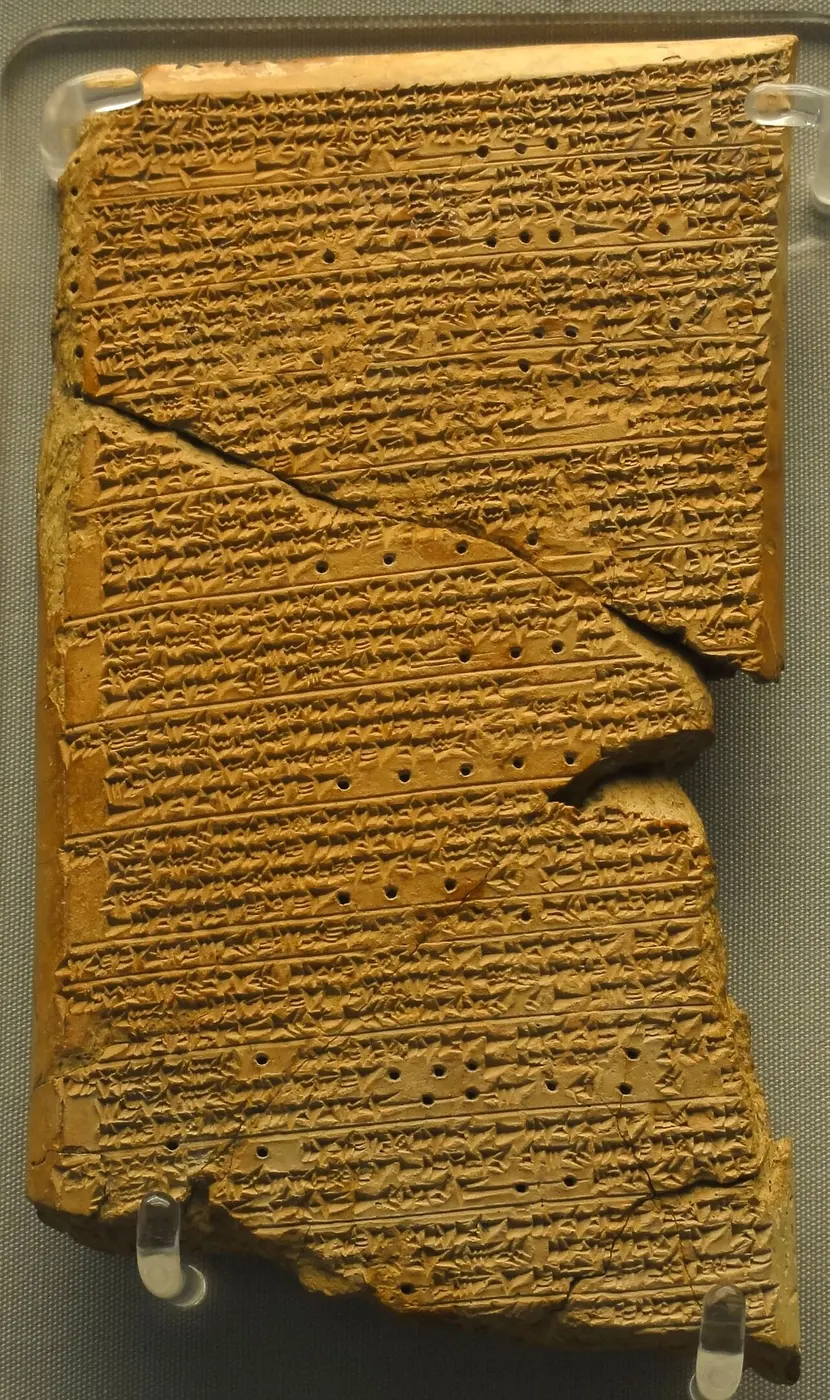

In Mesopotamia, on the other hand, people seem to have understood much earlier that the two were one. Ancient Babylonia left a record noting, over 21 years, the days on which Venus first appeared on the horizon at dawn or dusk and the days it vanished. The original observations are thought to date from around the seventeenth century BCE, in the reign of King Ammisaduqa.
Two names in Japan’s oldest poetry anthology
In Japan, too, Venus has been loved since ancient times. The eighth-century poet Yamanoue no Okura wrote a long poem in the Man’yōshū, Japan’s oldest surviving collection of poetry, mourning a young son who had died. In one passage he recalls:
When the morning star brought the dawn, he would not leave the side of my bed, but played with me whether I stood or sat; and when the evening star brought the evening…
Here the dawn Venus is called akaboshi, the “bright star,” and the dusk Venus yūzutsu, the “evening star,” each marking the beginning and the end of the day.