How do salmon find their way back to the river where they were born?
Close to home, they follow the smell of their birth river, which they memorized as youngsters. Out at sea, research suggests they navigate by Earth’s magnetic field.
2 billion
Every fall, big salmon force their way up the rivers of northern Japan. Their habit of returning to their birth river is known in Japanese as bosen kaiki, “mother-river return.”
According to the Hokkaido Research Organization, most of Japan’s chum salmon are raised in hatcheries and released in spring as fry weighing about a gram. The young fish head out to sea, roam thousands of kilometers across the northern Pacific and come back mostly at ages three to five. How do they find their own river in an ocean with no landmarks?
A breeze on a mountain trail
The first big clue came from Arthur Hasler, an ecologist at the University of Wisconsin. According to his National Academy of Sciences biographical memoir, he loved to tell how the idea came to him.
He was hiking in the Wasatch Range of his home state, Utah. His favorite waterfall was still hidden behind a rocky outcrop when, as he later wrote, “a cool breeze, bearing the fragrance of mosses and columbine,” swept around the rocks, and the whole scene of the waterfall “suddenly leapt into my mind’s eye.” If a smell could stir up memories that vividly in a person, Hasler reasoned, it might do the same for a salmon.
In 1951, Hasler and his colleague Warren Wisby showed that fish can tell the smells of different streams apart and proposed that young salmon memorize the smell of their home stream and follow it back as adults: the olfactory imprinting hypothesis.
Salmon with plugged noses
To test the idea, the two went to Issaquah Creek in Washington State, which splits into a main stem and a branch called the East Fork. Returning coho salmon choose one or the other.
As they reported in 1954, Wisby and Hasler trapped coho in both branches, plugged the nostrils of about half the fish and released them all about a mile (1.6 km) downstream of the fork. The salmon with working noses went back up the branch they had chosen before. Those with plugged noses split between the branches at random.
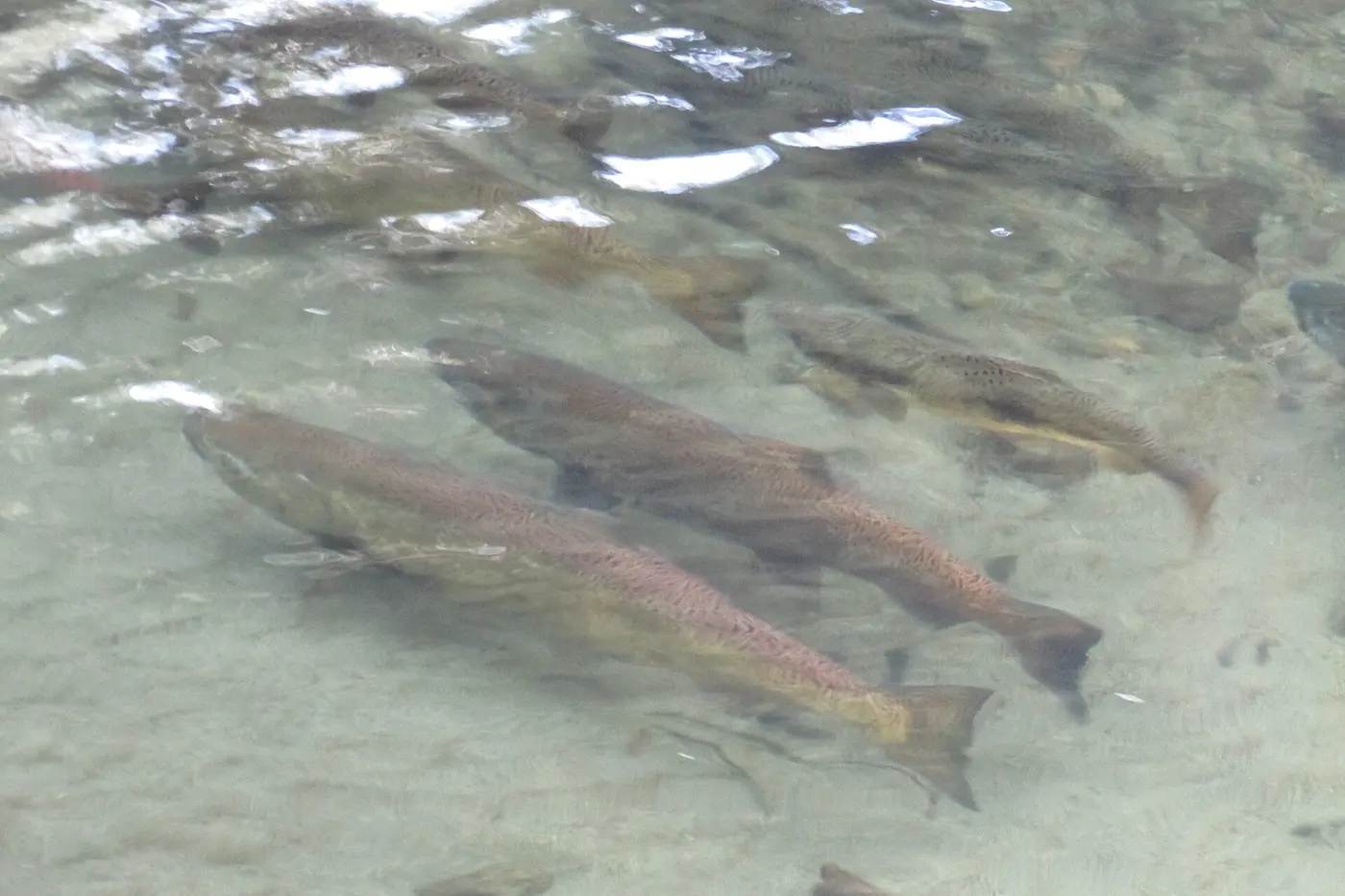

In the 1970s, Hasler’s group went further. They raised young coho for about six weeks in water scented with one of two artificial chemicals, morpholine or phenethyl alcohol, and released them into Lake Michigan. A year and a half later, at spawning time, the researchers dripped each chemical into a different stream. Most of the fish turned up in the stream that smelled like their youth.
What does a river smell like?
So what exactly is the smell of a river? Hiroshi Ueda and his colleagues at Hokkaido University in Japan have focused on amino acids dissolved in river water.
In the Teshio River in northern Hokkaido, the amount of amino acids swung widely by season and year, but the proportions of several stayed the same between spring, when the young fish swim downstream, and fall four years later, when the adults return. Four-year-old male chum salmon caught in the river preferred artificial water mixed to match those proportions over ordinary water.
Another experiment used landlocked sockeye salmon, which spend their whole lives in lakes. When young fish were exposed for two weeks to water containing the amino acid proline, during or shortly before smoltification, the silvering stage when sea-run salmon prepare for the ocean, 80 percent of them preferred proline-scented water two years later. Fish exposed after that stage showed no preference. There seems to be a window for learning the smell of home.
Magnetism on the open sea
Smell only helps near the river. How salmon get from the open ocean back to the right stretch of coast long remained a mystery.
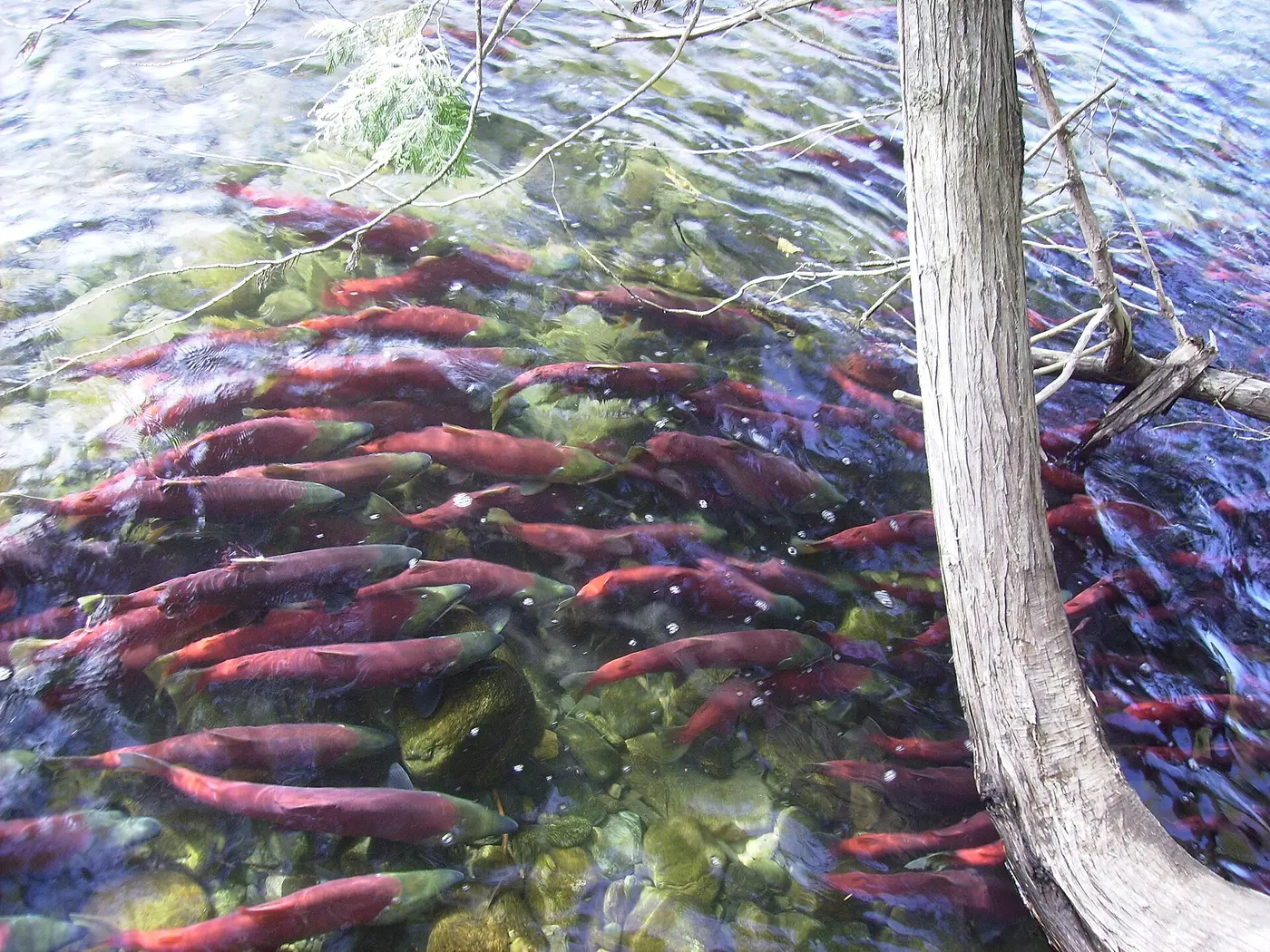

In 2013, Nathan Putman of Oregon State University and his colleagues analyzed 56 years of fisheries data on sockeye salmon returning to the Fraser River in Canada. Vancouver Island lies in the way, so the fish must swim around either its northern or its southern end. The share taking each route could be predicted from sea temperatures and from the slow drift of Earth’s magnetic field: the more the field at a passage entrance differed from the field at the river mouth, the fewer fish used that passage. The researchers think salmon memorize the magnetic signature of the river mouth when they first enter the sea and seek it out on the way back.
A year later, Putman and colleagues reported that young Chinook salmon that had never been to sea, placed in magnetic fields like those at the northern and southern edges of their ocean range, swam toward their feeding grounds. Salmon may be born with a magnetic map.
Only a small fraction make it home, though. From the mid-1980s through the 1990s, Japan released about 2 billion chum salmon fry a year. North Pacific Anadromous Fish Commission statistics show Japan’s chum catch peaking in 1996 at about 81 million fish, only a few percent of the fry released. The share has since fallen further: according to the Japan Fisheries Research and Education Agency, the national return rate in 2025 was 0.66 percent, the lowest since 1989.