When was the safety pin invented?
The modern design was patented by Walter Hunt in the US in 1849, but very similar fasteners existed more than 3,000 years earlier.
1849
Pinning a race number to a running shirt, threading elastic back through a waistband, holding things together where a button has popped off. The safety pin is one of those tools that waits quietly in a sewing kit or the back of a drawer until the moment it is needed.
Because the point tucks away inside a clasp, you can wear one without worrying about pricking yourself. This simple design was patented in nineteenth-century America. But the idea behind it goes back much further, to the ancient Mediterranean world.
An ancestor more than 3,000 years old
In ancient Europe, people often wore lengths of cloth draped around the body. To hold the edges together, they used a metal fastener called a fibula.
The first fibulae are thought to have appeared at the end of the Bronze Age, around the fourteenth to thirteenth centuries BCE, in the Mycenaean world of Greece. A single metal rod was bent back on itself, coiled into a spring at one end, and hooked into a catch at the other. The mechanism is strikingly like that of a modern safety pin.
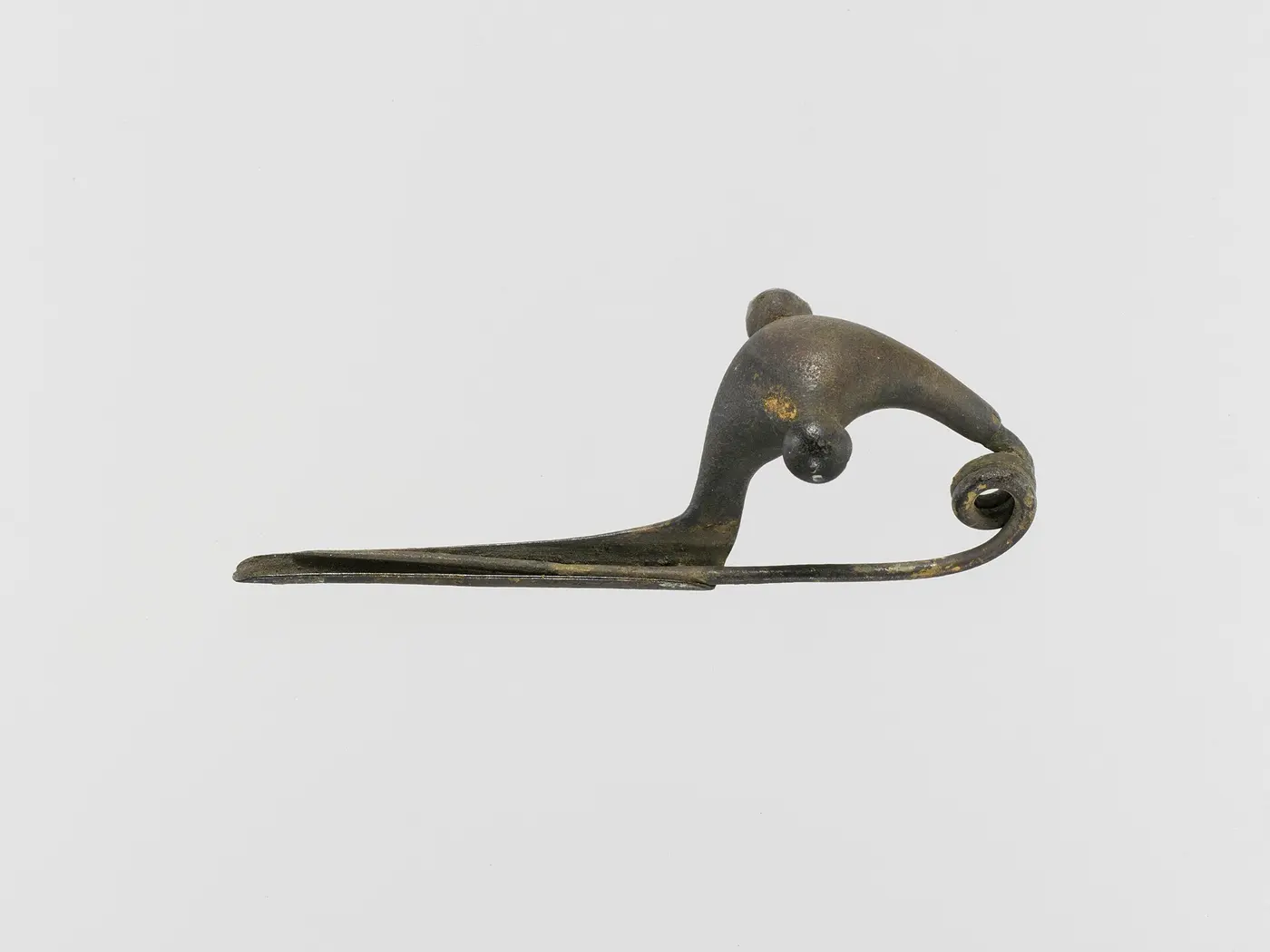

Fibulae spread to Italy and far beyond, and remained in use through Roman times. Many were luxurious objects made of gold, silver or ivory, as much jewelry as hardware. They were offered at temples and used to adorn the clothing of the dead.
Born of a $15 debt?
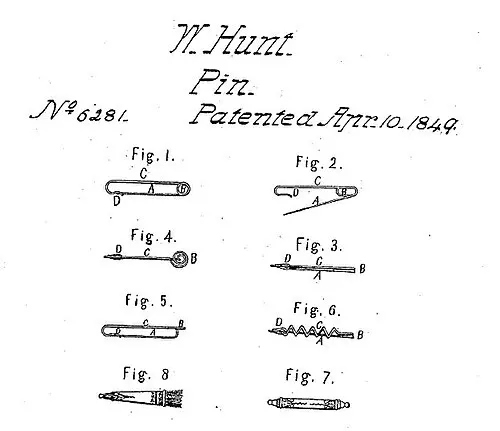
The direct inventor of today’s safety pin was Walter Hunt, a New York mechanic. On April 10, 1849, he received US Patent No. 6,281 for a fastener he called a “dress-pin.”
According to the patent, the pin is made from a single piece of wire. It is coiled partway along to form a spring, and the sharp point is held securely inside a clasp. With no joints, it is sturdy, and Hunt wrote that it could be put into a dress without danger of bending the pin or wounding the fingers.
A well-known story goes with the invention. Hunt is said to have owed $15 to a draftsman who drew his patent illustrations, and to have come up with the pin in about three hours while twisting a piece of wire, looking for a way to pay him back. He then sold the rights for just $400. Accounts differ on who bought them, but however many safety pins were sold afterward, Hunt never received more than that $400.

In October of the same year, a man named Charles Rowley in Birmingham, England, patented a very similar safety pin. In Japan, 1849 was still the Edo period, the era of samurai rule; Commodore Perry’s “black ships” would not arrive to force the country open for another four years.
The inventor who held back the sewing machine
Hunt (1796–1859) produced a remarkable number of inventions in his lifetime, including a forerunner of the fountain pen, a repeating rifle, a household knife sharpener and an ice plow.
The one that got away was the sewing machine. In the 1830s Hunt built a machine that used a lockstitch, interlocking an upper and a lower thread. But he worried that it would put seamstresses out of work and did not patent it. His wife, and his daughter, who ran a corset shop employing seamstresses, are said to have advised against it. Later, during the dispute over Elias Howe’s sewing machine patent, it was acknowledged that Hunt had built his first, but because he had abandoned the design, he was not granted a patent.
Hunt never struck it rich, yet several of his inventions are still in use almost unchanged. The safety pin is the best example.