How did people keep things cold before refrigerators?
They stored winter ice and snow in ice houses, and later chilled food in wooden boxes filled with natural ice.
115days
Cold drinks, food that keeps fresh: thanks to the refrigerator, we enjoy these in every season. Yet the household electric refrigerator appeared only about a hundred years ago.
So how did people keep things cold before that? One answer was a bold idea: save the cold of winter itself and keep it until summer.
Keeping winter’s ice until summer
The ice house, or himuro in Japanese, has a very long history. In ancient Mesopotamia there is a record from around 1775 BC of a king having an elaborate ice house built.
In Japan, too, the Nihon Shoki, an ancient chronicle, tells of an ice house. In the reign of Emperor Nintoku, a prince out hunting at Tsuge (in today’s Tenri, Nara Prefecture) spotted something like a hut in a field. When he asked a local about it, he was told that it was a pit dug deep into the ground and covered with grass, where winter ice was stored for use in summer. The Engishiki, a code of laws and procedures from the Heian period, lists ten ice houses belonging to the imperial court. Ice in summer was a precious luxury that only a very few could enjoy.
In the Edo period (1603–1868), the Kaga domain (today’s Ishikawa Prefecture) stored winter snow in ice houses, then took it out on the first day of the sixth month of the old lunar calendar and sent it as a gift to the shogun in Edo. In memory of this, the city of Kanazawa still calls July 1 “Himuro Day,” and people eat himuro manjū, a kind of steamed bun, to pray for good health.
The “Ice King” who sold ice to the world
In the 19th century, ice became big business. The man who blazed the trail was Frederic Tudor, a businessman from Boston.
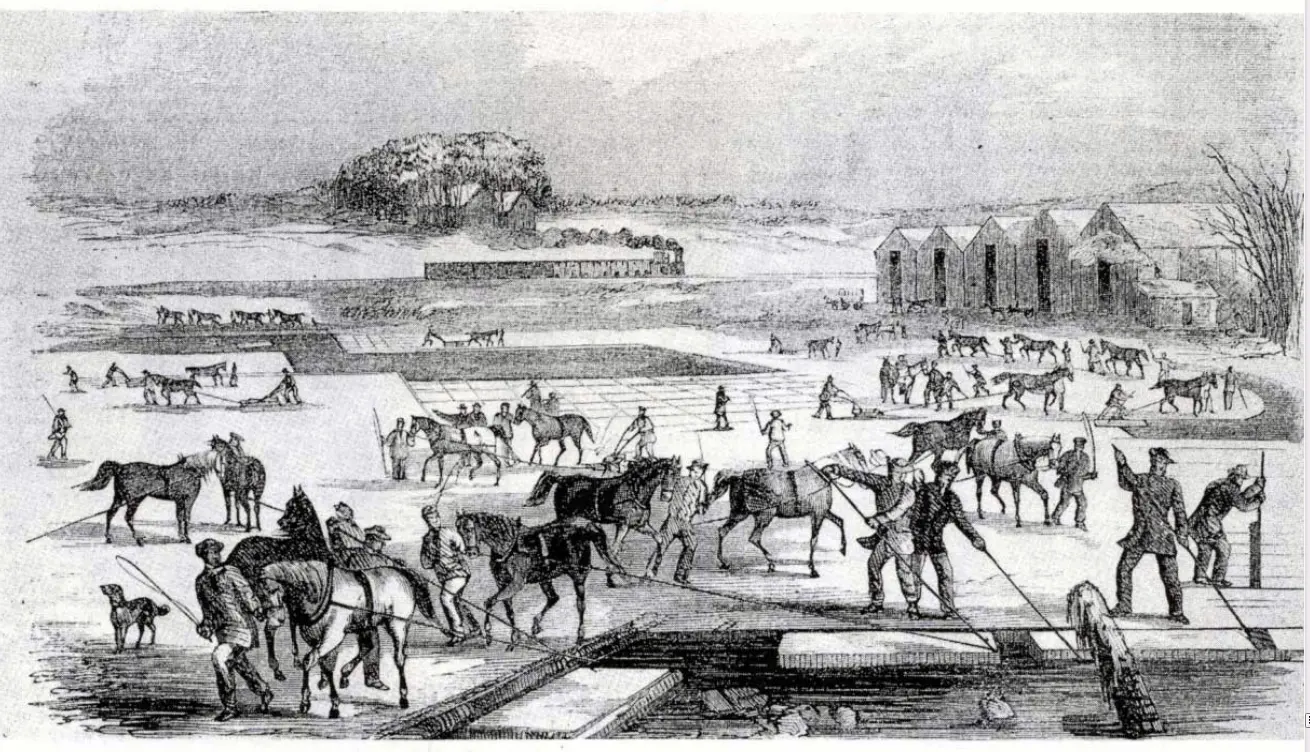

In 1806, Tudor shipped ice cut from lakes in winter to the Caribbean island of Martinique. At first there was nowhere to store it and sales were dismal, but he went on to build an ice depot in Havana, Cuba, and got the business on track. In 1825, a horse-drawn tool was devised to cut ice into square blocks, greatly speeding up the work.
In 1833, ice was successfully delivered all the way to Calcutta (now Kolkata) in India. Packed in sawdust to slow its melting, the ice was carried across the equator. The voyage could take as long as 115 days. At its peak at the end of the 19th century, the American ice trade had grown into a major industry employing an estimated 90,000 people.
The ice-cooled “refrigerator”
At home, people adopted the “icebox,” which used harvested ice. A block of ice went into the top of an insulated wooden cabinet, and the cold air chilled the food below. The first is said to have been made in 1802 by Thomas Moore, an American farmer. Before electric refrigerators came along, the English word “refrigerator” referred to exactly this kind of ice box.
In Japan, too, wooden ice-cooled refrigerators were in use from the Meiji era (1868–1912) into the early Shōwa era. You bought a block of ice from the ice shop, put it in the top compartment, and when it melted, you bought more. A refrigerator was a tool you could use only by buying ice again and again.
Enter the electric refrigerator
The seeds of mechanical cooling go back to the 18th century. In 1834, the American-born Jacob Perkins built a refrigerating machine in England that exploited the way a liquid absorbs heat as it evaporates. It works on the same principle as the refrigerator today.
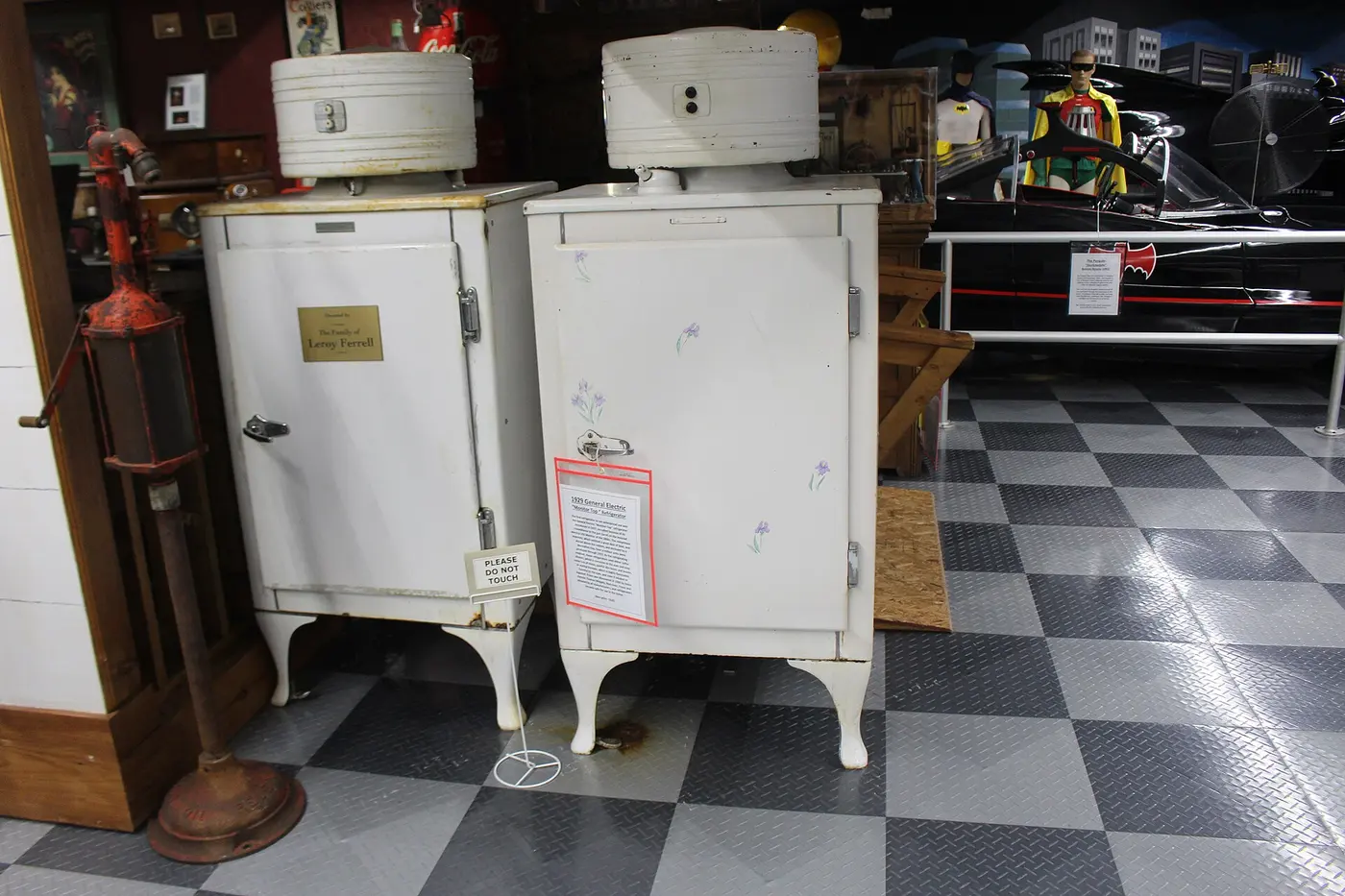
The household electric refrigerator appeared in the United States in 1913. The first models were essentially a cooling unit perched on top of an icebox. The first to see widespread use was General Electric’s “Monitor-Top,” launched in 1927, and more than a million were made.

In Japan, in 1930, Shibaura Seisakusho (today’s Toshiba) built the country’s first domestically made electric refrigerator, modeled on an American product. But it was expensive and did not catch on right away. It was in the late 1950s that the electric refrigerator, along with the black-and-white TV and the washing machine, became known as one of the “three sacred treasures” every household wanted. Ownership passed 50 percent in 1965, and by the mid-1970s nearly every home had one.