Does a rainbow really have seven colors?
As light, a rainbow is a smooth band with no gaps. Seven is the number Isaac Newton chose, partly to match the musical scale, and how many colors people count has varied by era and country.
Many English speakers learned the colors of the rainbow as Roy G. Biv, or with the sentence “Richard Of York Gave Battle In Vain.” In Japan, the link between rainbows and the number seven is so strong that the phrase nana-iro, “seven colors,” instantly calls a rainbow to mind.
Yet if you study a real rainbow after the rain, the colors don’t have clear borders. Indigo in particular, supposedly sitting between blue and violet, is hard to pick out at all. Does a rainbow really have seven colors?
A band with no gaps
A rainbow’s colors appear because sunlight is bent as it passes through raindrops, and each color is bent by a slightly different amount. Color, for light, is a matter of wavelength. The light our eyes can see has wavelengths of roughly 380 to 780 nanometers (a nanometer is a millionth of a millimeter), and across that range the wavelength changes smoothly, with no steps.
So the band of light spread out by a rainbow or a prism is a seamless gradient. There is no line drawn between red and orange. How many colors we see, and where we divide them, is decided not by the light but by our eyes, our brains and our words.
So where did the number seven come from?
Newton and the musical scale
The person who counted seven was the English scientist Isaac Newton.
Newton showed that white light is a mixture of many colors. In a paper sent to the Royal Society and published in its Philosophical Transactions in 1672, he listed the “primary colours” as “Red, Yellow, Green, Blew, and a Violet-purple, together with Orange, Indico, and an indefinite variety of Intermediate gradations.” Newton himself knew perfectly well that the colors shade into one another without end.
In his book Opticks, published in 1704, however, he divided the band into exactly seven colors. He had an assistant “whose Eyes for distinguishing Colours were more critical than mine” mark the borders between the colors in the spectrum from a prism, and found that the divisions matched the ratios of string lengths that produce the intervals of a musical scale. In the same book he drew a color circle, dividing its circumference into seven parts in proportion to the seven musical intervals of an octave, and assigned red, orange, yellow, green, blue, indigo and violet to them.
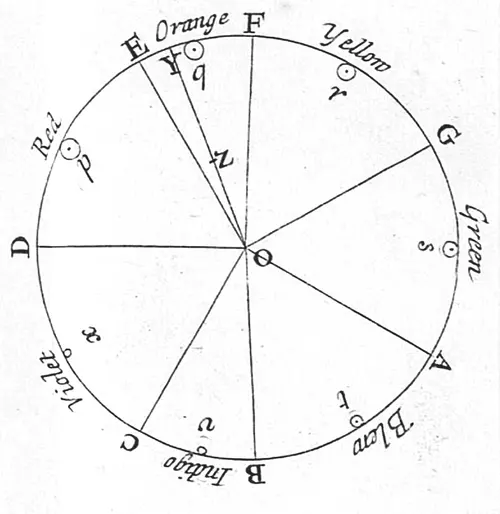

Newton’s seven were partly what he saw and partly a division chosen to harmonize with music. Some have also pointed out that what Newton called “blue” was closer to today’s cyan, and that his “indigo” is roughly what we would now call blue.
Japan’s seven colors came from the West
So how long have the Japanese counted seven colors in the rainbow?
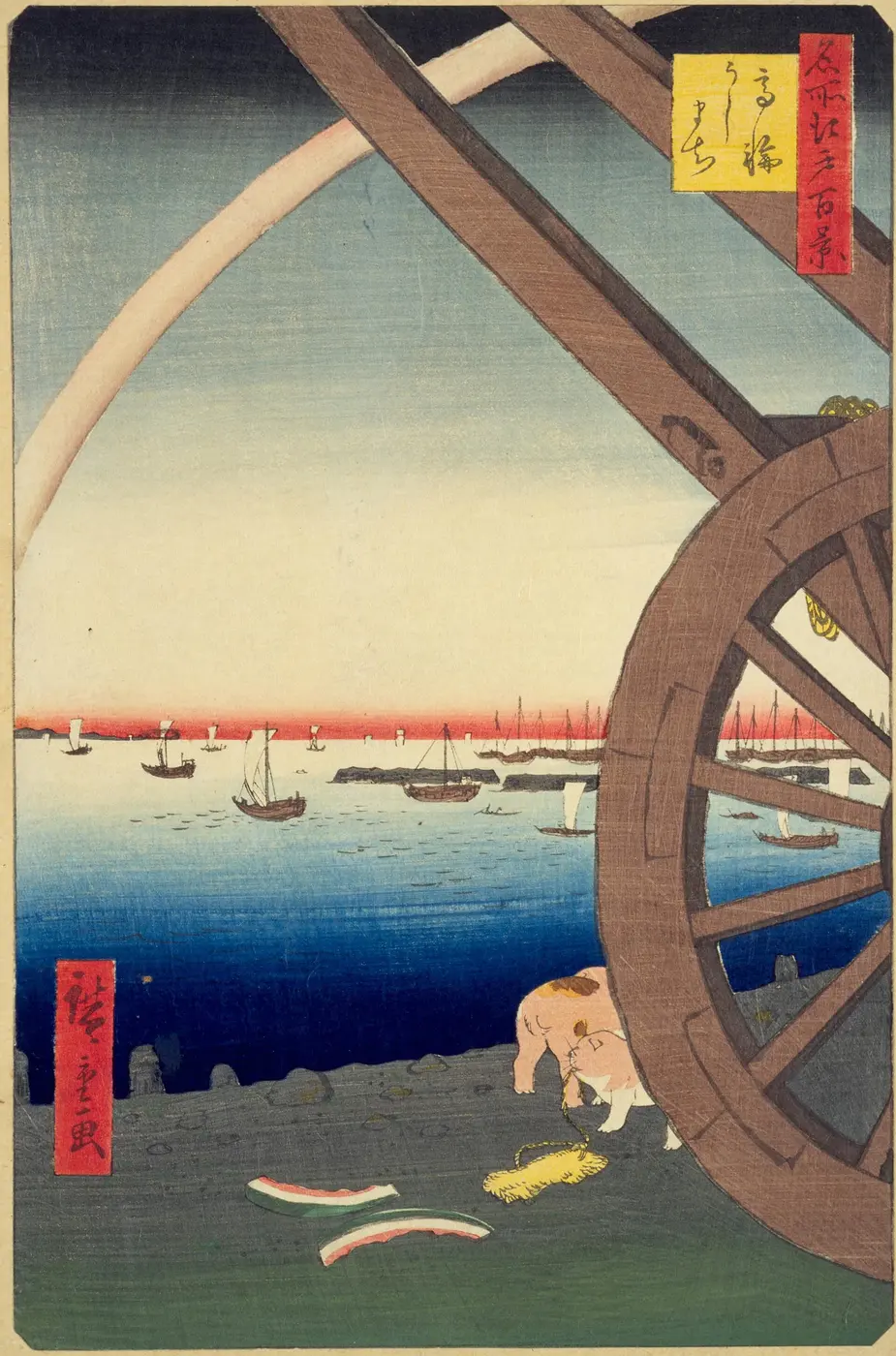
According to research by the Japanese historian of science and educator Kiyonobu Itakura, people in the Edo period (1603–1868) followed a Chinese convention and wrote of “red-and-green rainbows.” The idea that a rainbow has seven colors spread only at the very end of the Edo period and in the decades after, as Western science arrived in Japan. An American introductory science textbook that was translated and widely read in the early Meiji era (1868–1912) also stated that the rainbow has seven colors.

In the United States, meanwhile, elementary science teaching changed in the 1940s. Itakura describes a teaching manual by Bertha Morris Parker, an educator at the University of Chicago Laboratory Schools, in which children projected a prism’s spectrum onto a wall, looked for each color, and discovered that indigo was nearly impossible to tell apart from blue or violet. American textbooks increasingly settled on six colors, without indigo. Japan’s postwar textbooks did not follow suit and kept seven.
The Japanese linguist Takao Suzuki argued that the number of rainbow colors varies with language and culture, noting that many people in Europe and America think of the rainbow as having five or six colors. Yet Japan’s own “seven colors” turns out, on closer inspection, to be an import from Newton.
Color words differ, too
Languages also differ in how many basic color words they have. In 1969 the American anthropologist Brent Berlin and linguist Paul Kay published a comparison of basic color terms across languages. English has 11 basic color terms, they found, while the languages with the fewest have just two: roughly, “dark and cool” and “light and warm.”
The Japanese word ao once covered a far wider range than it does today. According to the Nihon Kokugo Daijiten, Japan’s largest historical dictionary, ao in early Japanese took in blue, green and purple, and even black, white and gray. That is why Japanese still calls a green traffic light, fresh green leaves and green apples ao. How we count a rainbow’s colors may say more about our words than about light.