Was the Nobel Prize inspired by a premature obituary?
A French paper did mistake Alfred Nobel for his dead brother in 1888, but no “merchant of death” obituary has ever been found, and there is no solid evidence that the error led to the prizes.
3wills
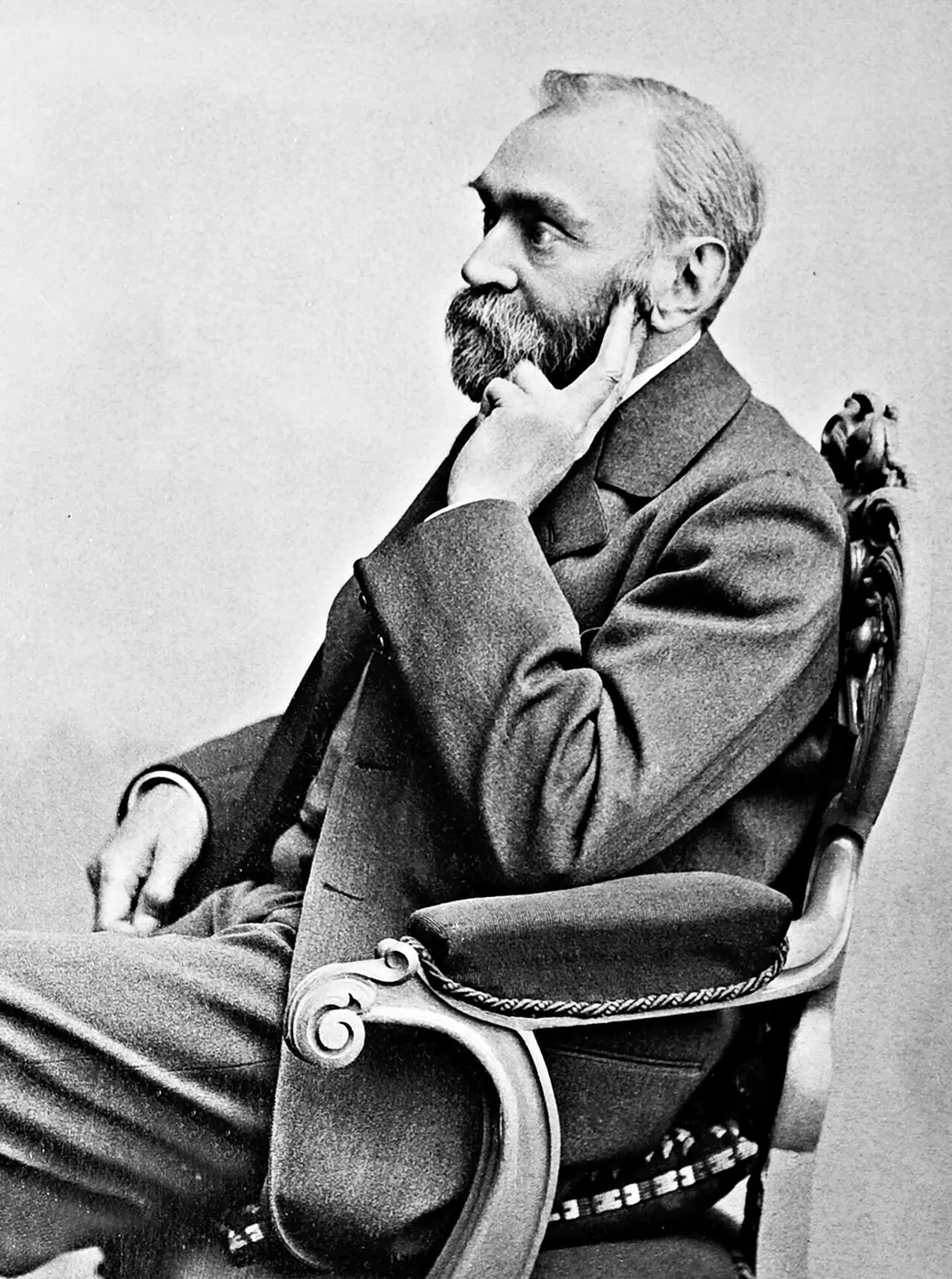
The Nobel Prize has a famous origin story. In 1888, when the brother of Alfred Nobel, the inventor of dynamite, died, a French newspaper mistook him for Alfred and ran an obituary headlined “The merchant of death is dead.” It described a man who had grown rich by finding ways to kill more people faster than ever before. Shaken by how he would be remembered, Nobel decided to leave his fortune to a set of prizes.
It is dramatic and full of moral. But when you check the sources, the true parts and the later additions separate quite cleanly.
Cannes, April 1888
Start with what is true. According to Sweden’s national biographical dictionary, Alfred’s older brother Ludvig Nobel died in Cannes, in the south of France, on April 12, 1888. Ludvig had made a fortune in the oil business in Baku, then part of the Russian Empire, and had been spending time on the Mediterranean because of heart disease.
On April 15, the Paris newspaper Le Figaro printed a short item on its front page:
“A man who can hardly be passed off as a benefactor of humanity died yesterday in Cannes. It is Mr. Nobel, the inventor of dynamite. Mr. Nobel was Swedish.”
The man who had died was Ludvig, not Alfred, so this was a plain case of mistaken identity. The tone is barbed, but it is a few lines long, not the scathing tirade of the legend.

The missing “merchant of death”
No article with the headline “Le marchand de la mort est mort” (“The merchant of death is dead”), on the other hand, has ever been found. Even History.com, which tells the story, notes that historians have yet to find an original copy.
According to a 2024 paper in Substantia, a journal of the history of chemistry, the story was spread by Nicholas Halasz’s 1959 biography Nobel, and became entrenched through later books such as the 1991 biography by the Swedish director Kenne Fant. The paper concludes that the tale was most likely invented by biographers.
The phrase itself also looks out of place. “Merchant of death” refers to those who make and sell weapons and profit from war. One of the things that made it widely known in English was Merchants of Death, a 1934 American exposé of the international arms industry. That same year, the U.S. Senate’s Nye Committee began investigating arms makers. As a newspaper headline in 1888, the phrase seems ahead of its time.
Three wills
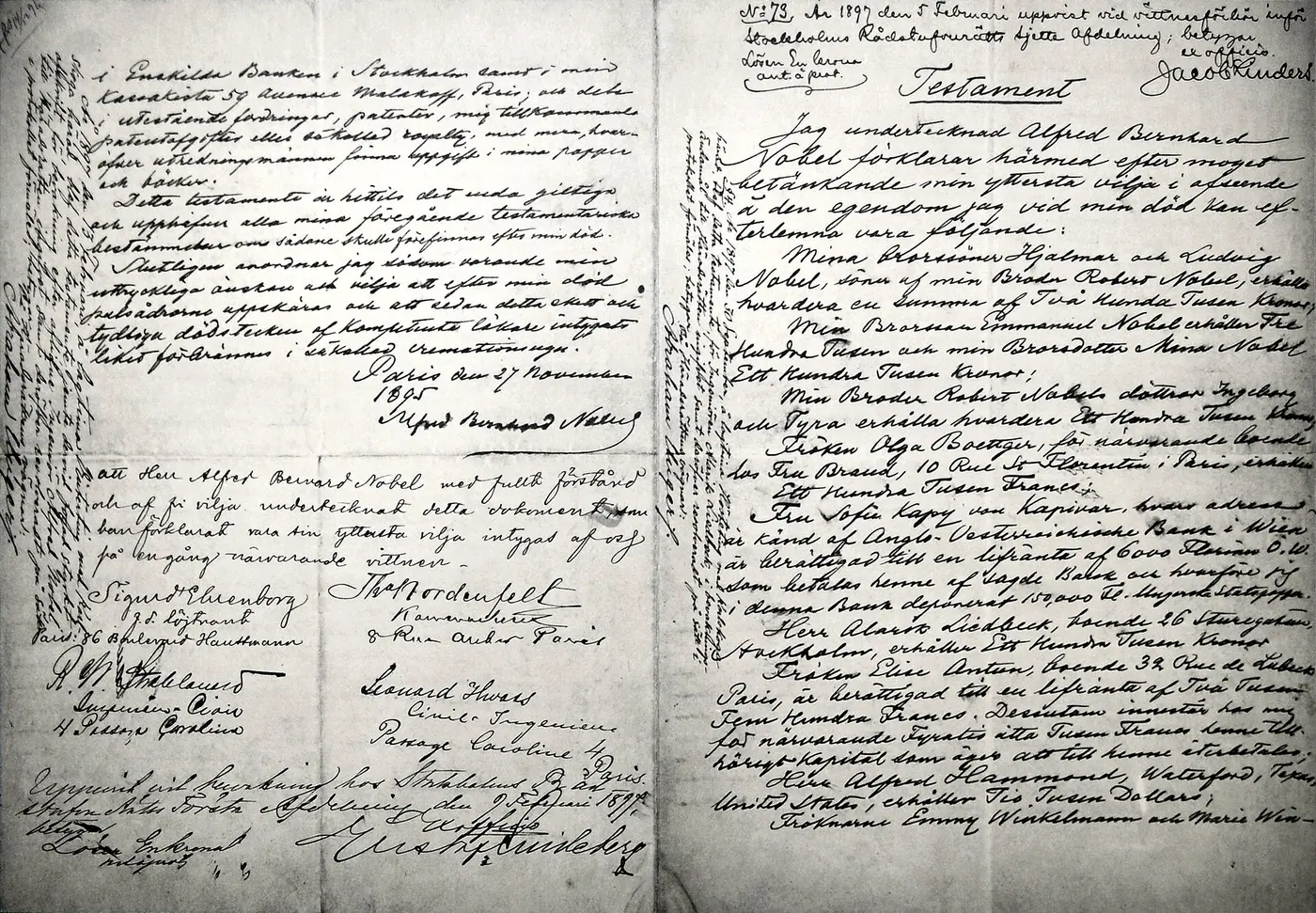
So when did the idea of the prizes take shape? According to the Nobel Foundation’s official website, the will Nobel signed on November 27, 1895, was his third and last.
In a speech at the 1995 award ceremony, the chairman of the foundation’s board explained that Nobel’s will of 1893 already directed part of his fortune to a fund managed by the Royal Swedish Academy of Sciences, whose income would be awarded each year as “a reward for the most important pioneering discoveries or works in the field of knowledge and progress.” Only the final will divided the money into five prizes: physics, chemistry, physiology or medicine, literature and peace. The 1893 will made no mention of a literature prize.
The peace prize is widely thought to owe much to Bertha von Suttner, an Austrian writer who worked briefly as Nobel’s secretary in Paris in 1876 and corresponded with him for years afterward. She became a leading figure in the peace movement with her antiwar novel Lay Down Your Arms, and in January 1893 Nobel wrote to tell her about a peace prize he hoped to found. The prizes, in other words, took shape gradually, over years.

What really produced the prizes
On November 27, 1895, at the Swedish-Norwegian Club in Paris, Nobel signed a will he had written himself, without the help of lawyers, in front of four Swedish witnesses. When he died in Sanremo, Italy, on December 10, 1896, and the will was opened, its plan to devote most of his wealth to prizes caused a sensation. His relatives objected, the process dragged on, and the first prizes were not awarded until 1901, five years later.
Nobel may well have heard about Le Figaro’s blunder. But no reliable record has been produced to show that it made him rewrite his will. The evidence fits better with prizes that grew out of years of reflection than with a single shocking misprint.