Is the platypus venomous?
Yes. Males deliver venom through a spur on the ankle of each hind leg. A sting causes severe, long-lasting pain in people, but no human deaths have been recorded.
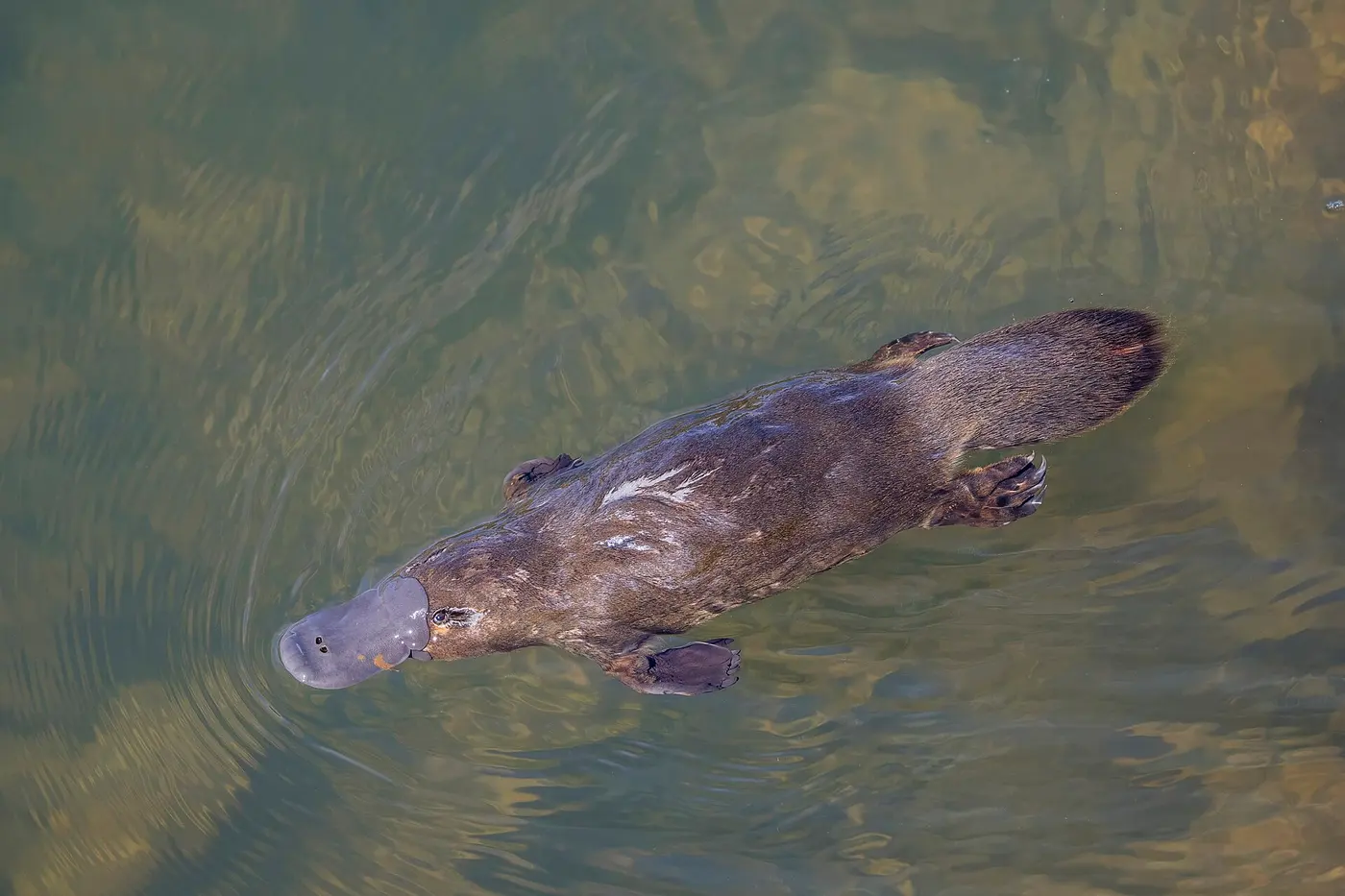
A bill like a duck’s, a flat tail like a beaver’s, webbed feet, and eggs instead of live young: the platypus of eastern Australia is famously strange for a mammal. It has one more surprise, too. It is venomous.
Venomous mammals are rare. A 2014 review by researchers at the University of Sydney lists just four lineages: certain shrews and the solenodons, the vampire bats, the slow lorises, and the monotremes, the group that includes the platypus.
The specimen that looked like a fake
The platypus was first described scientifically in 1799 by George Shaw, keeper of the natural history collections at the British Museum. According to London’s Natural History Museum, what first reached Europe was a skin and a drawing.
Writing in volume 10 of The Naturalist’s Miscellany, Shaw said the animal showed “the perfect resemblance of the beak of a Duck engrafted on the head of a quadruped,” so perfect that at first view it “naturally excites the idea of some deceptive preparation by artificial means.” Faced with something so extraordinary, he added, a degree of skepticism was “not only pardonable, but laudable,” and he confessed that he almost doubted the testimony of his own eyes.
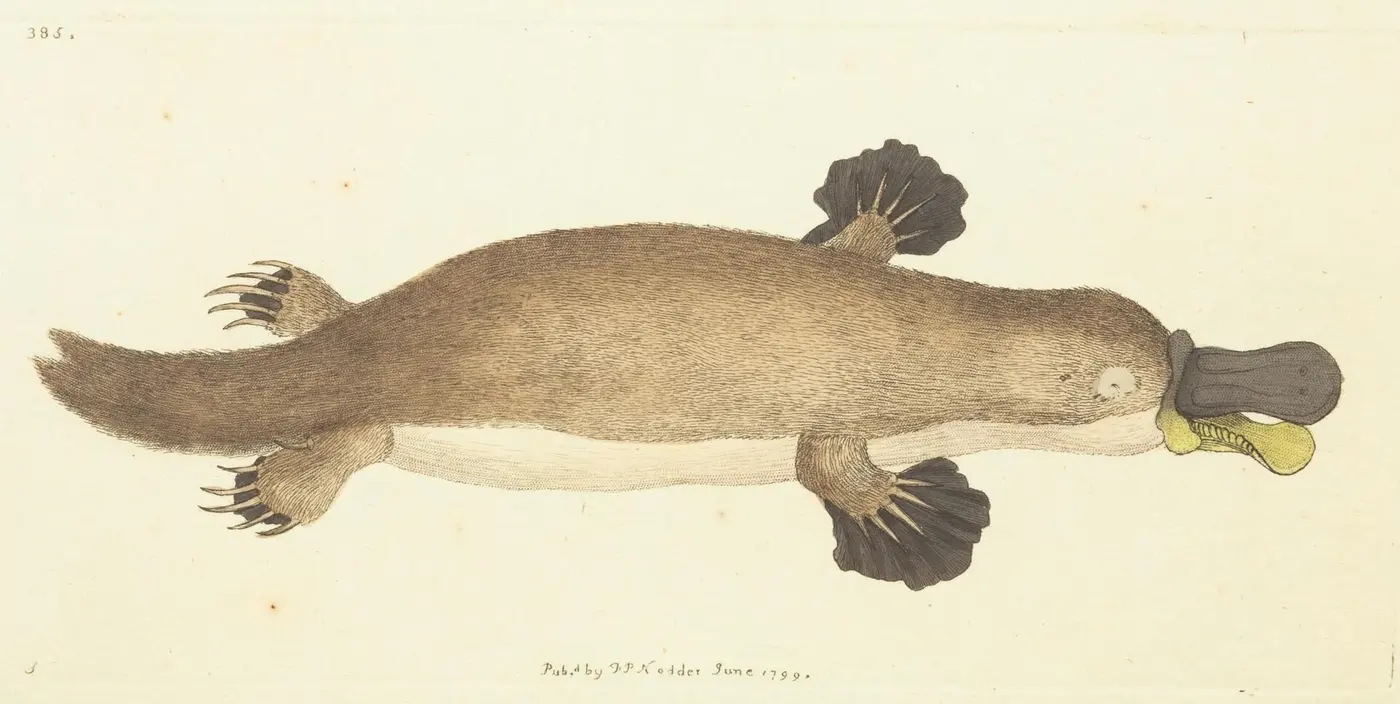

Shaw did not, however, conclude that it was a fake. He softened the bill and its surroundings by soaking them in water until every part could move, and found that the joins looked perfectly natural; even expert anatomists, he wrote, could find no trickery. A popular story says Shaw took scissors to the skin to hunt for stitches, but the test he actually describes in his own text is the soaking.
Shaw also noticed something on the hind feet: a sixth “claw,” set higher than the rest, which “resembles a strong, sharp spur.” He did not say anything about what it might be for.
Venom in the heel
According to the Australian Museum, a male platypus has a sharp spur about 12 mm (half an inch) long on the ankle of each hind leg. The spur is connected by a long duct to a venom gland in the upper leg, which produces venom mainly during the breeding season. The University of Sydney review explains that the venom glands evolved from modified sweat glands. Young females develop a small spur sheath too, but lose it before they reach adulthood.
Outside the breeding season the glands shrink, and males rarely use their spurs. That is why the venom is thought to serve mainly in fights between rival males during the mating season. A male that has been spurred may be left with a temporarily paralyzed limb.
As for what the venom contains, research took off after the platypus genome was sequenced in 2008; scientists have since found genes for venom components resembling toxins in fish, reptiles, spiders and other venomous animals.
What happens to a person?
People have been spurred, too. A 1992 report in the Medical Journal of Australia describes a 57-year-old man who was spurred in the right hand by both hind legs of a male platypus. The animals are said to wrap their hind legs around a victim and drive the spurs in, and a spur can stay stuck fast until it is pulled out by hand.
The pain began immediately and was, in the authors’ words, “sustained, and devastating.” Standard first aid did nothing, and even powerful narcotic painkillers given intravenously in hospital could not control it. What finally worked, dramatically, was a nerve block at the wrist. The man spent six days in hospital; his hand stayed painful and swollen, with little movement, for three weeks, and its function remained impaired for three months.
Still, no human deaths have been recorded. There is no antivenom, so the Australian Museum advises anyone who has to handle a platypus, for instance to help an injured one, to hold it by the far half of its tail.