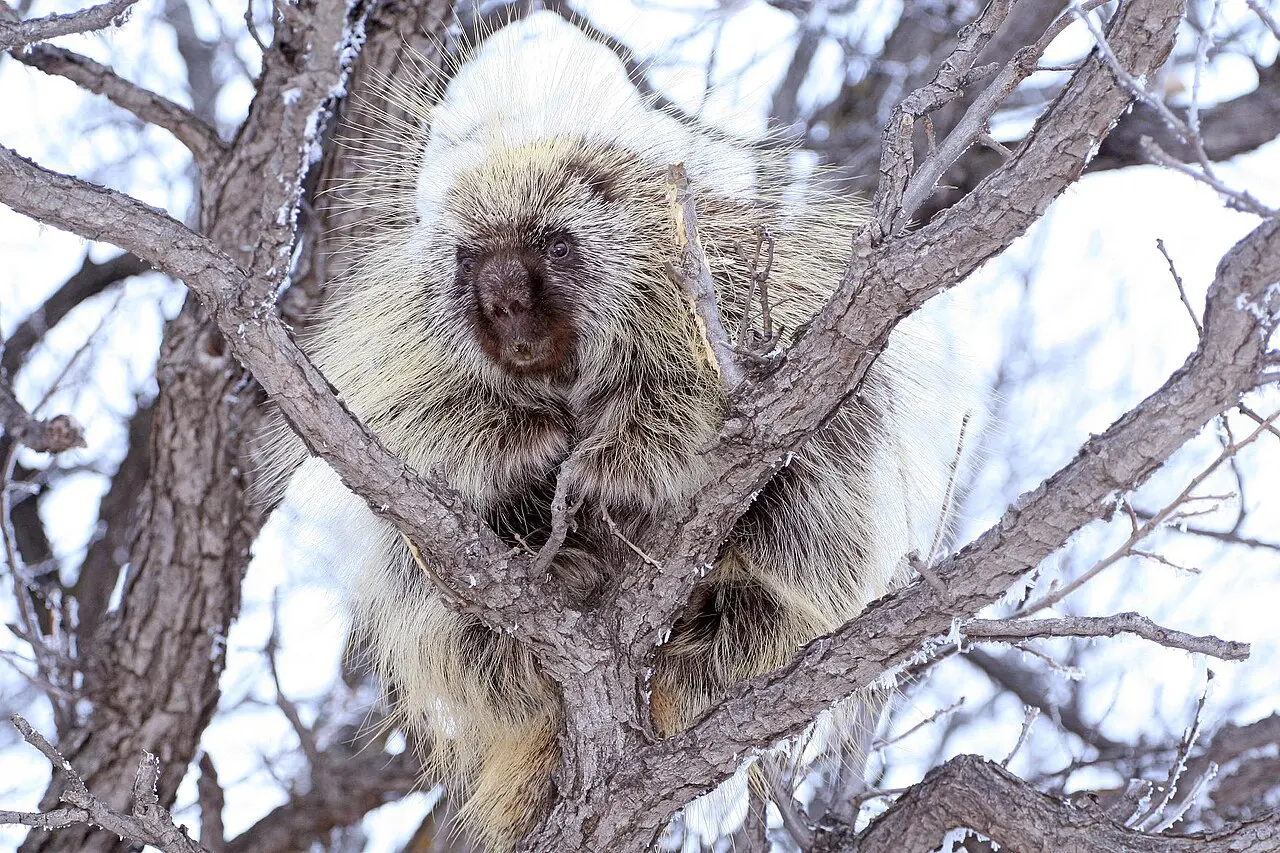
Can porcupines shoot their quills?
No. Porcupine quills come loose easily and lodge in whatever touches them, but they cannot be fired. The quills of North American porcupines are tipped with tiny barbs that make them hard to pull out.
30,000
A porcupine with every quill raised is a fearsome sight, and an old story makes it even more so: provoke one, and it will shoot its quills at you like arrows. The story is so durable that it still turns up today.
Porcupines cannot shoot their quills, though. The quills simply come away easily and stay stuck in whatever touches them. So where did the idea of a porcupine firing its quills come from?
A Roman “missile”
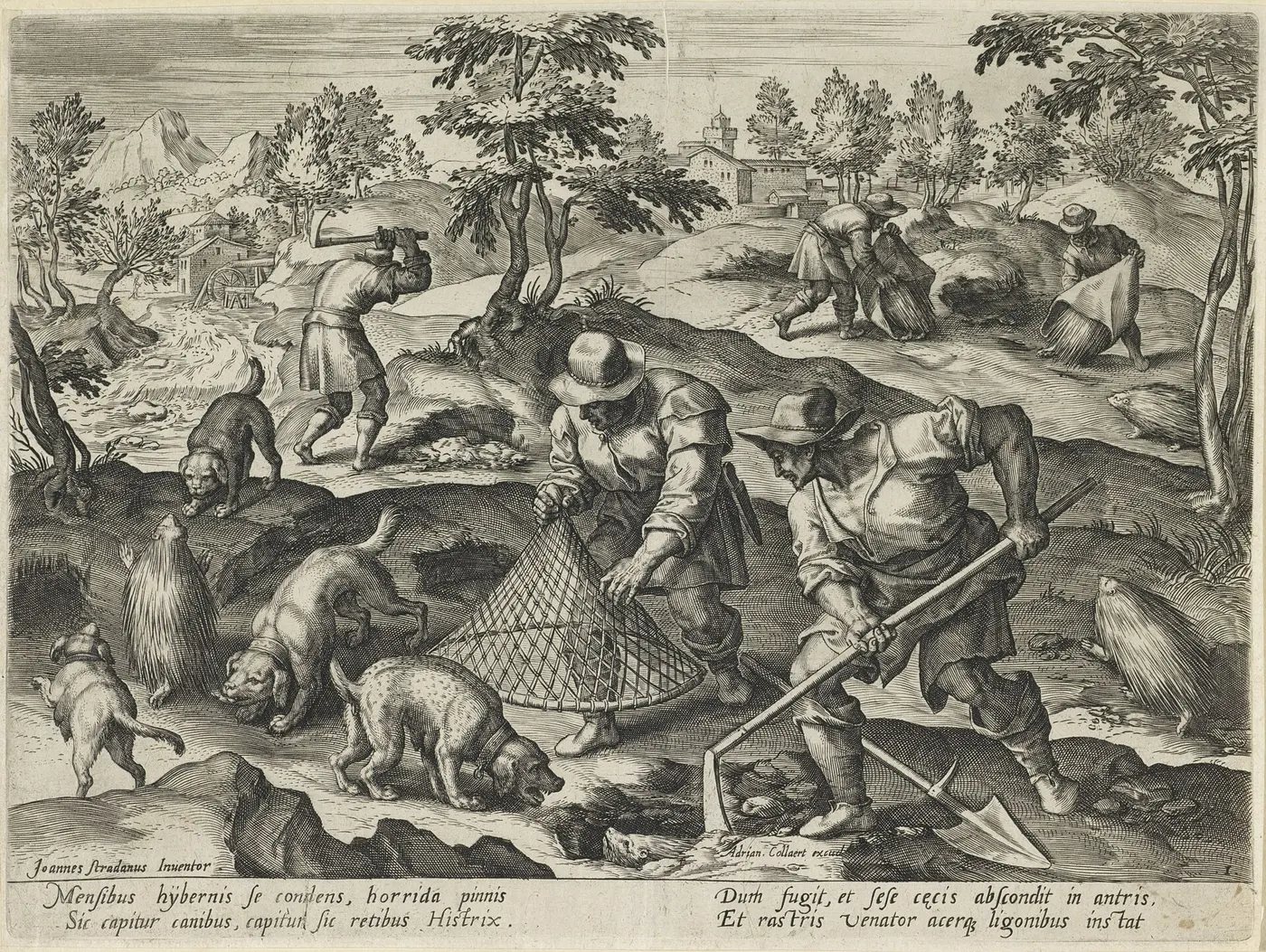
One of the earliest sources is the Natural History written by the Roman naturalist Pliny the Elder in the first century AD. Pliny described the porcupine as a kind of hedgehog from India and Africa with much longer spines, and said that “when it stretches the skin, it discharges them like so many missiles,” piercing the mouths of dogs that press too close and even sending its darts some distance farther. When the work was translated into English in the 19th century, the translators added a pointed footnote: quills may stick so firmly in a dog that they come away from the porcupine, “but there is no reason to believe that they can be darted out” by the animal itself.
The San Diego Zoo says that the philosopher Aristotle also warned that porcupines could shoot their quills. Yet in Aristotle’s History of Animals, the porcupine appears only in remarks that its spines are a kind of hair, and in notes on its hibernation and breeding. There is nothing about shooting.
The legend lived on for centuries. In Toxophilus, a book on archery published in 1545, the English scholar Roger Ascham cited the Roman poet Claudian as saying that nature gave the first example of shooting through “the porpentine, which shootes his prickes and will hitte anye thinge that fightes with it.”

Quills that come away easily
According to the Smithsonian’s National Zoo, the North American porcupine carries about 30,000 hollow quills, each 5 to 7 cm (2 to 3 inches) long. Because they are only lightly attached to the skin, they come off easily when a predator touches them. They cannot be thrown or shot. A cornered porcupine raises its quills, turns its back on the attacker and lashes out with its tail.
The San Diego Zoo explains that quills are shed like other hairs, and that loose ones can fly off when a porcupine shakes itself, though without any real force. In 1883, Emma Phipson, who collected the animal lore of Shakespeare’s England, suggested that the myth may have started when people saw loose quills drop out as a porcupine suddenly raised them.
Barbs that won’t let go
What makes the North American porcupine’s quills so nasty is their tip. In a 2012 study by a team from Harvard Medical School, the Massachusetts Institute of Technology (MIT) and other institutions, researchers found that roughly the last 4 mm of each quill is covered in tiny backward-facing barbs. Compared with quills whose barbs had been removed, barbed quills needed only about half the force to penetrate tissue, and four times the force to pull out. The barbs concentrate the force at small points, much as a serrated knife cuts more cleanly than a straight blade. Once the quill is in, they act like anchors.
African porcupines, however, have no such barbs. The “Old World” porcupines of Africa and Asia live on the ground, warn off enemies by rattling the hollow quills on their tails, and if that fails, charge backward to drive their quills in. Despite their similar looks, they are not close relatives of the tree-climbing “New World” porcupines of the Americas. A genetic study published in 2001 placed the New World porcupines in a South American group of rodents that also includes guinea pigs and chinchillas. The two kinds of porcupine are thought to have acquired their armor of quills independently.