Do hippos sweat blood?
No. The red fluid isn’t blood, and it isn’t true sweat from sweat glands. It is a skin secretion that starts out colorless, turns red within minutes, and works as both a sunscreen and an antibiotic.
When a hippo hauls itself out of the water, its skin is sometimes coated with a reddish fluid. It looks as though the animal is oozing blood, which is why the fluid has long been called “blood sweat.”
It is not blood, though, and it is not sweat in the sense that we sweat. The fluid comes out of the skin colorless, turns red within a few minutes, and eventually goes brown. What gives it that color was only worked out in the 21st century.
London’s “blood-sweating” hippo, 1850
On May 25, 1850, a young hippopotamus arrived at London Zoo. Named Obaysch, he had been caught in the Nile. According to the Zoological Society of London, he was the first hippo to reach Europe since the days of the Roman Empire, and Queen Victoria came to inspect him soon after he arrived.
Charles Murray, the British consul general in Egypt, who had looked after the young hippo in Cairo, wrote that its skin was at times covered with a “blood-coloured exudation,” most abundant just after a bath. At first this caused considerable alarm, but because it kept happening and the animal was otherwise perfectly healthy, people came to believe it was normal.
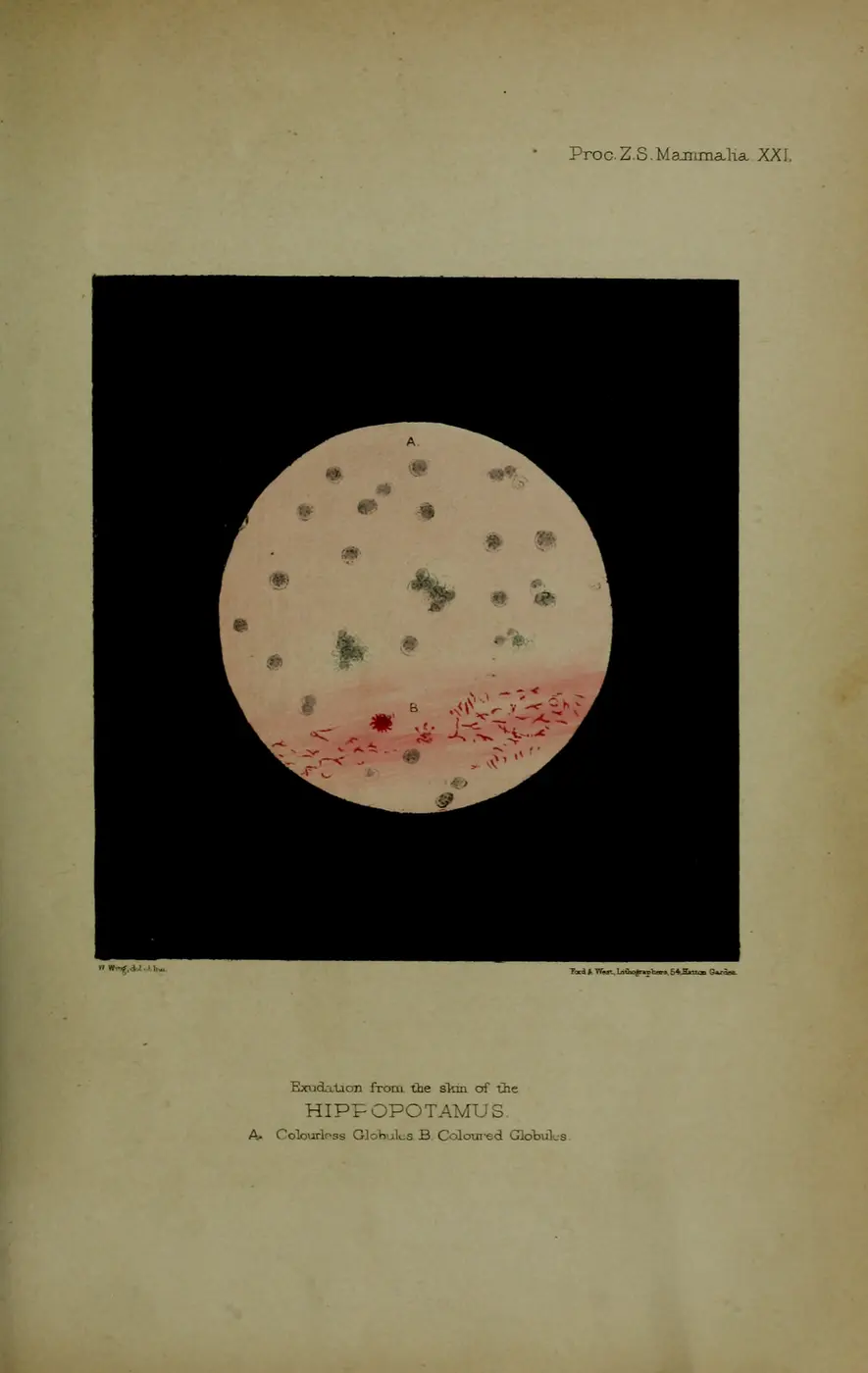

On May 28, just after the hippo’s arrival, John Tomes, a dental surgeon and Fellow of the Royal Society, examined the fluid under a microscope. When the hippo emerged from its bath, he wrote, raised spots on its skin each released a drop of pink fluid “of the consistence of white of egg.” Tomes reported that the color came from colored particles dissolving into the fluid, not from intact red cells as in blood, which made it strikingly different from blood.
No sweat glands
Our sweat comes from sweat glands, and as it evaporates it carries away body heat. According to the San Diego Zoo, however, hippos have no true sweat glands. The red fluid is a thick secretion released through pores in the skin. S. Keith Eltringham, a hippo specialist at the University of Cambridge, has explained that it is not technically sweat at all: it comes from larger glands deep in the skin and flows out through visible pores.
Hippo skin dries out easily, and a hippo that stays out of the water too long can become dehydrated. That is why hippos spend much of the day in water. More than 170 years ago, Tomes himself suspected that the slimy secretion had something to do with the animal’s aquatic way of life.
Solved with help from Ueno Zoo
The mystery of the color was solved by a team including Kimiko Hashimoto of Kyoto Pharmaceutical University and Yoko Saikawa of Keio University. With the cooperation of Ueno Zoo in Tokyo, the researchers wiped the secretion from the hippos’ faces and backs with gauze and analyzed it. Staff from the zoo were among the paper’s coauthors.
The pigments turned out to be extremely unstable. The colorless secretion turns red within minutes and then brown. Hashimoto later recalled that, to avoid stressing the animals, samples were collected only once a week, and only between about May and October, when the hippos secrete. The team froze samples on dry ice right away and kept them in dilute solution so that the pigment molecules would not clump together.
In 2004 the team published its results in Nature. The red pigment was named hipposudoric acid and the orange one norhipposudoric acid, from sudor, Latin for sweat. The brown color, they found, appears as the pigments link up into larger molecules. Later work showed that the pigments form when a colorless substance in the secretion, homogentisic acid, is oxidized by oxygen in the air, with the help of an enzyme secreted alongside it.
Natural sunscreen, natural antibiotic
In the team’s tests, the red pigment stopped the growth of two disease-causing bacteria, Pseudomonas aeruginosa and Klebsiella pneumoniae, at concentrations lower than those found on hippo skin. Both pigments also strongly absorb ultraviolet light. The red secretion seems to serve the hippo as a natural sunscreen and as medicine for its wounds.
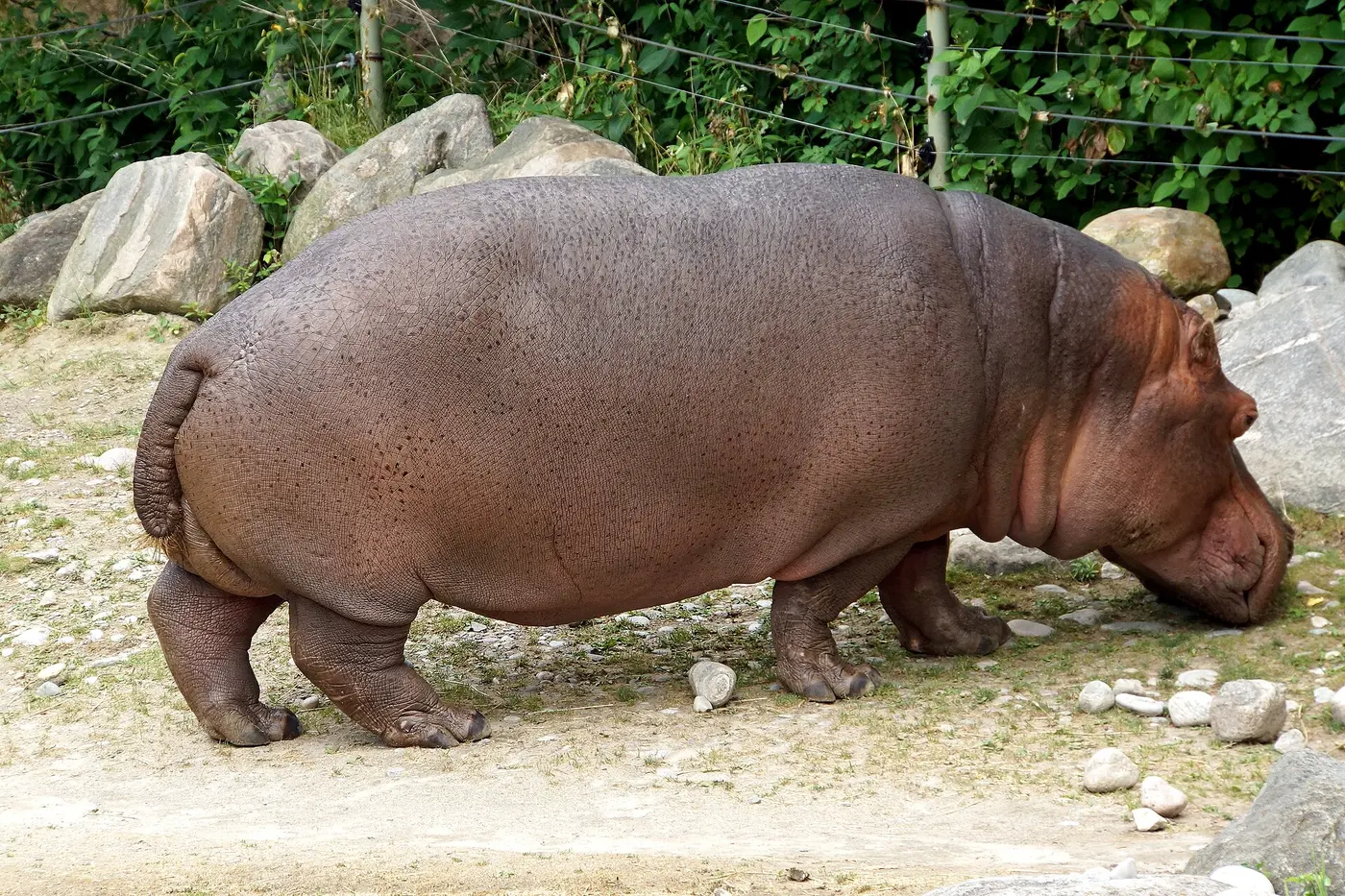

Male hippos fight fiercely over territory and often end up badly gashed. Yet it has long been noticed that their wounds rarely fester, even though they live in mud and murky water. The San Diego Zoo notes that even large wounds don’t seem to get infected. The red “sweat” may be part of the reason.