How many digits of pi have been calculated?
In 2025, pi was calculated to 314 trillion digits. Yet even space navigation uses only about 15 decimal places.
314trillion digits
The distance around a circle is about 3.14 times its diameter. That ratio is pi. Written out as 3.14159265358979…, its decimal digits never settle into a repeating pattern, and they never end.
Knowing that it never ends has not stopped anyone from wanting to see what comes next. The hunt for pi’s digits began in ancient Greece and has grown into a huge computing effort that keeps machines running for months at a time.
The age of hand calculation
Around the third century BCE, the Greek mathematician Archimedes imagined 96-sided polygons fitting snugly inside and outside a circle, and showed that pi is greater than 3 10/71 and less than 3 1/7. As decimals, that puts it between 3.1408 and 3.1428.
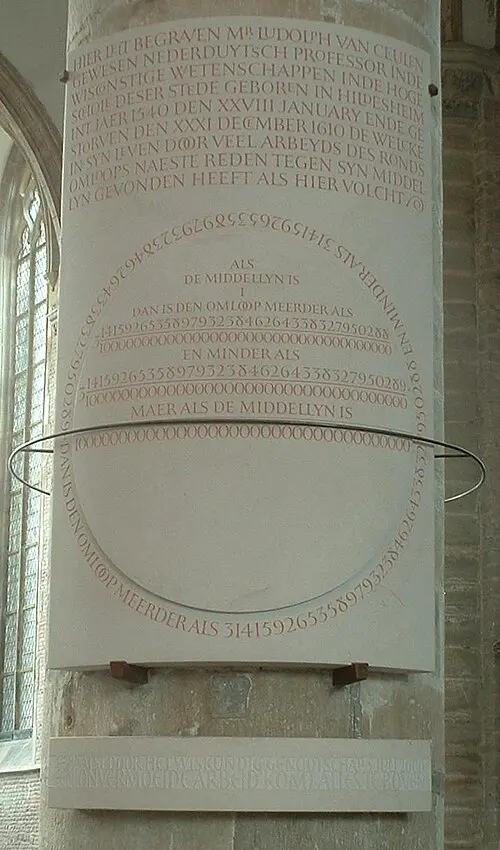
In fifth-century China, Zu Chongzhi pinned down pi correctly to seven decimal places. In the early 1600s in the Netherlands, Ludolph van Ceulen spent much of his life calculating it to 35 digits, and in Germany pi was for a time even called the “Ludolphine number.”
Japan’s traditional mathematicians, practitioners of wasan, were not far behind. In 1722, during the Edo period, Takebe Katahiro found the correct value to 41 digits.

The greatest feat of the hand-calculation era came in 1873, when the Englishman William Shanks published 707 digits. But when his work was checked in the 20th century, everything from the 528th digit onward turned out to be wrong. About a quarter of the digits he had labored over for years were wrong.
Computers take over
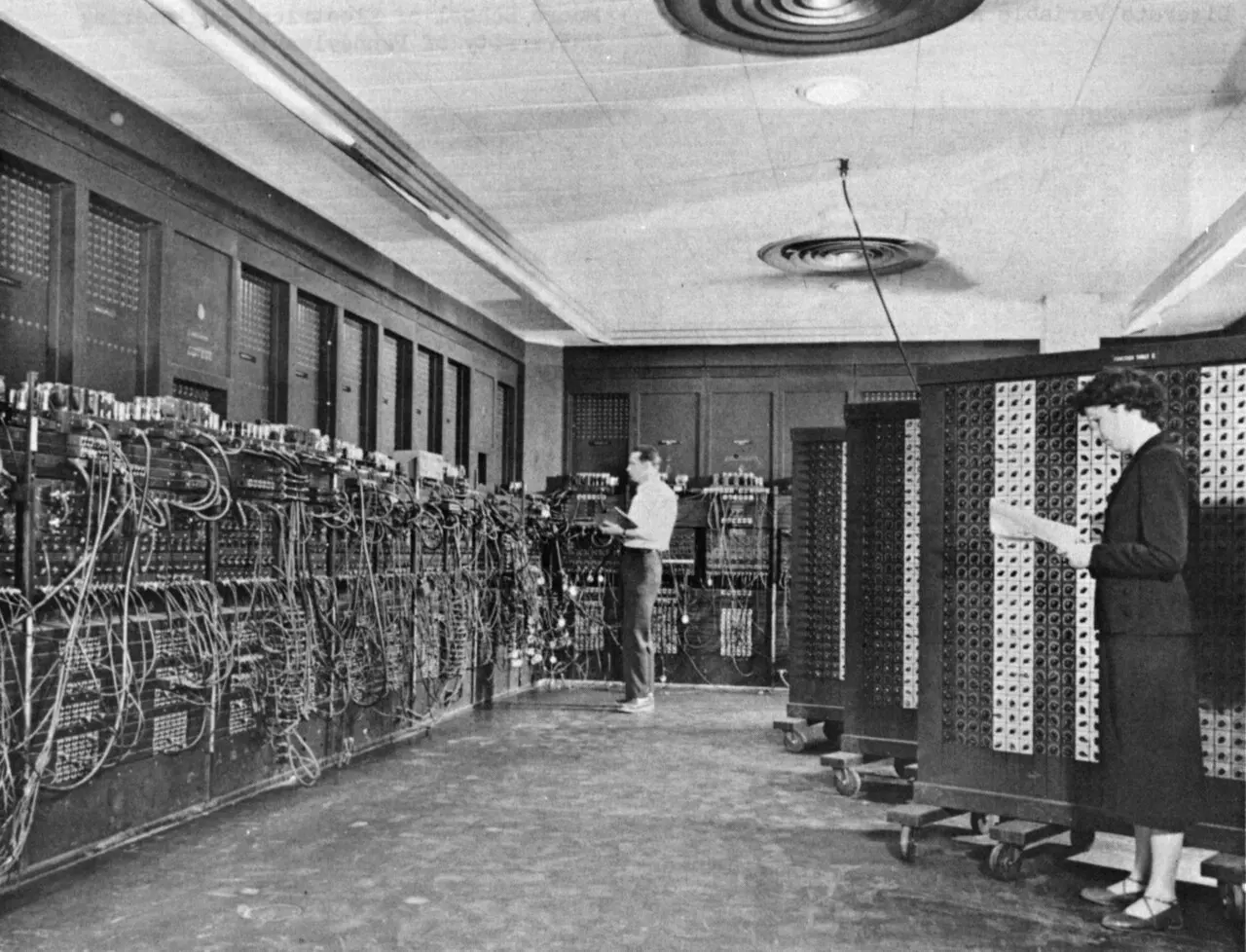
In 1949, ENIAC, one of the first electronic computers, built in the United States, calculated 2,037 digits in 70 hours. In about three days, a machine had overtaken what people had needed lifetimes to reach.

Japanese researchers went on to play a big part in the record chase. A team led by Yasumasa Kanada at the University of Tokyo broke the record again and again on supercomputers, reaching 1.2411 trillion digits in 2002. In 2011, Shigeru Kondo, an office worker in Nagano Prefecture, made headlines by reaching 10 trillion digits on a computer he had built himself. And Emma Haruka Iwao at Google used cloud computing to calculate 31.4 trillion digits in 2019 and 100 trillion in 2022.
The latest record: 314 trillion
The record has kept climbing. In May 2025, a team including Canada’s Linus Media Group announced 300 trillion digits. That December, a team from the American website StorageReview ran a single server nonstop for about 110 days and announced a new record of 314 trillion digits, a fittingly pi-shaped number.
At this scale, even writing out the digits is a challenge. The intermediate calculations need enormous amounts of storage, and this run used dozens of drives, each holding more than 60 terabytes.
How many digits do we actually need?
So are all those digits useful? According to NASA’s Jet Propulsion Laboratory, even its most precise calculations, for navigating spacecraft between the planets, use 3.141592653589793, just 15 decimal places. With that value, the circumference of a circle 64 billion kilometers (40 billion miles) across comes out wrong by only about 1.5 centimeters (half an inch). To calculate the circumference of a circle the size of the observable universe to within the width of a hydrogen atom, 38 digits would be enough.
The record attempts go on because they make an excellent test of a computer’s speed and reliability. Pi’s digits measure whether a machine can calculate accurately, without a break, for months on end.