Do peanuts grow underground?
Yes. The flowers bloom above ground, but after they wither, a stalk at the base of each ovary grows down into the soil, and the pod develops there.
Crack open a peanut shell and you will usually find two kernels in papery red skins. Peanuts are about as familiar as snacks get. Yet ask how they grow and many people draw a blank. Do they hang from branches like pea pods?
The answer is underground. Peanut flowers bloom above ground, but the pods grow beneath it.
A flower that lasts a morning
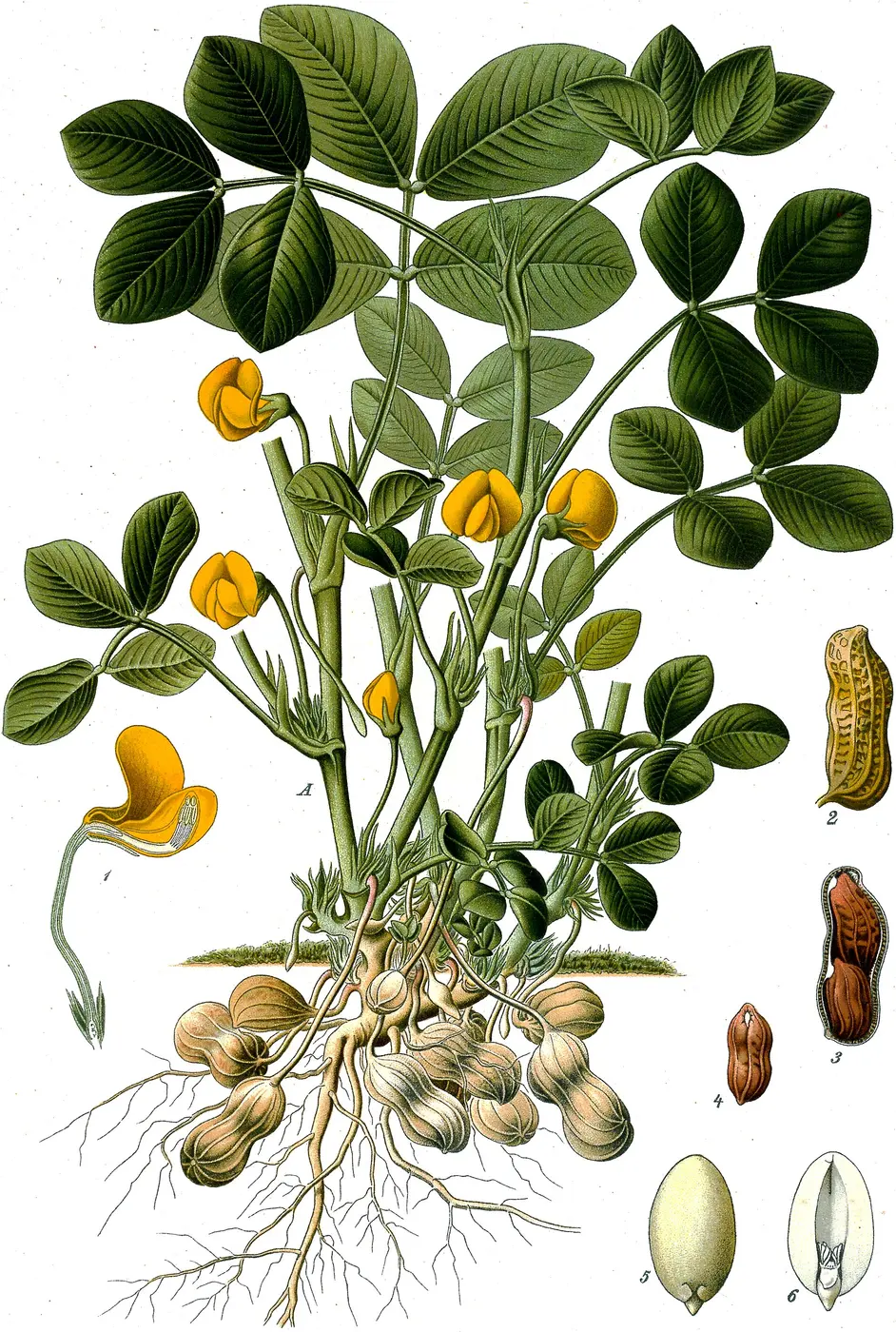
The peanut is an annual in the legume family, native to South America. In Chiba Prefecture, Japan’s biggest peanut-growing region, the plants produce a stream of small yellow flowers, about a centimeter across, at the bases of their leaves from late June through July. According to Japan’s Nipponica encyclopedia, each flower opens early on a summer morning and withers by midday. In that short window it pollinates itself.
The flower holds a small surprise. Beneath it is what looks like a slender stalk, but it is really a long tube formed by the calyx, the ring of sepals around the petals. The ovary, the part that will become the pod, sits at the bottom of that tube. An 1895 US Department of Agriculture bulletin for farmers, Peanuts: Culture and Uses, put it this way: the blossom “is at the end of a long pedicel-like calyx tube, the ovary being at the base.” The petals open some distance from the stem, while the all-important ovary stays tucked in close to it.

The peg heads for the ground
Once the flower is fertilized, it shrivels and falls. About five days after flowering, the tissue at the base of the ovary begins to lengthen. Growers call this structure the peg; botanists call it a gynophore. Chiba Prefecture describes it as something like a root growing out from the base of the flower and burrowing into the ground.
The peg senses gravity and grows downward, pushing the ovary at its tip into the soil. According to a 2019 review by researchers in India and the United Kingdom, once the tip is underground it turns sideways, and that change of direction sets the stalled embryo growing again. The ovary swells a few centimeters (an inch or two) below the surface into the familiar netted pod. Darkness matters: light suppresses the swelling of the pod. If a peg fails to reach the soil, the developing seed aborts.
Named for the way it grows
In Japanese the peanut is rakkasei, written with characters meaning “fall,” “flower” and “be born.” The name comes from Chinese. According to a 2025 article in Chinese Social Sciences Today, published by the Chinese Academy of Social Sciences, the earliest record of the name is a 1503 gazetteer of Changshu, a county in eastern China, which explains that “people say the flower falls to the ground and the seed is born in the soil, hence the name.”
Strictly speaking, the fallen petals do not go anywhere. What enters the soil is the ovary that was hidden at the base of the flower. Still, if you watched something reach for the ground just as each flower faded, you might well draw the same conclusion. The scientific name, Arachis hypogaea, makes the same point: hypogaea is Greek for “underground.” The English name groundnut does too.
150 years in Chiba
Peanuts reached Japan by way of China during the Edo period (1603–1868). According to the Japanese encyclopedia Sekai Daihyakka Jiten, the earliest record is a 1675 text noting that they had “recently arrived.” One of their Japanese nicknames, nankinmame, or “Nanjing beans,” reflects that route: in old Japanese, “Nanjing” was attached to the names of things that came via China. But peanuts did not become a real crop in Japan until they were reintroduced in the Meiji era (1868–1912).
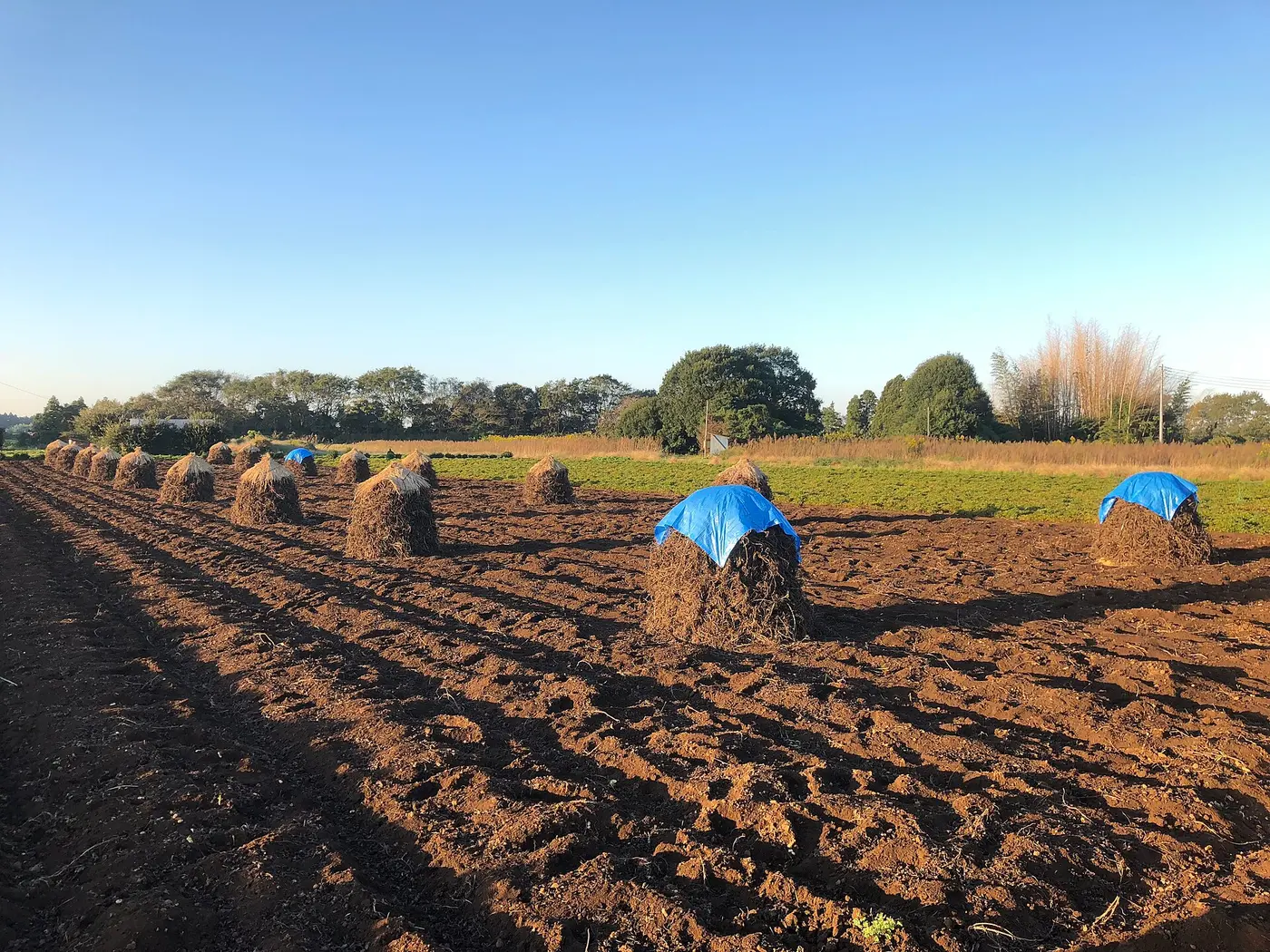
In Chiba, which grows more peanuts than any other prefecture, cultivation is said to have begun in 1876, when a man named Makino Man’uemon, from what is now the city of Sanmu, obtained seeds from Kanagawa Prefecture and tried growing them. That makes 2026 the 150th anniversary. Each autumn, Chiba’s fields fill with botchi: harvested plants stacked into squat cylinders with the pods turned inward and topped with a straw cap. The peanuts are left to dry in the wind for one to two months, which is said to deepen their flavor.