Are cabbage and broccoli the same plant?
They’re the same species. Kale, cauliflower, Brussels sprouts, kohlrabi and Japan’s ornamental cabbage are all varieties of wild cabbage too.
Cabbage, broccoli, cauliflower, Brussels sprouts: line them up in the produce aisle and they look like four completely different plants, with different shapes and colors.
Yet all of them belong to a single species, Brassica oleracea. Over a very long time, people kept selecting wild cabbage plants for bigger and better versions of different parts, and from that one species came vegetables that look nothing alike.
Same plant, different parts
The main difference between these vegetables is which part of the plant was enlarged.
Kale is a cabbage bred for its leaves. Cabbage itself is an enlarged bud at the tip of the stem, with leaves wrapped layer upon layer into a tight head. Brussels sprouts are side buds, which grow where the leaves join the stem and develop into miniature cabbages. Kohlrabi is a stem swollen into a ball like a turnip.
Broccoli and cauliflower, meanwhile, are enlarged clusters of flower buds, harvested before they bloom. Each tiny bead on a head of broccoli is a flower bud; leave it unharvested and it opens into yellow flowers. Gai lan, or Chinese broccoli, and the spiral-patterned romanesco are members of the same species too.
Because they are all one species, these crops can be crossed with one another. Broccoli has become a staple in Japan as well. In 2024, Japan’s Ministry of Agriculture, Forestry and Fisheries decided to make broccoli a “designated vegetable” from fiscal 2026, a status for heavily consumed vegetables whose supply and prices the government helps stabilize. It was the first addition to the list since the potato in 1974, about half a century earlier.
An ancestor that clings to sea cliffs
So what is wild cabbage like?
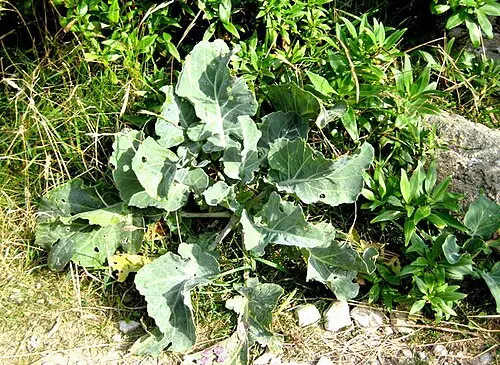
Wild Brassica oleracea is a tall biennial or perennial. In its first year it forms a thick rosette of large, fleshy, grayish-green leaves; in its second, it sends up a stalk as tall as 1.5 meters (5 feet) bearing clusters of yellow, four-petaled flowers. It tolerates salt and lime well but competes poorly with other plants, so in the wild it tends to grow on limestone sea cliffs, such as the chalk cliffs on both sides of the English Channel.

Where people first began growing it as a vegetable, however, long remained unclear. In 2021, a team led by researchers at the University of Missouri analyzed the genes of 224 samples representing 14 crops and nine wild relatives. They found that the closest living wild relative of cultivated cabbage and its kin is Brassica cretica, a plant found only around the Aegean Sea, and concluded that cultivation most likely began in the eastern Mediterranean. The earliest written references to these plants come from Greek scholars some 2,500 to 2,000 years ago, while the oldest reliable archaeological evidence is seeds found at Gibala, a site in western Syria, dating back about 3,000 years.
Japan’s New Year cabbage
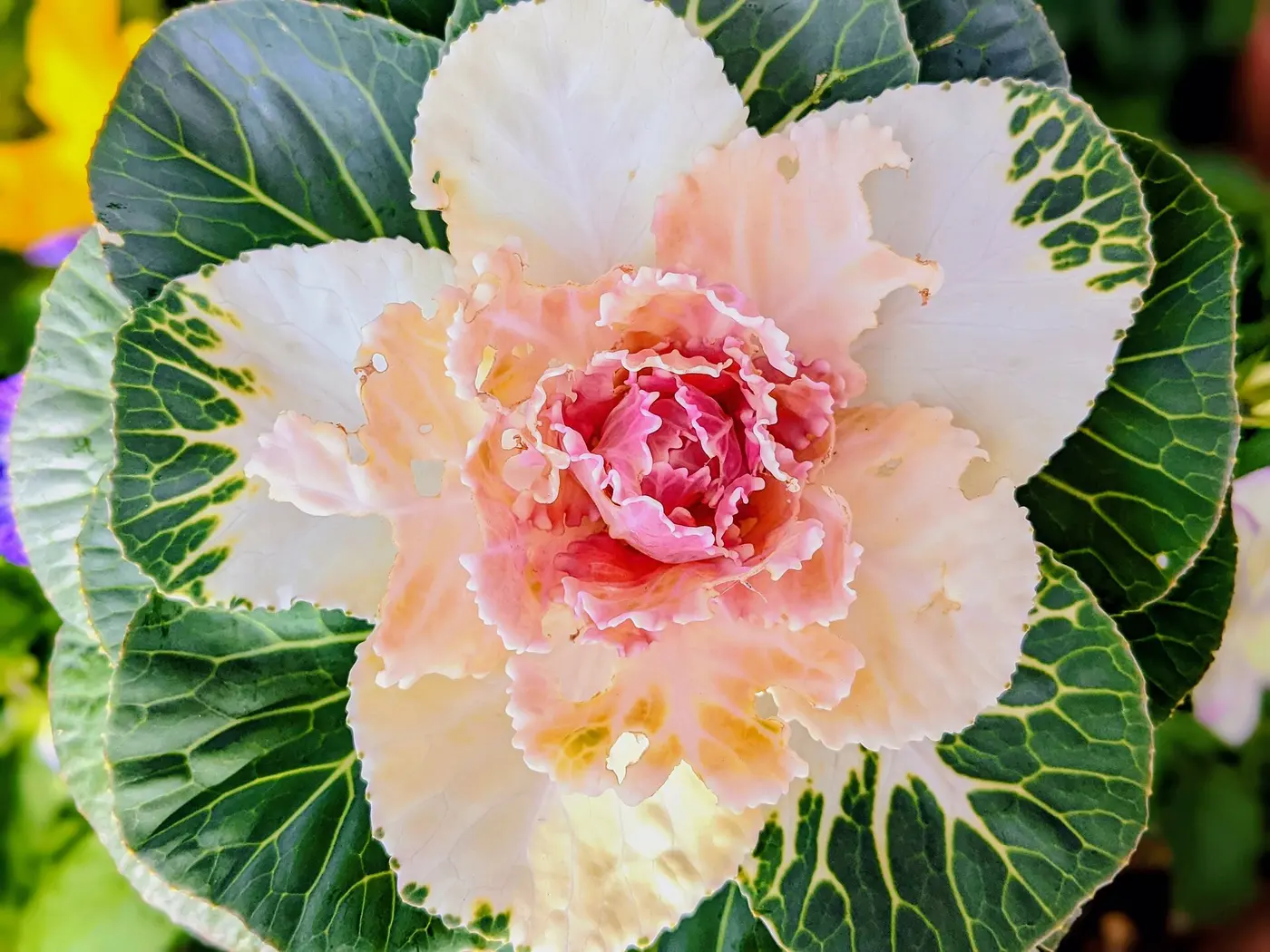
Habotan, the ornamental cabbage that brightens Japanese gardens and doorways in winter, belongs to the same family tree. It is thought to have been developed from old non-heading varieties of cabbage or kale grown for their looks.
The name habotan, meaning “leaf peony,” first appears in writing in a 1778 work by the naturalist Yamaoka Kyoan. From the mid-Edo period onward, its red-and-white coloring, considered auspicious in Japan, made it a popular winter decoration, and it is sometimes added to kadomatsu, the pine-and-bamboo arrangements placed at entrances for the New Year. Regional strains have emerged as well, from the smooth-leaved Tokyo Maruba to the finely frilled Nagoya Chirimen and the in-between Osaka Maruba. The name compares the layered leaves to the petals of a peony.