Was Pachelbel’s Canon forgotten for centuries?
Yes. The score was not printed until 1919, more than 200 years after it was written, and the piece became a worldwide favorite only after a 1968 recording.
1919
A bride walks down the aisle, or graduates file into a hall, and the strings begin their slow, unhurried pattern. Johann Pachelbel’s Canon is one of those pieces almost everyone has heard, even people who could not name it.
Yet its fame is surprisingly recent. For more than two centuries after it was written, the Canon was never printed, and almost nobody knew it existed.
A respected organist
Pachelbel was born in Nuremberg, Germany, in 1653. He started out as a deputy organist at St. Stephen’s Cathedral in Vienna, worked at courts and churches in Eisenach, Erfurt and elsewhere, and in 1695 became organist of St. Sebaldus Church in his hometown, where he died in 1706.
In his own lifetime he was known above all for organ and other keyboard music. While working in Erfurt, he taught Johann Christoph Bach, the eldest brother of Johann Sebastian Bach.
Nobody knows when or why he wrote the Canon. It was scored for three violins and basso continuo (a bass line played by cello, harpsichord and the like) and paired with a lively dance called a gigue. Suggested dates range from around 1680 to the end of his life. One popular story says he wrote it for Johann Christoph Bach’s wedding in 1694, but the British classical station Classic FM calls that an unsubstantiated claim, and a pretty unlikely one.
Only a 19th-century copy survived
No score in Pachelbel’s hand survives, and neither does any copy from his own time. The oldest source is a handwritten copy in the Berlin State Library, which RISM, the international catalog of music sources, dates to around 1840, more than 130 years after the composer’s death. A second copy, once also in Berlin, has since been lost.
During the 18th century, Baroque music fell thoroughly out of fashion. Pachelbel’s works were largely neglected, and very little of his chamber music has come down to us at all. The Canon is one of the few pieces that made it through.
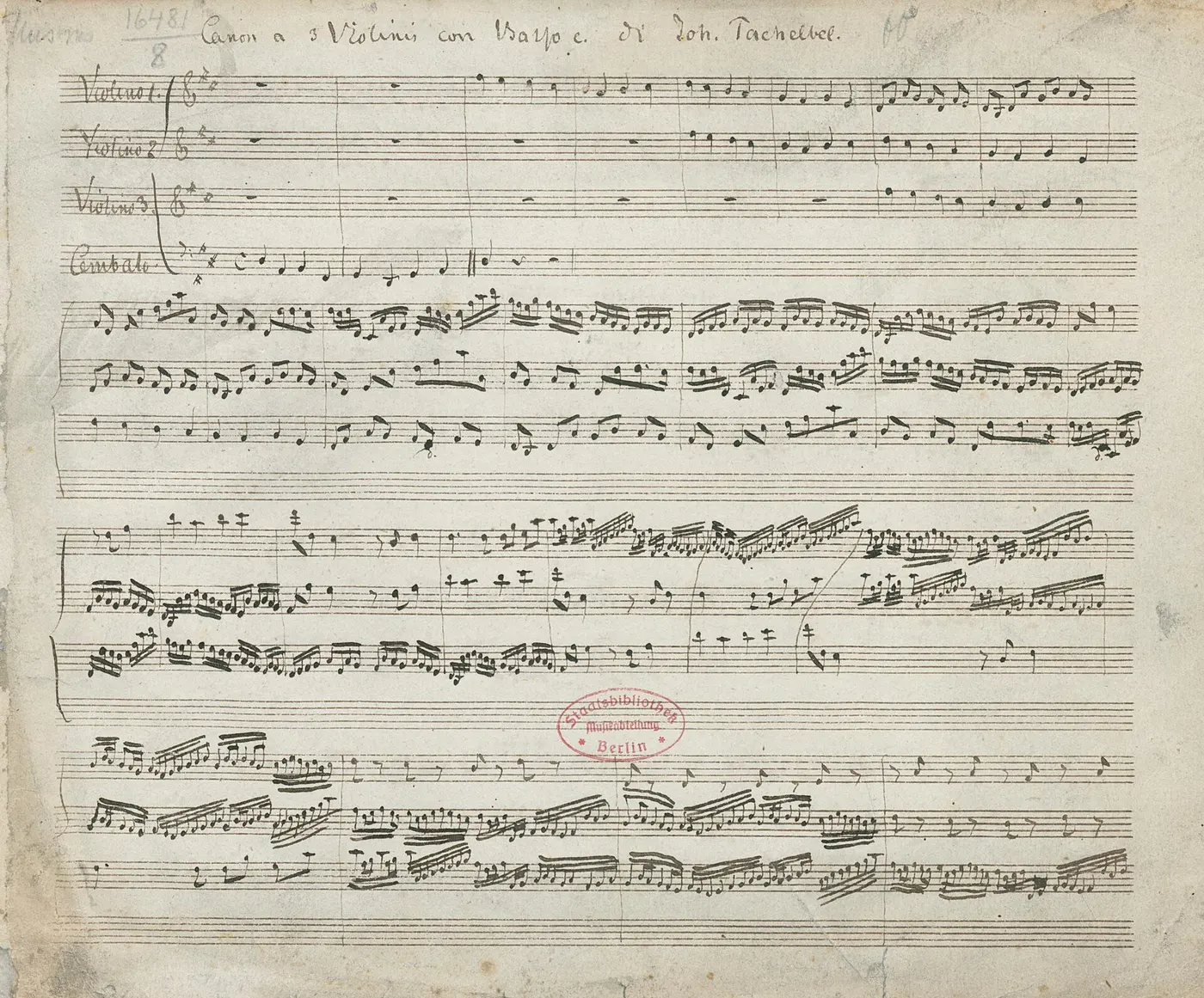

The Canon finally appeared in print in 1919, when the musicologist Gustav Beckmann included the score in a scholarly article about Pachelbel’s chamber music. According to the critical edition by the German music publisher Henle, the companion gigue was not printed until a decade later, in 1929.
The slow Canon of 1968
A few recordings followed, but the piece remained something for specialists. What changed everything was a 1968 recording by the chamber orchestra of the French conductor Jean-François Paillard.
Released by the French label Erato, it was played far more slowly than before, with lush, Romantic feeling, and Paillard added melodic lines of his own that are not in the original. The sweet, unhurried Canon most people know today is essentially the one that recording made famous.
That same year, the Greek band Aphrodite’s Child turned the Canon into the single “Rain and Tears,” a hit across Europe. In the United States, the story goes that when a San Francisco classical radio station played the Paillard recording in the early 1970s, it was swamped with requests. Then in 1980, Robert Redford’s film Ordinary People used the Paillard version prominently, and the piece’s fame was sealed.

Chords that live on in pop
“Canon” is the name of a musical form: one voice plays a melody and others follow with the same tune a little later, like a round. In Pachelbel’s piece, the three violins play the same line, each entering two bars after the last. Underneath, the bass repeats a short pattern of eight notes from beginning to end.
The chords built on that bass line are easy to remember and faintly nostalgic, and pop songwriters have leaned on them for decades. Classic FM points out that the chords of Oasis’s “Don’t Look Back in Anger” follow the Canon almost exactly, apart from the final chord. Maroon 5’s “Memories” (2019) goes further, borrowing not only the harmony but the opening of the violin melody for its vocal line. The skeleton of a piece written more than 300 years ago, and forgotten for more than 200 of them, is still holding up hit songs.