Did a composer really die from conducting?
Yes. Jean-Baptiste Lully, court composer to Louis XIV, struck his own foot with the staff he used to beat time, and the wound killed him.
A conductor raises a slim baton, and the orchestra waits for the first beat. It is a familiar sight at any concert, but the baton has only been in wide use for about two hundred years.
Before that, conducting sometimes involved very different tools. And one composer died because of his. He was Jean-Baptiste Lully, who served the Sun King, Louis XIV of France, in the 17th century.
A favorite of the king
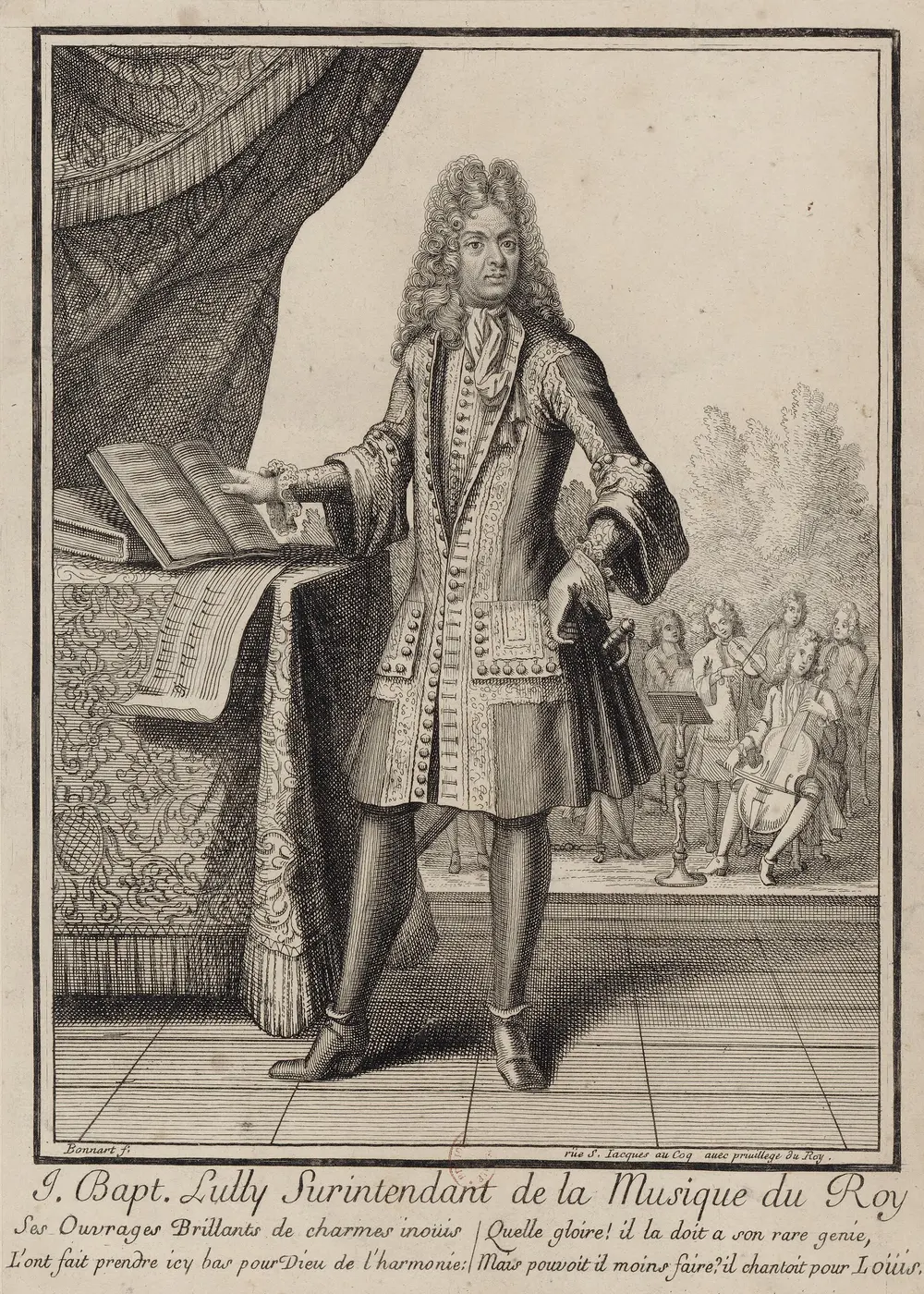
Lully was born in Florence, Italy, in 1632 as Giovanni Battista Lulli. In 1646, still a boy, he was taken to Paris as a page to a young noblewoman, a cousin of the king, and he soon made his mark at court. Early in 1653 he danced alongside the teenage Louis XIV in a court ballet, and shortly afterward he was appointed the king’s composer of instrumental music.
In 1661 he became a French citizen and was named superintendent of the king’s music. In 1672 he obtained the sole right to stage opera in France, a monopoly that let him block other composers’ stage works.

A hymn for the king’s recovery
On November 18, 1686, Louis XIV underwent surgery for an anal fistula, performed in his own bedchamber by his chief surgeon, Charles-François Félix. It was a major operation in an age without anesthesia, but the king recovered.
To celebrate, Lully performed his own Te Deum on January 8, 1687. The Te Deum is a Latin hymn of praise to God, and Lully had originally written his setting in 1677 for the baptism of his eldest son, with the king himself as godfather. Scored for a large ensemble including trumpets and timpani, it became the most performed sacred work of its day, heard at royal weddings, military victories and royal recoveries. Lully is said to have conducted it about ten times.
According to Baker’s Biographical Dictionary of Musicians, a standard American reference, Lully was keeping time that day with a pointed staff, pounding it on the floor. Carried away by the music, he struck his own foot with it.
A small wound turns deadly
Gangrene set in. Lully is said to have refused amputation. On March 22, 1687, a little over two months after the accident, he died of blood poisoning at the age of 54.
The details vary from source to source. A program note from the Palace of Versailles says he pierced his foot with the tip of his staff while beating time during the performance itself, at the church of the Feuillants monastery in Paris; other accounts place the accident at a rehearsal. Some say it was his toe that was hurt. Either way, it seems clear that the tool he used to keep time ended up costing him his life.
Before the baton
In Lully’s day there was no single way to lead an ensemble. Usually the leader was the keyboard player or the principal violinist, who directed with gestures of the arms and body, or with the bow, while still playing. Sometimes the beat was marked with a staff or pole, or with a rolled-up sheet of paper. Something like an early baton was tried at the Paris Opera as far back as the 17th century, but it remained an isolated case.
The slim baton came into wide use only around 1820. The German composer and violinist Louis Spohr wrote in his autobiography that he used a baton at a Philharmonic Society concert in London in 1820, which is thought to be the first time one was used in England. Later composers such as Felix Mendelssohn and Hector Berlioz led orchestras baton in hand. By the late 19th century, a typical baton was a light stick of maple about 53 to 56 centimeters (21 to 22 inches) long, a far cry from the staff that cost Lully his life.