Where does the Japanese word “kawaii” come from?
From an old word meaning “face-dazzling,” which first meant “embarrassed.” It then came to mean “pitiful,” and only later “lovable” and “cute.”
A baby, a puppy, a tiny keychain: in Japan, almost anything small and charming gets a “kawaii!” It is a word people use many times a day, and one that has traveled around the world.
Trace it back, though, and it turns out to have started somewhere unexpected. The earliest kawaii had nothing to do with cuteness. It meant “embarrassed.”
A face too bright to look at
According to the Nihon Kokugo Daijiten, Japan’s largest dictionary, the modern kawaii developed from the classical word kawayushi, which in turn is thought to come from kawahayushi. Written in characters, that means “face-dazzling,” combining kao, “face,” with hayushi, the same element found in mabayui, “dazzling.”
That element survives in another modern word, omohayui, meaning “embarrassed” or “bashful.” The dictionary explains its original sense as finding it dazzling to meet someone face to face. Think of the feeling of your cheeks burning when everyone is looking at you.
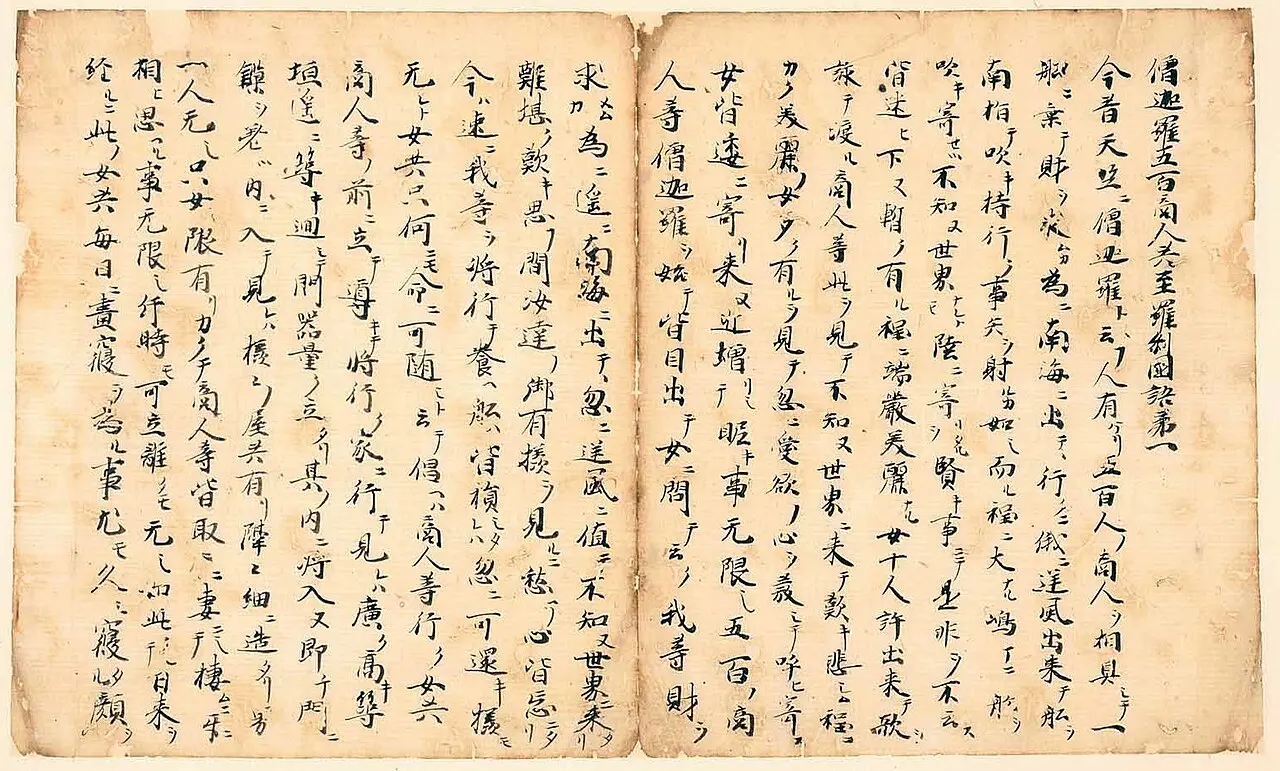
Early examples of kawayushi appear in the Konjaku Monogatarishū, a vast collection of more than a thousand tales from India, China and Japan, compiled around 1120, toward the end of the Heian period (794–1185). The same collection also uses the fuller form kawahayushi. Both mean feeling ashamed or having a guilty conscience, and the “face-dazzling” etymology was worked out from these two forms and the way they are used.

Too painful to watch
From the sense of being too embarrassed to look came a new meaning: too painful to look at, and so “pitiful” or “pathetic.” According to the Nihon Kokugo Daijiten, most medieval examples carry this meaning.
One appears in Essays in Idleness, written around 1330 by the monk Kenkō. Listing the evils of drink, he describes an old monk in his robes, clinging to the shoulder of a young boy and staggering along while mumbling nonsense, and calls the sight “ito kawayushi”: utterly pitiful.
Lovable takes over
In the later Middle Ages, pity for the weak and helpless gave rise to affection. A text from 1563 observes that the love of a parent for its young is the same in deer and in humans, using a form of kawayushi for that tender feeling. By the Edo period (1603–1868), “lovable” had become the main meaning.
Meanwhile the form shifted from kawayui to kawaii. The usual written form, 可愛い, borrows two Chinese characters meaning “can be loved,” but it is what Japanese call ateji: characters chosen to fit a word that already existed. By the late Edo period, the “pitiful” sense had disappeared, and kawaii was also being used for things that are pleasingly small. The haiku poet Kobayashi Issa, writing in the early 19th century, used it for young bamboo shoots coming up while butterflies flitted about. The sense of “pitiful” lives on in a related word, kawaisō, which still means “poor thing.”
Kawaii around the world
The word is still growing. The Japanese dictionary Digital Daijisen notes that people now call all sorts of things kawaii, not just children and small objects but also elderly men, buildings and cars, whenever they feel a sense of fondness.
It has crossed the sea as well. According to Dictionary.com, the modern kawaii aesthetic took shape in Japan in the 1970s and 1980s, when students adopted a rounded, cartoonish style of handwriting and companies such as Sanrio, the maker of Hello Kitty, began selling stationery and lunch boxes decorated with cute characters. It began to attract Western attention in the 1980s, and English speakers were using kawaii online as early as 1989. Today both the Oxford Advanced Learner’s Dictionary and the Cambridge Dictionary list kawaii. Both treat it as a noun, and Cambridge defines it as “the Japanese culture or style of cuteness, often involving simple drawings of small people, animals, and things.” In English, kawaii is less an adjective than the name of a whole aesthetic.