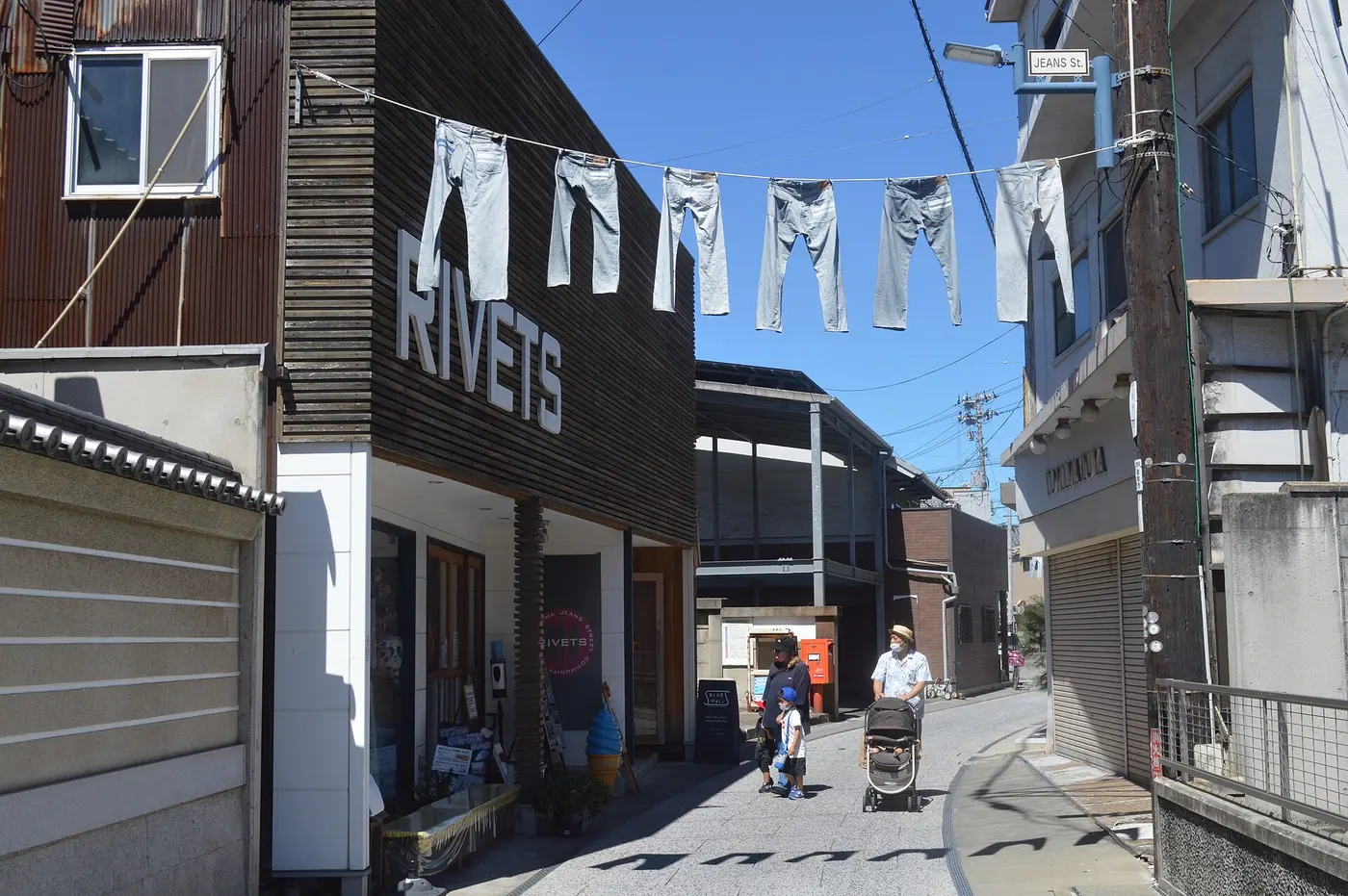
Is the word “jeans” named after a city?
Yes. It is said to come from “Gênes,” the French name for the Italian port city of Genoa.
1873
They work as workwear and as everyday clothes, and they only get better the more you wear them. There may be no garment loved by more people around the world than jeans. Whatever the age or nationality, walk down any street and someone will be wearing a pair.
They are about as familiar as clothing gets, but have you ever wondered what the word “jeans” actually means? It is said that the word originally named not a piece of clothing, but a city.
A name from an Italian port
That city is Genoa, a port in northwestern Italy. Genoa had prospered on Mediterranean trade since the Middle Ages, and by around the 16th century, a sturdy cotton fabric was being exported from there to all corners of Europe. There is even a story that Genoese sailors wore trousers made of this fabric, which was easy to deal with whether wet or dry.
In French, Genoa is called Gênes. When the fabric reached England, the place name was corrupted into “jean.” Eventually trousers made from the fabric came to be called by the plural, “jeans,” or so the usual account goes.

“Denim” comes from a French town
“Denim,” the name of the fabric jeans are made of, also hides a place name: Nîmes, a town in southern France. Nîmes produced a strong twill fabric known as serge de Nîmes, “serge from Nîmes.” The accepted explanation is that “de Nîmes” was shortened to become the English word “denim.”
That said, researchers disagree about whether the fabric made in Nîmes back then was the same as today’s denim. Perhaps it is most natural to think that only the name was handed down, while the cloth itself changed over time. Either way, the name of the trousers carries an Italian city, and the name of the fabric carries a French one.
Work pants born in gold country
Jeans as we know them were born in the American West in the 19th century. In a region swept up in the Gold Rush, people working in mines and on ranches needed work clothes that were, above all, tough.
Jacob Davis, a tailor in Nevada, was looking for a fix for a nagging problem: pocket corners that kept tearing. He hit on the idea of fastening the seams with copper rivets. Teaming up with Levi Strauss, the San Francisco merchant who supplied his fabric, he applied for a patent, which was granted on May 20, 1873. This is regarded as the starting point of the jeans we wear today.
At the time, however, these trousers were called “waist overalls.” The name “jeans” did not come into wide use until the mid-20th century, when movie stars and young people began wearing them as fashion. Levi’s itself is said to have started calling them “jeans” only around 1960. It was when workwear turned into fashion that the name of a European city finally took center stage.
Japan’s “jīpan”
Jeans became widely known in Japan after World War II. They caught on because American soldiers stationed in the country wore them, and because surplus pairs found their way onto the market.
In Japan, jeans are also called jīpan (ジーパン). The word was coined in Japan, and there are two theories about its origin. One says it is a contraction of jīnzu no pantsu, “jeans pants”; the other says it comes from “GI pants,” the trousers worn by GIs, as American soldiers were known. Since trousers made of chino cloth are similarly called chinopan (チノパン), the first theory seems to have the edge, but no one knows for sure.
In the 1960s, Japan began producing its own jeans. Kojima, a district of Kurashiki in Okayama Prefecture, drew on sewing skills honed making school uniforms and other garments, and became known as a major center of Japanese denim.