Where did Japanese hiragana and katakana come from?
Both came from Chinese characters: hiragana by simplifying whole kanji, katakana by taking just one part.
“A” written as あ and as ア; “ka” written as か and as カ. When people write Japanese, they use kanji—characters borrowed from Chinese—plus two more sets of symbols that represent exactly the same sounds, switching between them as needed. Among the world’s languages, it is said to be rare for one to mix so many kinds of script in ordinary writing.
So where did hiragana (ひらがな) and katakana (カタカナ) come from? The short answer is that both are children of kanji. But they were born in very different places, and raised by very different parents.
The puzzle of writing Japanese in Chinese characters
Japan originally had no writing system of its own for recording its language. Then kanji arrived from China. But kanji had been developed to write Chinese, and they were poorly suited to capturing the little grammatical particles of Japanese, or the sounds of Japanese names for things, just as they were spoken.
The solution people came up with was to ignore a character’s meaning and borrow only its sound. In a poem recorded in the eighth-century chronicle Kojiki (古事記), for example, the phrase yakumo tatsu (“eightfold clouds rise”) is written 夜久毛多都, using characters purely for their pronunciation. Kanji used this way are called man’yōgana (万葉仮名), because they appear so often in the Man’yōshū (万葉集), Japan’s oldest anthology of poetry. The word kana (仮名) means “provisional characters,” as opposed to mana (真名), the “true characters”—the kanji regarded as the proper script.
Man’yōgana had a drawback, though. Writing even a single syllable meant drawing a kanji with many strokes, which was slow and laborious. People wanted to write faster and more easily, and that wish gave birth to new scripts.
Hiragana: born by simplifying
Hiragana emerged as people wrote man’yōgana quickly with a brush. They wrote the kanji in sōsho, a flowing cursive style, then simplified those shapes even further. That is how 安 became あ (a), 以 became い (i), 宇 became う (u), 衣 became え (e), and 於 became お (o).
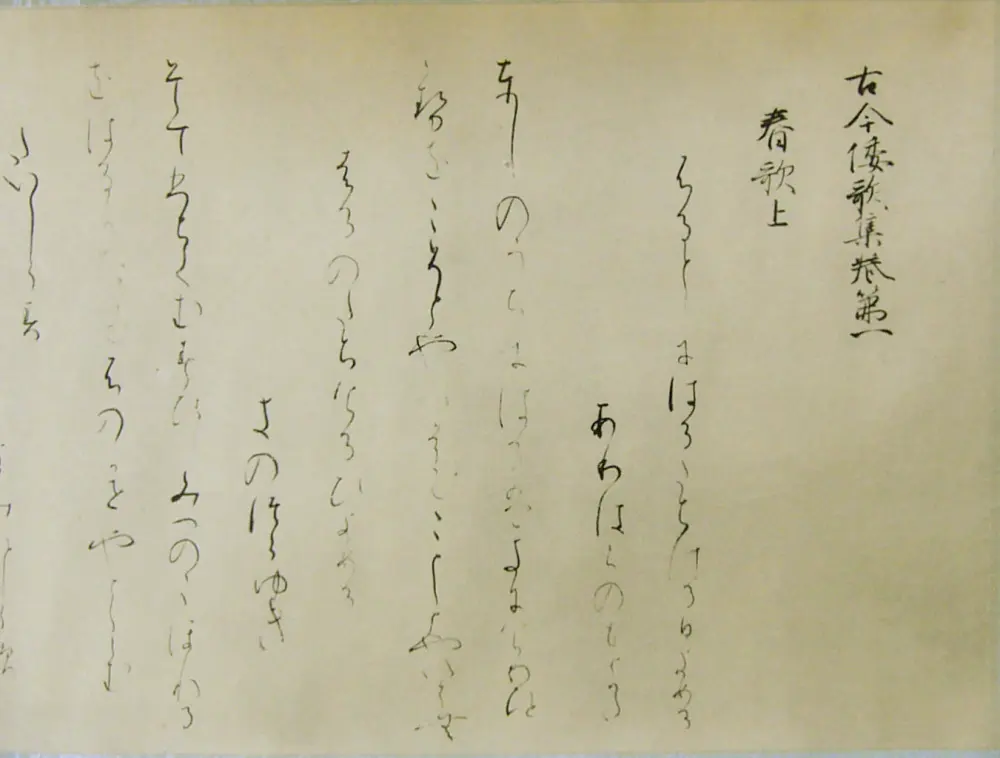

Hiragana is thought to have settled into a recognizable script around the ninth century. In 2012, pottery inscribed with hiragana from the late ninth century was discovered at the site of the residence of the aristocrat Fujiwara no Yoshimi, within the remains of the old capital Heian-kyō in Kyoto, and the find made headlines.
Because women at the imperial court used it so often for poems, letters, and tales, hiragana was also called onnade (女手), “the women’s hand.” In the early tenth century, the Kokin Wakashū, the first anthology of poetry compiled by imperial command, was assembled, and one of its compilers, Ki no Tsurayuki, wrote a preface to it in hiragana. It was in this same era that Tsurayuki wrote the Tosa Diary (土佐日記) in hiragana while posing as a woman. Men, of course, used hiragana too; it was indispensable for exchanging poems.
Katakana: born in the margins
Katakana, on the other hand, was born inside Buddhist temples. Around the beginning of the ninth century, monks at temples in Nara were studying Buddhist scriptures written in classical Chinese, which had come over from China. To read them as Japanese, they wrote small notes on pronunciation and grammatical endings in the narrow spaces between the lines.
For these notes they used abbreviated characters made by taking just one part of a kanji. The left side of 阿 became ア (a), the left side of 伊 became イ (i), the top of 宇 became ウ (u), and the right side of 江 became エ (e). The kata (片) in katakana means, in this case, “incomplete” or “partial.” The symbols could be jotted down quickly in tight spaces and were easy to tell apart from the kanji of the main text. As a shorthand for notes, nothing could have been handier.
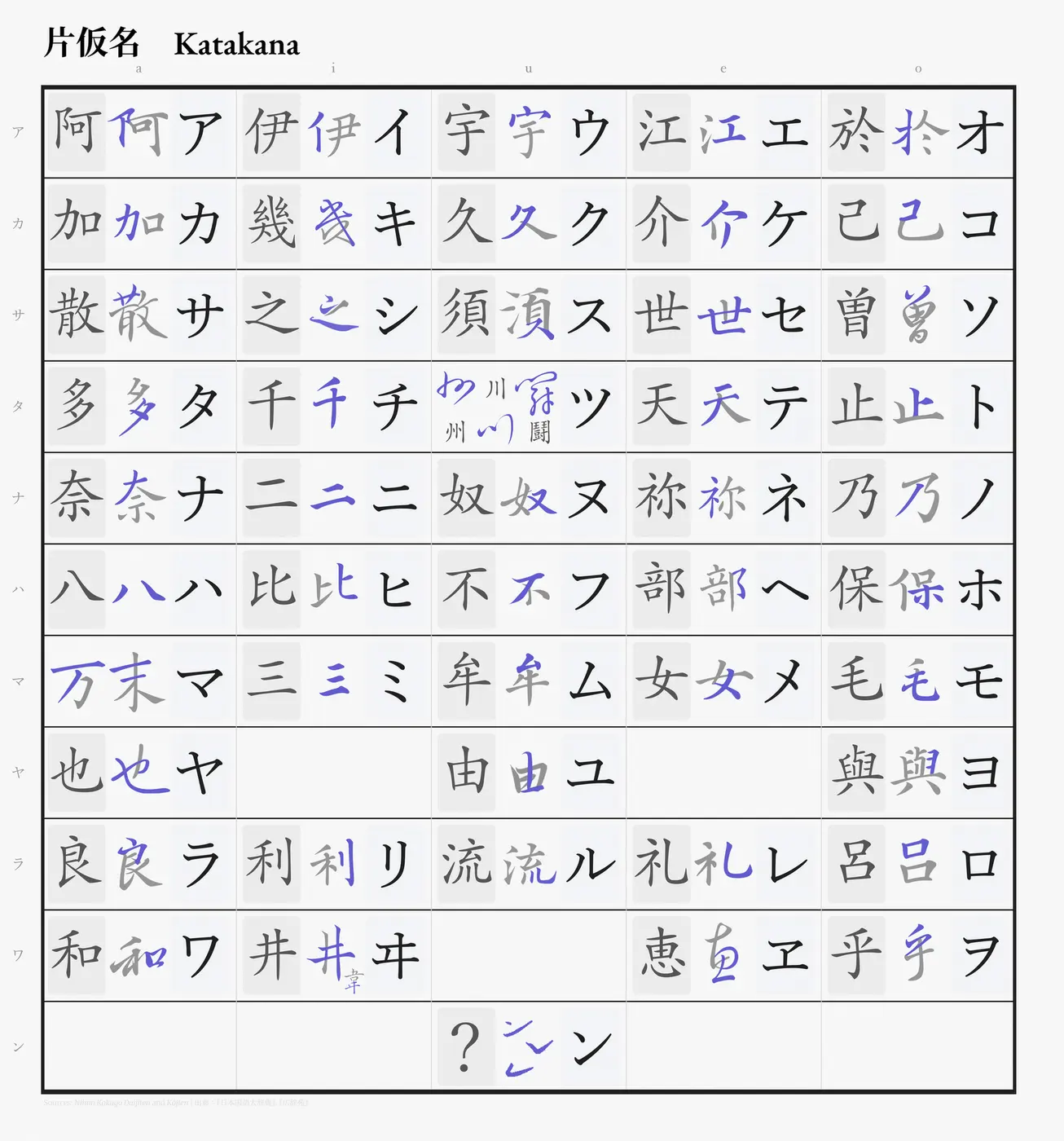

Born in the world of scholarship, katakana came to be used in a style of writing that mixed kanji and katakana. It took on Buddhist texts and scholarly works and, later, formal documents such as laws.
One sound, one character
In the past, there were several different kana for each sound. To write “ka,” for instance, people used not only a cursive form of 加 but also cursive forms of 可 and 閑. Kana like these, which have since fallen out of use, are called hentaigana (変体仮名), or “variant kana.”
It was only in 1900, the 33rd year of the Meiji era, that kana were tidied into today’s system of one character per sound. The government fixed the kana forms to be taught in elementary schools, and the others gradually disappeared from everyday life. For more than a thousand years, kana had been written freely; their standardization for the sake of education is a surprisingly recent event.