Is Rembrandt’s “Night Watch” really set at night?
No. It shows a militia company setting out in daylight. Because the picture looked so dark, it came to be called “The Night Watch” toward the end of the 18th century.
3.8m
The most famous painting in the Rijksmuseum in Amsterdam is surely Rembrandt van Rijn’s Night Watch. On a canvas about 3.8 meters (12½ feet) high and more than 4 meters (13 feet) wide, a crowd of men armed with pikes and muskets surges out of the shadows toward us.
Its familiar name comes from the Dutch nickname De Nachtwacht. But Rembrandt did not give the painting that title. And the scene it shows does not take place at night.
A militia group portrait
The Night Watch was finished in 1642. It was commissioned by members of one of Amsterdam’s civic guard companies, the arquebusiers. The civic guards were citizen militias that defended the city and helped keep order. The painting was made for the new great hall of the arquebusiers’ headquarters, the Kloveniersdoelen, where it hung alongside similar group portraits by other artists.
In other words, this is a group portrait of the guardsmen who paid for it. The Rijksmuseum catalog gives its full title as Officers and Other Civic Guardsmen of District II in Amsterdam, under the Command of Captain Frans Banninck Cocq and Lieutenant Willem van Ruytenburch. A record from 1653 describes it simply as Captain Frans Banninck Cocq and Lieutenant van Ruytenburch, painted by Rembrandt in 1642. A shield in the background lists the names of 18 of the men portrayed.
Group portraits of the time usually showed their subjects lined up politely. Rembrandt instead captured a moment of action: the captain, dressed in black, is telling his lieutenant to start the company marching, and the guardsmen are getting into formation. According to the Rijksmuseum, Rembrandt was the first to paint the figures in a group portrait actually doing something.
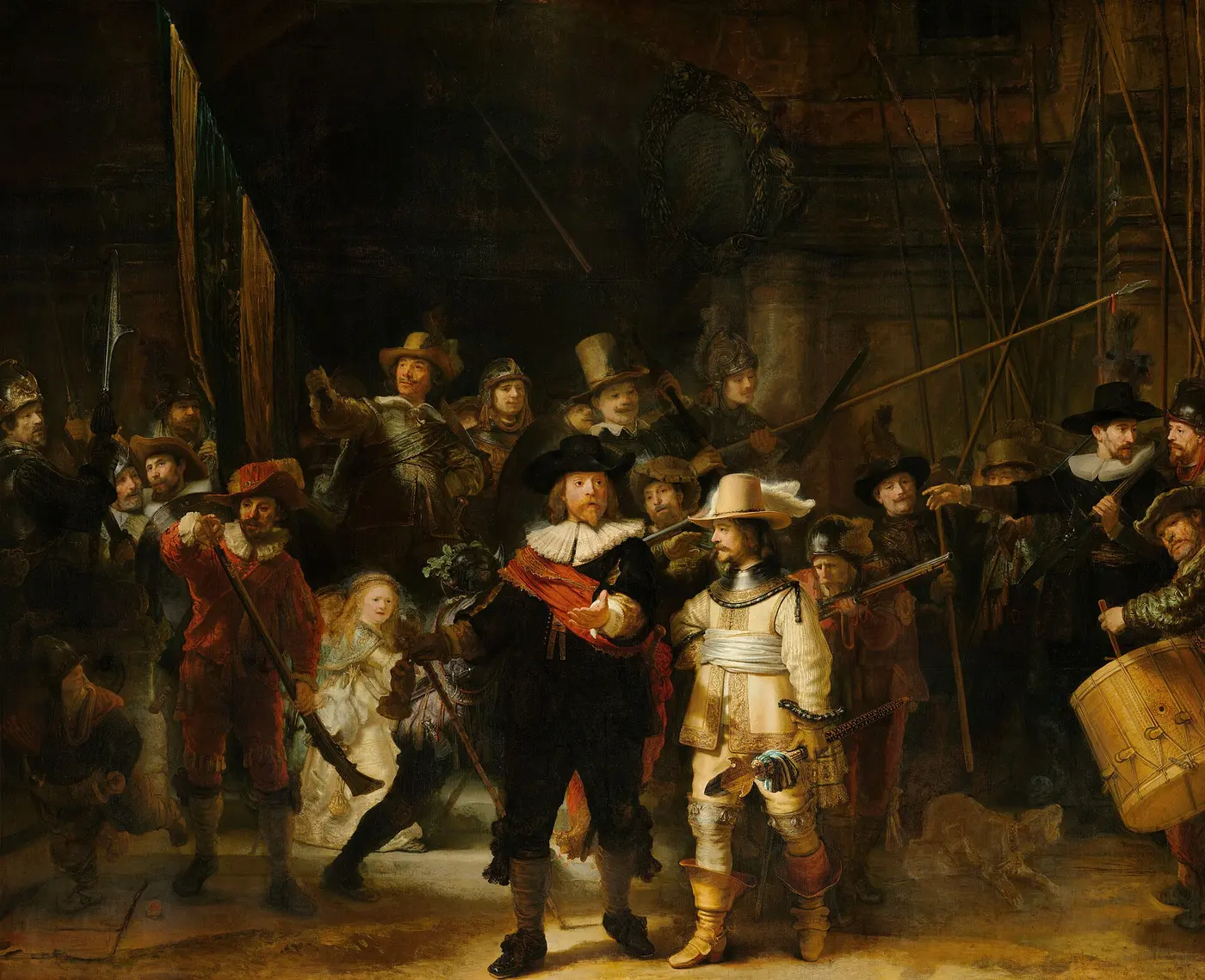

How it became a night scene
According to the Rijksmuseum, the painting has been known as The Night Watch only since the end of the 18th century, some 150 years after it was painted.
The museum explains that despite its dark tones, the scene is a daylight march, and that this misreading gave the painting its nickname. Oil paintings are coated with varnish, which deepens the colors and protects the paint, but varnish yellows and dulls over time. Years under a darkened varnish are said to have strengthened the impression that this was a night scene.
Rembrandt was, of course, a master of light and shadow. Here he uses light to steer the viewer’s eye, picking out details such as the captain’s gesturing hand and a young girl in the background. Dressed in gold, she was the company’s mascot, and she carries a chicken at her waist.
Cut down on all four sides
Darkening was not the only thing to happen to the painting. In 1715 it was moved to Amsterdam’s city hall, now the Royal Palace on Dam Square. It was too large for its new home, so strips were cut from all four sides, the biggest from the left. The missing pieces have never been found.
We know what the painting originally looked like thanks to a much smaller 17th-century copy, attributed to Gerrit Lundens. It shows that on the far left there were three more figures on a bridge: two guardsmen and a child.
In June 2021, the Rijksmuseum used artificial intelligence to recreate the missing sections from the copy, and mounted them around the original. The reconstruction showed that the captain and lieutenant, who now seem to stand at the center, were originally a little to the right, which makes the whole composition even more dynamic.
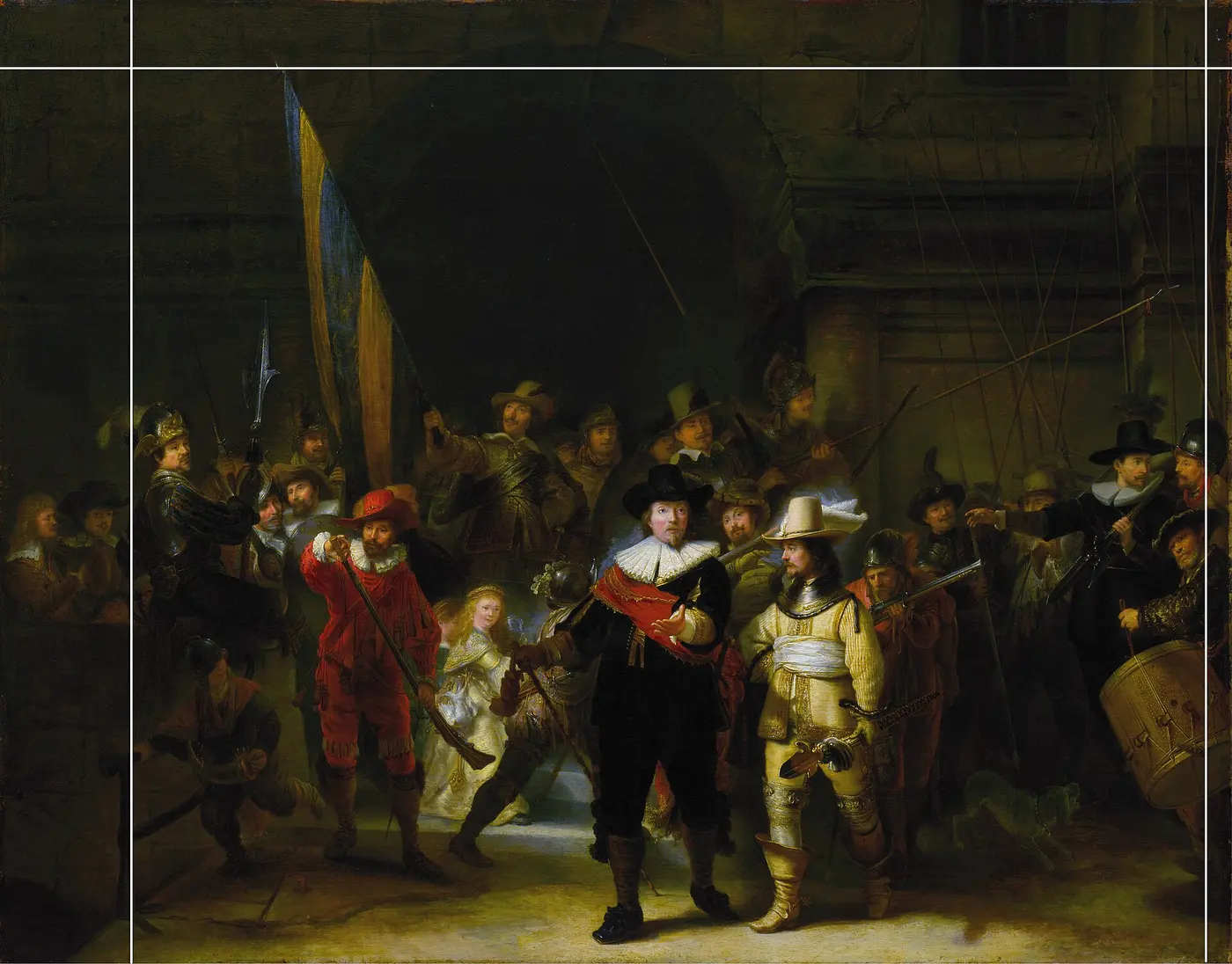

Restoration behind glass
In July 2019 the Rijksmuseum launched Operation Night Watch, the biggest research and restoration project in the painting’s history. The work takes place inside a glass chamber in the gallery, so visitors can watch it up close.
The research has turned up one discovery after another. In 2021, scans revealed a sketch Rembrandt made on the canvas before he began painting. In 2023, researchers found that Rembrandt had impregnated the canvas with a lead-containing layer before applying the ground, apparently because he knew the painting would hang on a damp outer wall. And in November 2024, conservators finally began removing the old varnish.