Who was the model for Girl with a Pearl Earring?
No one knows. The painting is thought to be a “tronie,” not a portrait of a particular person.
2guilders
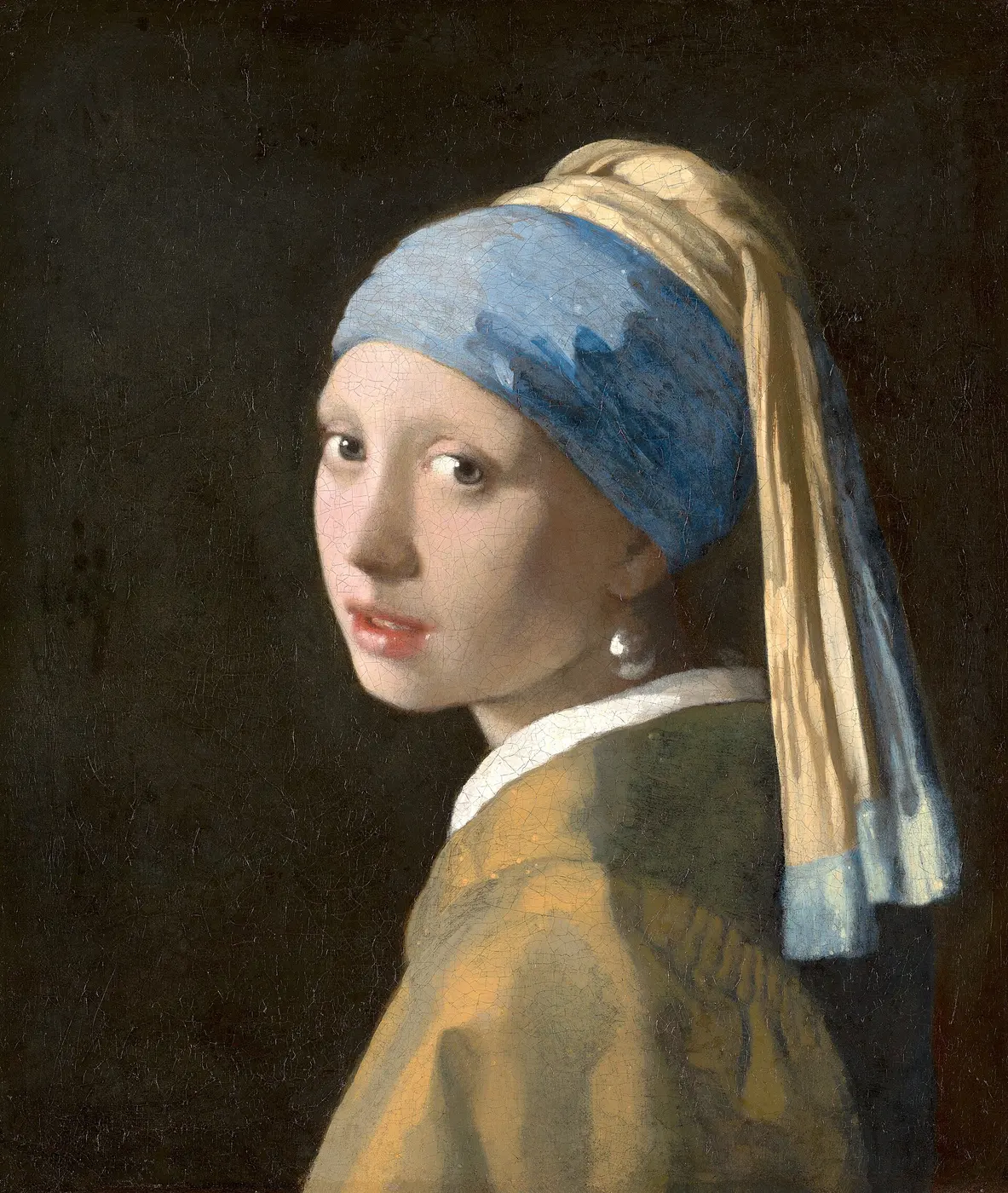
A girl in a blue and yellow turban turns to look back over her shoulder. Her lips are slightly parted, and a large pearl gleams at her ear. Girl with a Pearl Earring, painted around 1665 by the Dutch artist Johannes Vermeer, is a masterpiece sometimes called “the Mona Lisa of the North.”
For all its fame, no one knows who the girl was. And the more you look into it, the more it seems that the painting was never meant to depict any particular person at all.
Not a portrait but a “tronie”
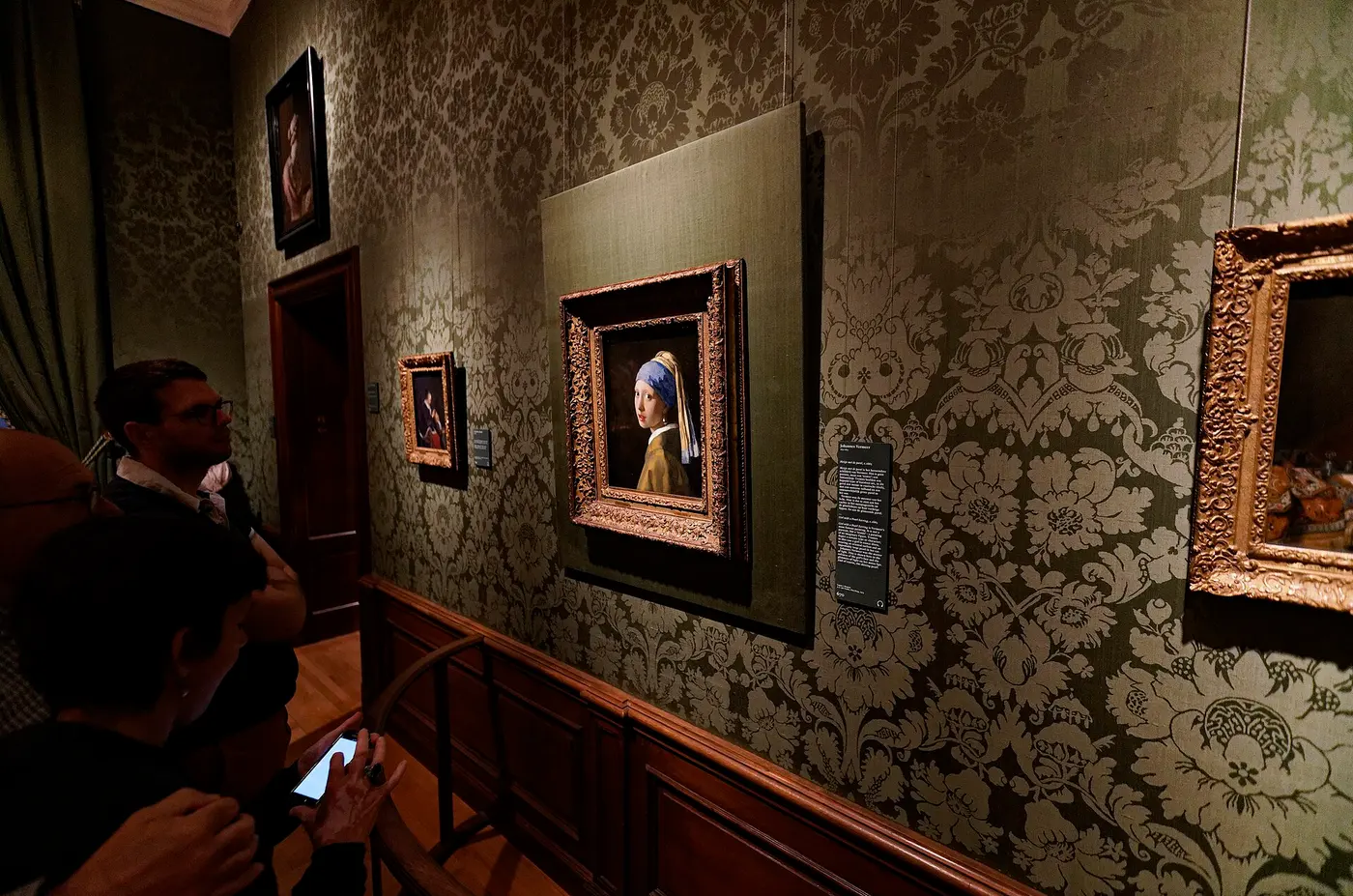
The painting belongs to the Mauritshuis museum in The Hague, in the Netherlands. It is surprisingly small for such a famous oil painting: 44.5 centimeters tall and 39 centimeters wide (about 17.5 by 15.4 inches).
Art historians classify it as a “tronie,” a type of work painted in the 17th-century Netherlands that takes a “face” as its subject. Unlike a portrait, which records what a specific person looked like, a tronie did not have to resemble its sitter. Its real subject was a captivating face: exotic costume, a striking expression.
The girl’s turban, too, was a kind of exotic dress that fascinated Europeans at the time. An inventory of Vermeer’s possessions drawn up after his death lists “two tronies painted in the Turkish fashion,” and it has been suggested that this painting may be one of them.

Candidates, but no proof
Even so, people have never stopped wondering who the model was. Names often put forward include Vermeer’s eldest daughter, Maria, and Magdalena van Ruijven, daughter of Vermeer’s most important patron. But there is no conclusive evidence for either.
In 1999 the American writer Tracy Chevalier published a novel imagining that a young servant in the Vermeer household had been the model, and in 2003 it was made into a film. It is, however, fiction.
A pearl with no outline and no hook
From February to March 2018, the Mauritshuis carried out a research project called “The Girl in the Spotlight.” The painting was taken out of its frame and placed in a specially built glass-walled studio, where, as visitors looked on, an international team spent two weeks examining it with microscopes, X-rays and other tools. The results were announced in 2020.
One of the findings concerned the earring. The pearl is made of just a few touches of translucent and opaque white paint. It has no outline, and there is no hook painted to hang it from her ear. The pearl we see is, in effect, an optical illusion created by brushstrokes of light and shadow.
Even earlier, in 2014, the Dutch astrophysicist Vincent Icke had pointed out that the earring is too big to be a pearl, and that its shape and the way it reflects light make it look more like polished tin. Was it a real pearl, an imitation made of glass or metal, or an earring that never existed at all? The answer is not in the painting.

The research also revealed fine eyelashes, invisible to the naked eye, and showed that the background, which looks pitch black, originally depicted a green curtain. The green paint is thought to have changed over the long years until it appeared black. Among the pigments was ultramarine, a costly blue made from lapis lazuli from Afghanistan.
Yet the one thing the research could not reveal was the girl’s identity. The museum’s director said, in effect, that the girl had not yet given up the secret of who she was, but that they had come to know her a little better. Perhaps it is precisely because she has no name that every viewer is tempted to give her a story of their own.