Did a falling apple really give Newton the idea of gravity?
Newton himself said so late in life, and the conversation was written down. But none of the early accounts says the apple hit him on the head.
About 60years
Isaac Newton is sitting under a tree, lost in thought, when an apple drops onto his head. In that instant, the law of universal gravitation comes to him. It is a scene familiar from cartoons and picture books.
The story is so neat that many people assume it was made up long after the fact. In fact, it has a clear source, and the person who told it was Newton himself.
A memory shared over tea
On April 15, 1726, the physician and antiquarian William Stukeley visited Newton at his lodgings in Kensington, then on the western edge of London, and spent the whole day with him alone. Stukeley, like Newton, came from Lincolnshire in eastern England, and the two were friends.
According to a memoir Stukeley completed in manuscript in 1752, after dinner the weather was warm, so the two went out into the garden and drank tea in the shade of some apple trees. In the course of the conversation, Newton said that he had been in just the same situation when the notion of gravitation first came into his mind. As he sat “in a contemplative mood,” an apple fell. “Why should that apple always descend perpendicularly to the ground,” he thought to himself. “Why should it not go sideways, or upwards? but constantly to the earth’s centre? assuredly, the reason is, that the earth draws it.”
Newton was 83 at the time, and he died the following March. Stukeley’s manuscript belongs to the Royal Society in London, which put it online for anyone to read in 2010.

A force that reaches the Moon
So when did the apple fall? John Conduitt, the husband of Newton’s niece and a close companion in his last years, wrote down the same story. In Conduitt’s draft, it happened when Newton had left Cambridge because of the plague and gone home to his mother in Lincolnshire, which is usually dated to 1665–66.
The key part of Conduitt’s account comes next. Musing in the garden, Newton wondered whether the power of gravity that made an apple fall to the ground might not stop near the Earth’s surface but extend much farther. “Why not as high as the Moon said he to himself & if so that must influence her motion & perhaps retain her in her orbit.”
Everyone already knew that things fall. Newton’s insight was that the force pulling the apple down and the force keeping the Moon in orbit around the Earth might be one and the same. His first calculation did not quite work, because he used an old, inaccurate figure for the size of the Earth. The Principia, the book that set out his law of universal gravitation, came out only in 1687, some 20 years later.
Voltaire spreads the word
The person who did most to popularize the story was the French writer Voltaire. While staying in England, he published an essay in English in London in 1727, the year Newton died, which says that Newton, “walking in his gardens had the first thought of his system of gravitation, upon seeing an apple falling from a tree.” In his 1738 book on Newton’s philosophy, Voltaire added that he had heard the story from Newton’s niece, Mrs. Conduitt.
Neither Stukeley, nor Conduitt, nor Voltaire says that the apple hit Newton on the head. The bonk seems to be a later embellishment. Still, this was an old man’s recollection of something that had happened 60 years earlier, so we cannot be sure every detail was accurate.
The tree that survived, and its offspring
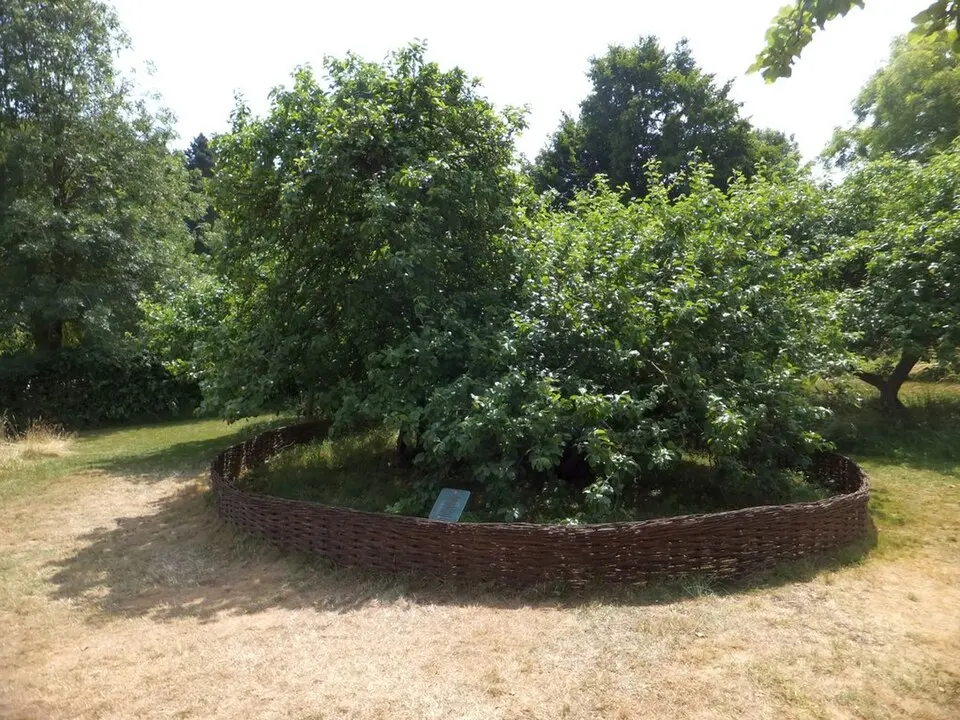
At Woolsthorpe Manor in Lincolnshire, the house where Newton was born, “Newton’s apple tree” still stands in the garden. According to a 1998 study by Richard Keesing, a physicist at the University of York, the tree blew down in a storm before 1816 but put down new roots from its fallen trunk and survived. Keesing concluded that the present tree is very likely the same one identified as Newton’s tree in the mid-18th century.
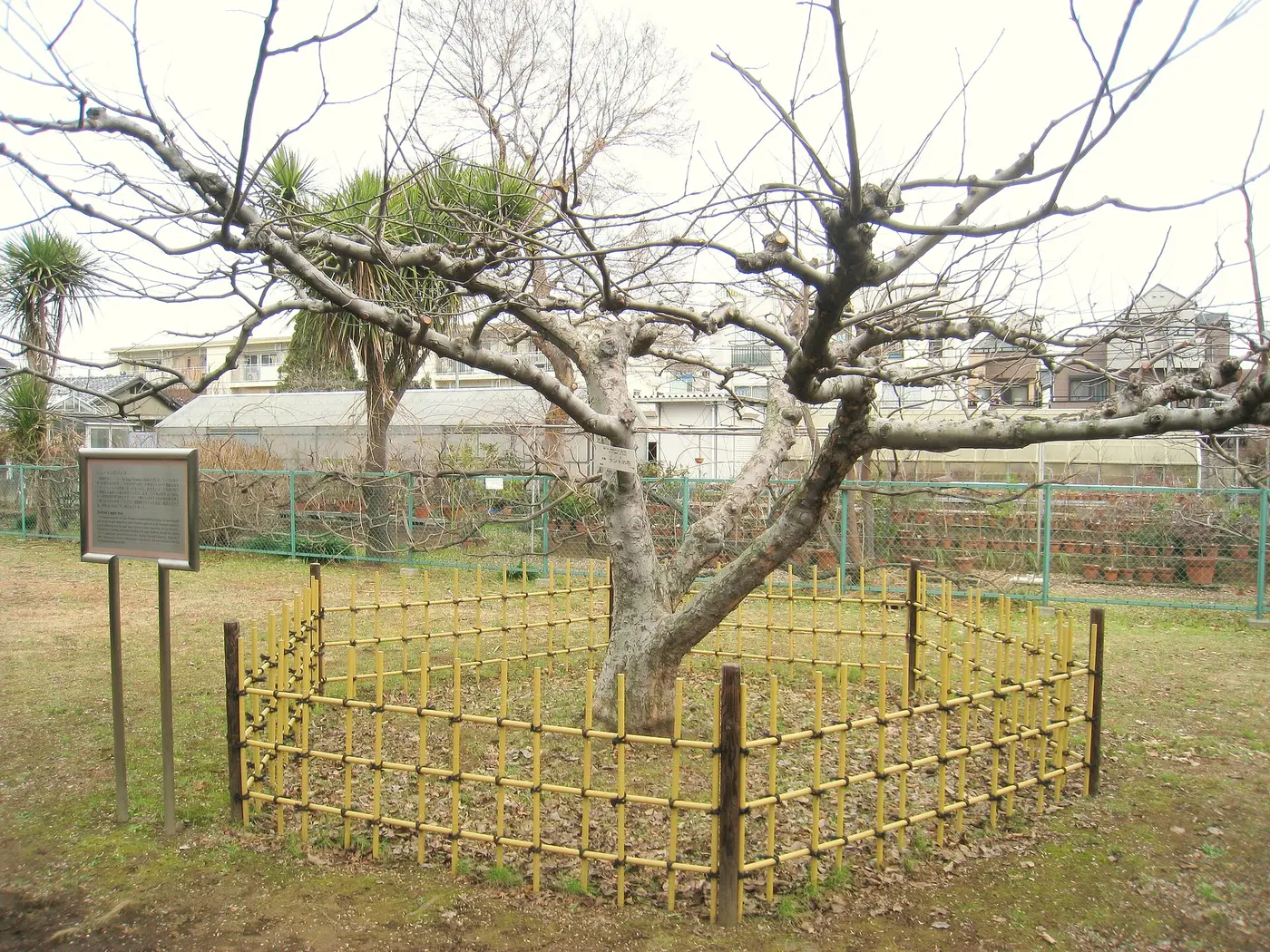
Grafts from the tree have spread around the world. According to the Nagoya City Science Museum, a branch reached Japan in 1964 to mark the 300th anniversary of the discovery of universal gravitation, sent by the director of Britain’s National Physical Laboratory to Yuji Shibata, president of the Japan Academy. It turned out to carry a virus, so the University of Tokyo’s Koishikawa Botanical Garden had to treat it to remove the infection, and the tree was finally planted out in 1981. Its descendants now grow at schools and science museums across Japan.