Why is Mars red?
Because the fine dust that blankets its surface contains iron oxide, which is essentially rust. The red is only skin-deep: drill into the rock and it is gray inside.
Mars shines with a reddish tint that sets it apart from the other lights in the night sky, which is why it is called the Red Planet. According to NASA, the ancient Romans named it after their god of war because its color reminded them of blood.
The short explanation for the color is rust. But when and how Mars rusted is another matter, and a new proposal published in 2025 has reopened the debate.
Rusty dust
NASA explains that Mars looks red because iron minerals in the Martian soil have oxidized, or rusted. It is essentially the same thing that happens to an iron nail left out in the rain.
That said, the surface isn’t fire-engine red. NASA describes the planet’s colors as “brown, gold, and tan,” and in spacecraft photos Mars looks closer to ochre or butterscotch than to true red.
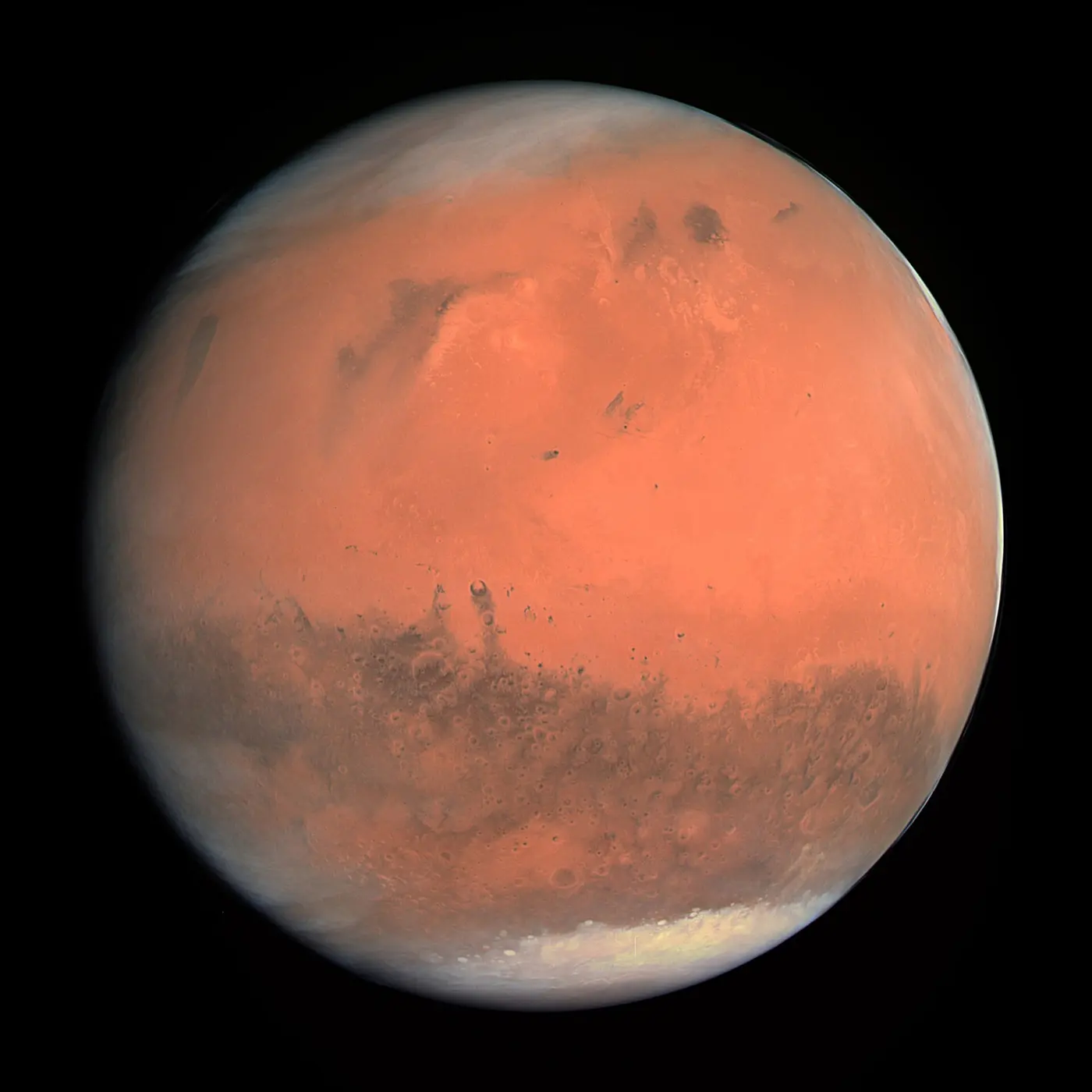

What gives Mars its color is the fine dust that coats the surface. According to the European Space Agency (ESA), the rusty material has been broken down into dust over billions of years and spread all over the planet by the wind, a process that continues today. Every so often, Mars is swept by dust storms that cover much of the planet. All that mixing seems to have left the dust with nearly the same composition everywhere.
When did Mars rust?
So what kind of iron oxide is in the dust? According to a paper published in Nature Communications in February 2025, early telescope observers suspected limonite, a rusty iron ore that contains water.
Later, the leading candidate became hematite, which contains no water. ESA explains that spacecraft found no sign of water in the dust’s iron oxide, so researchers concluded it must be hematite. In that picture, Mars rusted slowly, on a dry surface, long after its early wet period had ended.
The authors of the 2025 paper, a team from the University of Bern in Switzerland, Brown University in the United States and other institutions, challenged that view. They prepared a range of iron oxides and ground them to a realistic dust grain size, which ESA describes as about one hundredth the width of a human hair. Then they compared them with data from spacecraft orbiting Mars and rovers on the ground. The best match was a 1:2 mixture, by weight, of a water-bearing rust mineral called ferrihydrite and basalt, a volcanic rock.
Ferrihydrite forms when iron oxidizes quickly in cold water, and it turns into hematite in warm conditions. The team’s experiments showed that it can survive in today’s Martian environment. So Mars may have rusted not after it dried out, but during a cold, wet era when there was still water on the surface. The paper suggests such conditions may have existed around 3 billion years ago. The rust was later broken up and spread across the planet by wind and dust storms.
The case isn’t closed, though. As coauthor Jack Mustard of Brown University put it, the results can only be verified by samples from Mars, like those NASA’s Perseverance rover is collecting, analyzed in laboratories on Earth.
Gray underneath
One rover showed in plain view that the red goes no deeper than the surface. On February 8, 2013, NASA’s Curiosity rover drilled its first sample hole into a rock in Gale Crater nicknamed “John Klein.” The hole was about 1.6 cm (0.63 inch) wide and 6.4 cm (2.5 inches) deep.
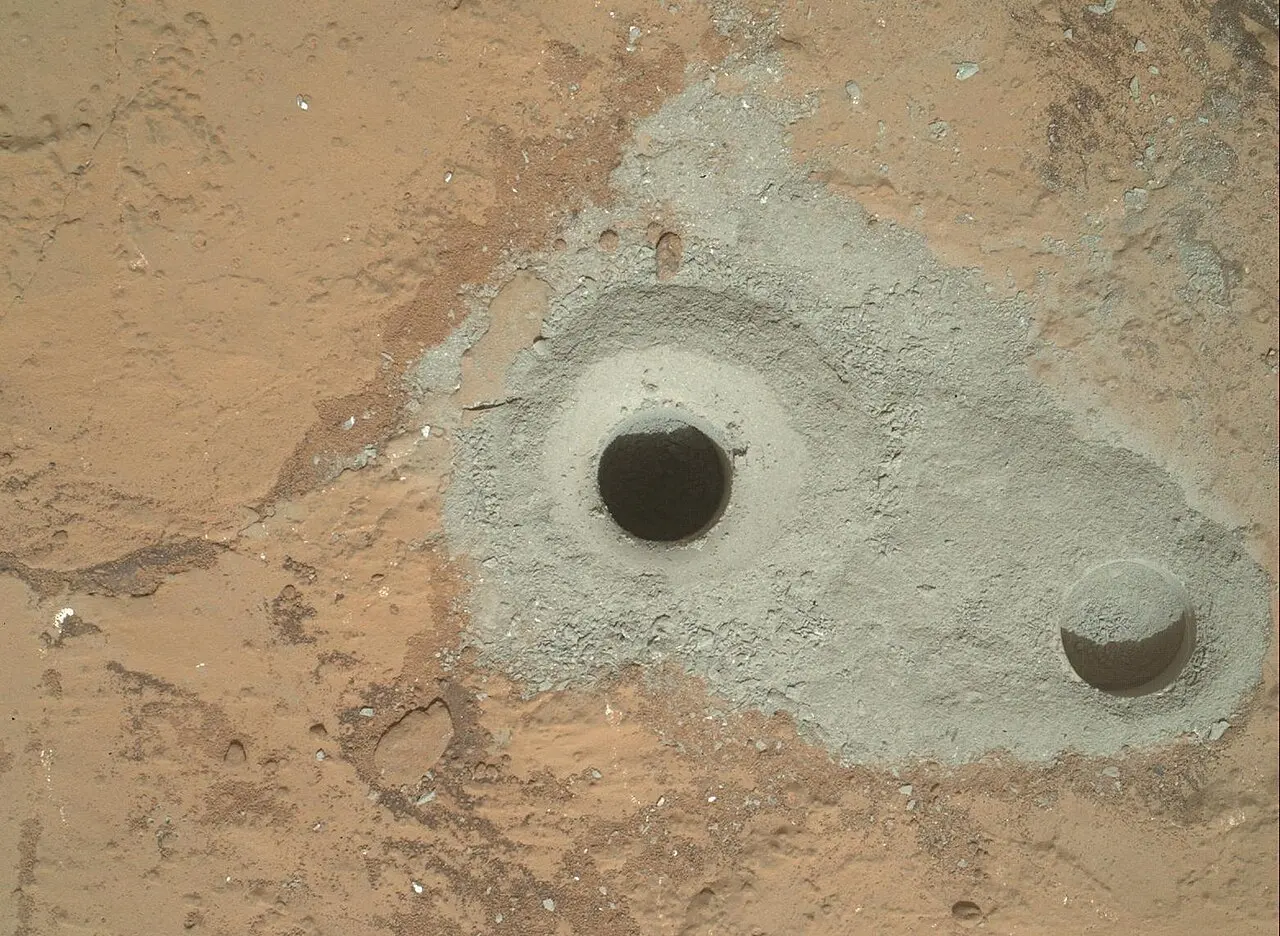

The powder that came up was gray, not red. According to NASA’s Jet Propulsion Laboratory, the gray cuttings were the first hint that the rock’s interior was less oxidized than its surface. Closer analysis found a mixture of oxidized, less-oxidized and even non-oxidized chemicals.
The red of the Red Planet, in other words, is less the color of the planet itself than a thin coat of rusty makeup.