Does your nose breathe through one nostril at a time?
For most people, yes. The lining on each side of the nose swells and shrinks in turn every few hours, narrowing one airway at a time.
You notice that one side of your nose is a little stuffy. You don’t have a cold, and a while later the other side is blocked instead, while the first one has cleared. Most people have had this experience without giving it much thought.
It’s a perfectly normal rhythm that plays out in many people’s noses every day. It is called the nasal cycle, and it is thought to occur in about 70 to 80 percent of healthy adults.
A rhythm first described in 1895
The nasal cycle was first described in 1895 by the German physician Richard Kayser. Inside the nose, the lining on the left and right sides takes turns swelling and shrinking. When one side becomes congested, the other opens up, so a “working” side and a “resting” side swap places over time.
How often they swap varies from person to person and from moment to moment, anywhere from about 30 minutes to 6 hours. In 2016, a team at the Weizmann Institute of Science in Israel recorded airflow through each nostril of 33 people for 24 hours. The cycle averaged about 2 hours while they were awake and about 4.5 hours while they slept. Few people follow the neat textbook pattern all day, though. Sometimes both sides swell together, or only one side changes, and most people show a mix of patterns.
Even so, hardly anyone notices. As one side narrows, the other widens, so the total airflow through the nose changes surprisingly little. In a 2026 survey of 120 adults at an ear, nose and throat clinic in India, only about 28 percent had heard of the nasal cycle. About half had felt their nostrils take turns being blocked, but most of them thought something was wrong.
A sponge inside your nose
What swells and shrinks is the lining of the nasal passages. Deep inside each nostril are the wall that divides left from right and a set of shelf-like ridges called turbinates that jut out from the outer wall. Beneath the lining lies a spongy tissue packed with small veins. When blood pools there, the tissue swells; when it drains, it shrinks.
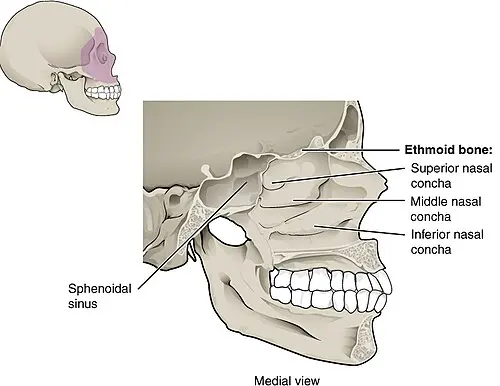

The flow of blood is controlled by the sympathetic nervous system, part of the autonomic nervous system that works without our conscious control. Strong sympathetic signals tighten the blood vessels, the lining shrinks and air flows freely. When the signals ease off, blood collects and the lining swells. The nasal cycle is thought to arise as this strength alternates between the two sides. What coordinates the whole thing is still unclear; one suggestion is the hypothalamus, a small control center deep in the brain.
Why take turns?
Your nose is an air-conditioning unit. It warms and humidifies the air you breathe and traps dust and germs before they reach the lungs. Ronald Eccles, who studied colds and the nose for many years at Cardiff University in Wales, proposed that the nasal cycle lets each side rest from this work in turn. He also suggested that the repeated swelling and shrinking pumps fluid containing antibodies onto the surface of the lining, helping to defend the nose.
The cycle may also affect your sense of smell. In 1999, a team at Stanford University in California reported that the faster-flowing and slower-flowing nostrils pick up smells slightly differently, publishing the finding under the title “The world smells different to each nostril.” Still, nobody knows for sure what the nasal cycle is for.
Lie on your side and the lower nostril blocks
Body position matters too. Lie on your side and the nostril closer to the pillow becomes congested while the upper one opens up. In 1986, researchers in Canada reported that pressure on the side of the shoulders, hips and chest is relayed through the nerves and makes the nasal lining on the same side swell. Lying down also raises the pressure in your veins, so more blood collects in the nasal lining, which is one reason noses tend to feel stuffier in bed.


If one nostril is blocked when you are trying to sleep, turning so that the blocked side is on top may help it clear. But if the same side is always blocked, or you keep having nosebleeds or trouble smelling, the cause may be something other than the nasal cycle, and it is worth seeing an ear, nose and throat doctor.