Is spaghetti Napolitan an Italian dish?
No. It took shape in postwar Yokohama and spread through Japan’s coffee shops as a Japanese Western-style dish.
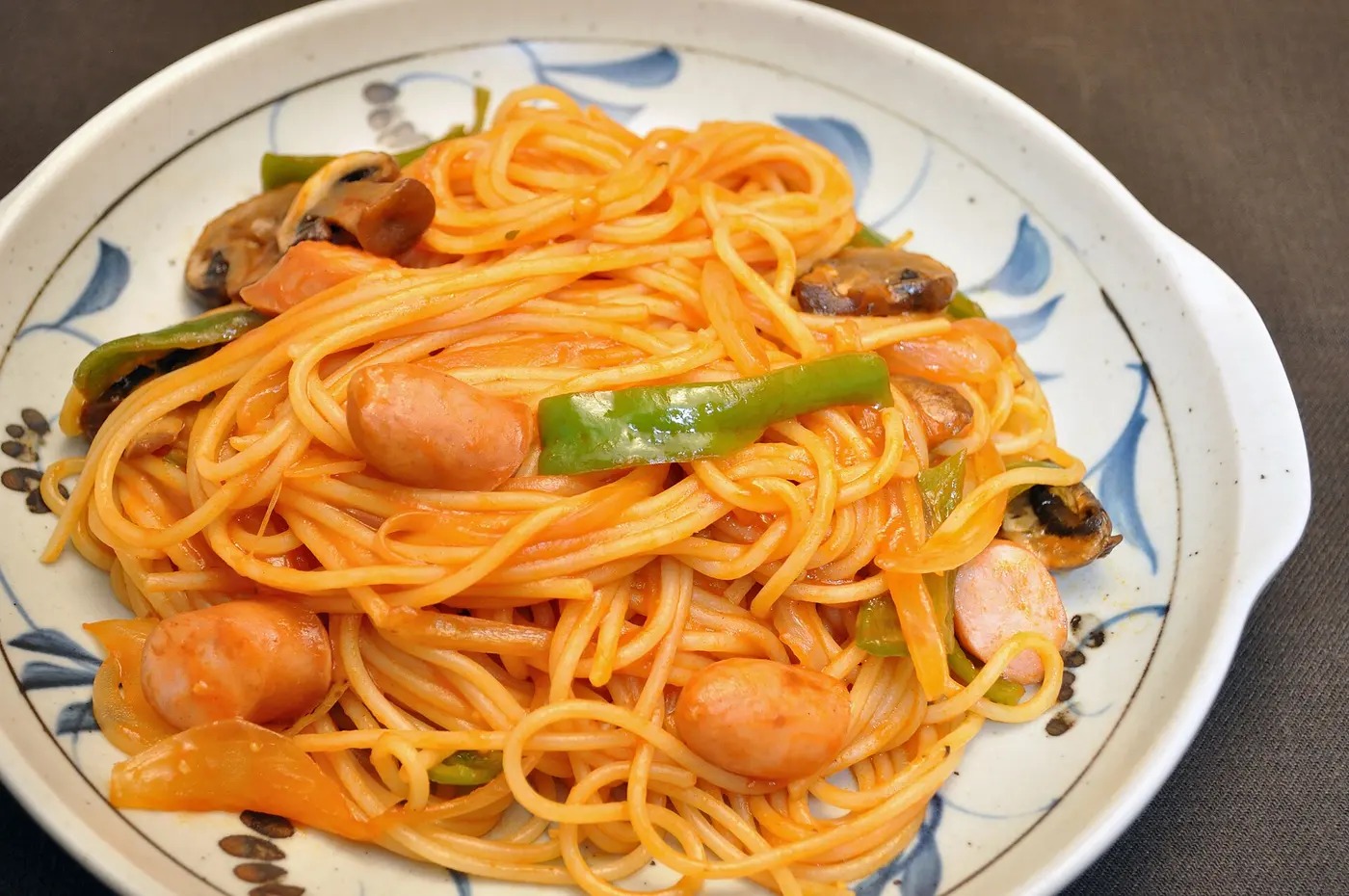
Boiled spaghetti, stir-fried with onion, green pepper and sliced sausage, all coated in ketchup. Spaghetti Napolitan, served in old-fashioned Japanese coffee shops (kissaten) and Western-style diners, tastes of nostalgia for many people in Japan.
The name makes it sound like a dish from Naples, the port city in southern Italy. Yet you will hardly find it in Naples, because Italians do not stir-fry spaghetti with ketchup. So where did Napolitan come from?
“Neapolitan style” meant tomato
In Western cooking, spaghetti dressed with tomato sauce had long been described as “Neapolitan style,” or spaghetti à la napolitaine in French. The area around Naples was famous for its tomatoes and known as the home of tomato-sauce pasta.
Spaghetti “in the Neapolitan style” already appeared in Japan before the Second World War, on hotel menus and in cookbooks of Western cuisine. A 1935 menu from the Tokyo branch of the Hotel New Grand, for instance, listed a spaghetti “Napolitaine.” That, however, seems to have been a proper European dish made with strained tomatoes, quite different from today’s Napolitan.

Born in a Yokohama hotel
The best-known starting point for the modern dish is the Hotel New Grand in Yokohama, the port city next to Tokyo. Opened in 1927, the hotel was requisitioned after the war by the General Headquarters of the Allied occupation (GHQ) and used to house American officers.
According to the hotel, American soldiers at the time ate boiled spaghetti tossed with nothing more than salt, pepper and tomato ketchup. Seeing this, the hotel’s second head chef, Shigetada Irie, set out to create a spaghetti dish worthy of being served in a hotel.
Irie’s version started with minced garlic and onion, sautéed and simmered into a sauce with fresh tomatoes, canned tomatoes, tomato paste, bay leaf and olive oil, then combined with ham, green pepper and mushrooms. It was named “Spaghetti Napolitan” and remains a hotel specialty to this day. In other words, the dish credited as the original Napolitan contained no ketchup at all.
How ketchup took over
So why did ketchup become the standard? At a time when fresh tomatoes were precious, ketchup, cheap and long-lasting, was a convenient way to get tomato flavor. Center Grill, a Western-style diner founded in 1946 in Yokohama’s Noge district, is known for making Napolitan with ketchup from early on, and some credit it as the birthplace of the ketchup version.


A further boost came from domestically made spaghetti. Around 1955, Japanese flour millers began producing spaghetti and macaroni, and full-scale mass production got under way in the late 1950s. To sell the new product, the easy method of stir-frying spaghetti with ketchup was widely promoted, and it spread into homes and coffee shops. Ketchup Napolitan settled in as the taste of the Showa-era coffee shop, the Showa era being Japan’s imperial era from 1926 to 1989.
What Italians make of it
Serve Napolitan to someone from Italy, and they will often protest that this is not food from Naples. In Italy, pasta is not stir-fried but tossed with sauce straight after boiling, and ketchup does not come into it.
Even so, Napolitan is a dish in its own right, one that grew up on Japanese tables. Like curry rice and omurice (an omelet wrapped around rice), it belongs to yoshoku, Western-inspired dishes that were reinvented in Japan.