Is there light from the beginning of the universe in TV static?
Yes. A few percent of the static on an old analog TV was the afterglow of the newborn universe.
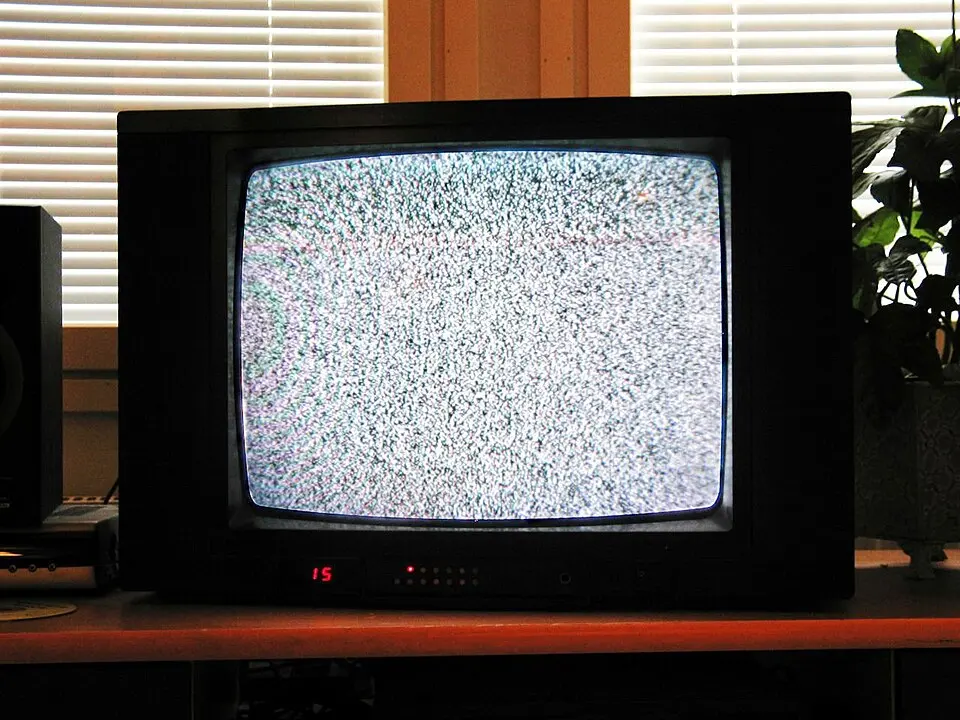
Late at night after broadcasting ended, or on a channel with no station, an old television filled its screen with flickering black and white dots and a loud hiss. English speakers called it snow or static; in Japan it was known as sunaarashi, a “sandstorm.”
Japan switched off analog terrestrial TV on July 24, 2011, in 44 of its 47 prefectures. In Iwate, Miyagi and Fukushima, the switch-off was postponed because of that year’s Great East Japan Earthquake and came on March 31, 2012. Many young people today have never seen TV static. Yet mixed into that flicker was light dating back to the beginning of the universe.
Static is a jumble of noise
A TV pulls its picture out of the radio waves picked up by its antenna. But a broadcast signal is not the only thing that reaches the antenna and receiver. Radio waves given off by the ground and the atmosphere come in too, along with noise generated by the receiver’s own components. On a channel with no broadcast, that noise is what appears on the screen.
Most of it comes from the TV’s own circuitry and its surroundings. A tiny part, though, comes from space. According to a NASA explainer video, about 2 percent of the fuzz on an old television set comes from the cosmic microwave background. Other explanations say “a few percent.” It depends on the antenna and the receiver, but either way it is only a sliver of the static.

The embers of the early universe
The cosmic microwave background is the leftover glow of the newborn universe. According to the announcement of the 2006 Nobel Prize in Physics, the universe was nearly 3,000°C (about 5,400°F) when this light was released. As the universe expanded, the light was stretched and cooled, and today it is a faint microwave glow matching an object just 2.7 degrees above absolute zero.
This radiation pours in from every direction in the sky at almost the same strength, so it reached a TV antenna no matter which way it pointed. Anyone staring at static was, without knowing it, watching embers of the early universe that had been traveling for close to 13.8 billion years.
Suspecting the pigeons
The first people to catch this radiation were also troubled by noise that would not go away.
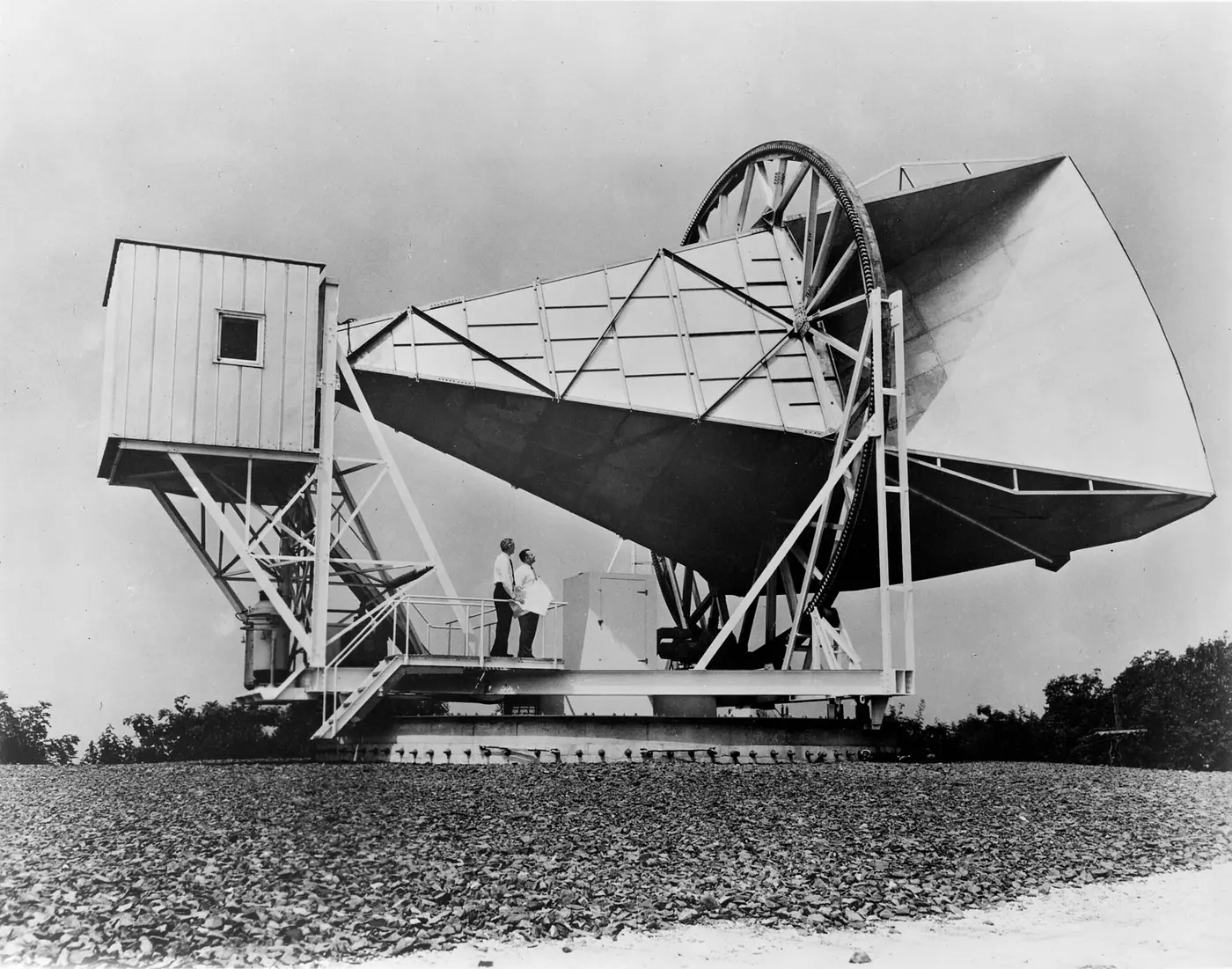
In 1963, Arno Penzias and Robert Wilson, radio astronomers at Bell Labs in the United States, started preparing a large horn-shaped antenna in Holmdel, New Jersey, for astronomy. It had been built in 1960 for communication experiments that bounced signals off the Echo satellite.
When they took measurements at a wavelength of 7.35 centimeters (about 3 inches), an unexplained extra noise was always there. They ruled out the causes one by one. They checked how much radiation came from the atmosphere, pointed the antenna toward New York City to look for man-made interference, and examined radio waves from the Milky Way. Nothing fit.
Suspicion turned to the antenna itself. As Wilson recalled in his Nobel lecture, a pair of pigeons had been roosting inside the narrow part of the horn and had coated it with “a white material familiar to all city dwellers.” The pair evicted the pigeons and cleaned up the mess, but the noise dropped only slightly. In the spring of 1965 they cleaned the antenna thoroughly and taped over its riveted joints with aluminum tape, with the same result.

The answer was at Princeton
The breakthrough came when Penzias, talking to Bernard Burke of the Massachusetts Institute of Technology about other matters, mentioned the mystery noise. Burke had heard about work by Robert Dicke’s group at Princeton University. Dicke and his colleagues reasoned that if the universe had passed through an extremely hot phase, radiation from it should still be detectable, and they were building an instrument to look for it.
In 1965 the two groups published side-by-side letters in the Astrophysical Journal. The Bell Labs pair had measured the excess noise at a temperature of about 3.5 kelvins. The finding became strong evidence for the big bang, the idea that the universe began in a hot, dense state, and Penzias and Wilson shared the 1978 Nobel Prize in Physics. Later, NASA’s COBE satellite, launched in 1989, measured the radiation in detail, earning another Nobel Prize in Physics in 2006.