Where was the music box invented?
In Geneva, in 1796. A watchmaker named Antoine Favre came up with the idea of playing tunes by plucking the teeth of a steel comb.
1796
Open the lid, and a pinned metal cylinder turns slowly while a clear, chiming melody spills out. There is something nostalgic about the sound of a music box.
How do you fit a tune into such a small box? The answer was found at the end of the 18th century in Geneva, a city famous for its watchmakers. And in Japan, the music box goes by a name that is used nowhere else.
No bells, no hammers
Look inside a music box and you will see two main parts: a cylinder studded with tiny pins, and a steel plate cut into teeth like a comb. As a spring turns the cylinder, the pins pluck the teeth one by one, and each tooth rings at a pitch set by its length.
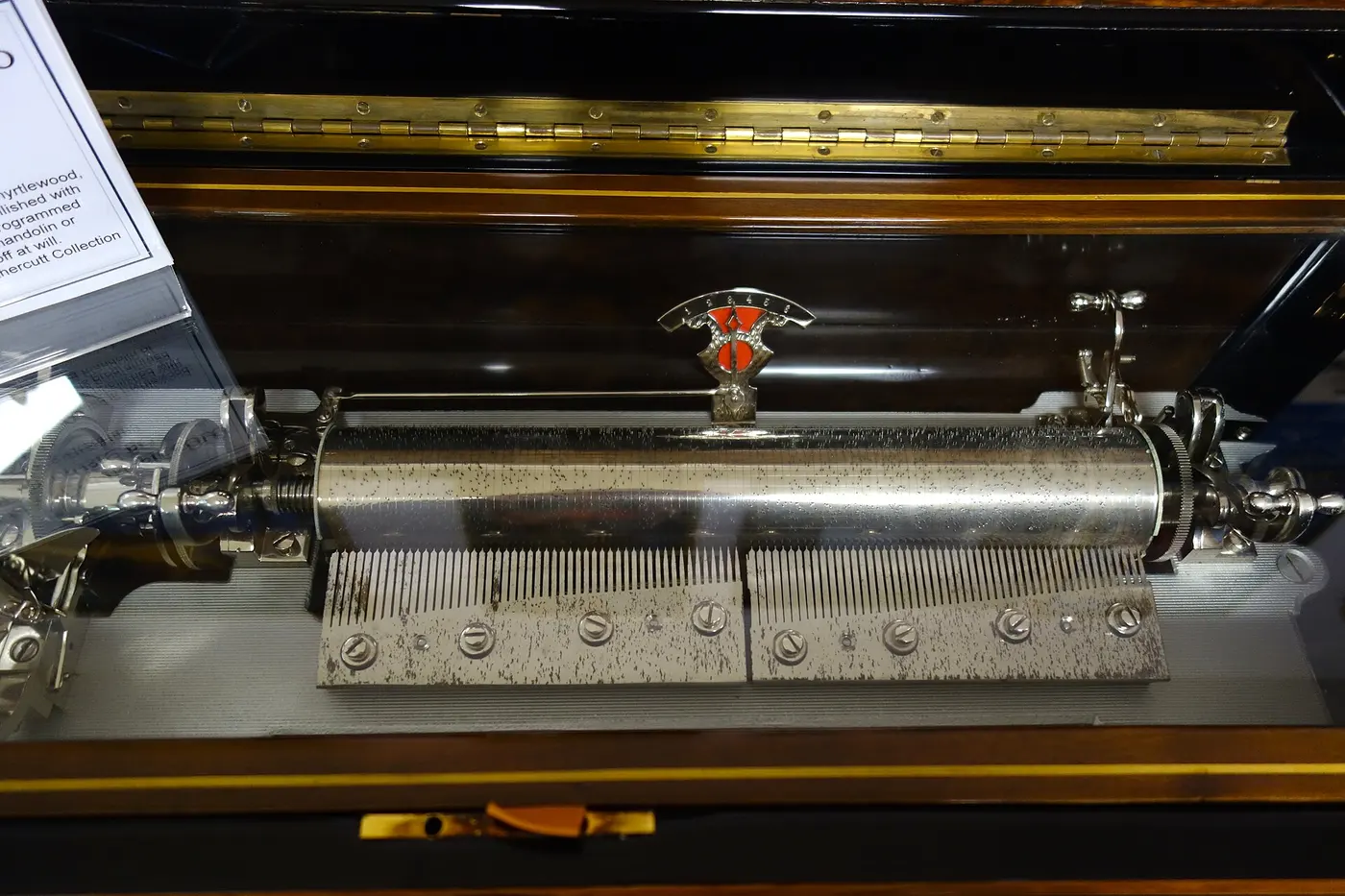

The mechanism made its debut early in 1796. According to the Museum für Musikautomaten in Seewen, Switzerland, a Geneva watchmaker named Antoine Favre presented a new kind of musical movement to the city’s Société des Arts. The society’s minutes of February 15 record that Favre had found a way to build musical movements “without bells and hammers,” the way such movements had worked until then. A later report added that the device played two tunes, sounded like a mandolin, and fit into the bottom of an ordinary-sized snuffbox.
Strictly speaking, Geneva was not yet part of Switzerland. It was an independent republic, and it joined the Swiss Confederation only in 1815.
The invention won praise everywhere, but it did little for its inventor. According to the Seewen museum, poor health forced Favre to give up his trade, and he died in poverty.
From rings to a mountain industry
Other craftsmen put his idea to work. At first it went into jewelry: a record from 1802 describes finger rings fitted with tiny musical movements on Favre’s principle. These could manage only a handful of notes. Movements with a wider range went into snuffboxes from 1813, and only after that did makers start building boxes whose only job was to play music.
Production spread from Geneva into the villages of the Jura mountains near the French border, and one of them, Sainte-Croix, became the music box capital. By around 1832, 17 makers there employed 360 workers. By the middle of the century, about 35,000 music boxes a year were being made, most of them shipped abroad on the new railroads. A typical box played four to twelve tunes, each about a minute long.
Discs, and a powerful rival
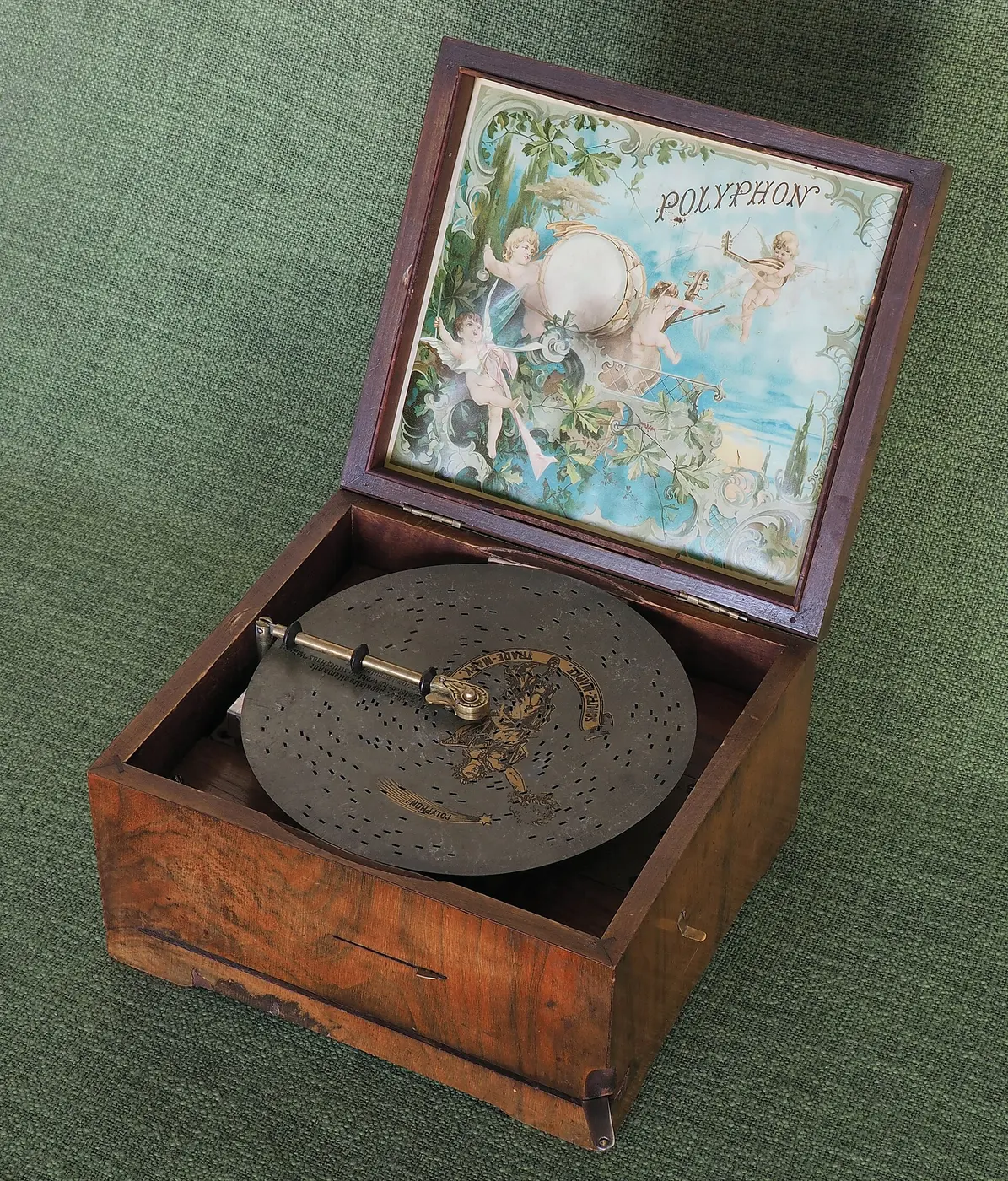
In 1886, Paul Lochmann of Leipzig, Germany, patented a new design. Instead of a pinned cylinder, a metal disc with punched-out projections turned above the comb. Discs were cheap to make, and swapping one for another changed the tune. According to Nidec Instruments, a Japanese maker of music box movements, the disc design could pluck harder and drive bigger combs, giving a fuller sound. Disc music boxes spread from Germany to Switzerland, and the United States, the biggest market, produced big makers of its own, such as Regina.

The golden age did not last. Thomas Edison invented the phonograph in 1877, and Emile Berliner the disc gramophone in 1887. Once recorded music could be played at home, the music box lost its place as the leading automatic instrument, and by the time of World War I the industry was in decline. Some Sainte-Croix firms survived by moving into phonographs themselves.
A name only Japan uses
In Japanese, a music box is an orugōru. The word is thought to come from the Dutch orgel, meaning “organ,” and according to Nidec Instruments, Japan is the only country where a steel-comb music box is called that.
Curiously, the word reached Japan before the steel-comb music box existed. According to the Japanese encyclopedia Nipponica, the form orugoru already appears in a book published in 1750. Nidec suggests that Japanese people picked up orgel from the musical clocks, organs and other “mysterious boxes that played music” brought by Dutch traders, the only Europeans allowed to trade with Japan during the Edo period (1603–1868). In 1852 a music box was still novel enough to be put on show as a curiosity in Edo, now Tokyo.
Japan began making music boxes in earnest only after World War II. Sankyo Seiki, founded in Suwa, Nagano Prefecture, in 1946 (now Nidec Instruments), started work on them two years later. According to the company, the six prototypes, which played the children’s song “Chōcho” (“Butterfly”), broke their comb teeth one after another, and the two that survived were said to sound “like someone banging on the bottom of a bucket.” Even so, the first 500 boxes shipped at the end of 1948, and the company says that at one point it held more than 90 percent of the world market.