What causes motion sickness?
It is thought to arise when what your eyes see doesn’t match the motion your inner ear feels, leaving the brain confused. Why that should make us nauseous is still debated.
67%
You’re on a school bus trip, reading a book, when the yawning starts. Then comes a cold sweat, and a slowly rising queasiness. According to the Japan Society of Otorhinolaryngology–Head and Neck Surgery, surveys suggest that 30 to 40% of elementary and junior high school students get motion sickness.
Humans have suffered from it for a very long time. As the British researcher John Golding notes, the ancient Greek physician Hippocrates wrote that “sailing on the sea proves that motion disorders the body.”
When the eyes and ears disagree
We keep our balance thanks to sensory organs in the inner ear. The three semicircular canals, looping tubes set at angles to one another, detect rotation of the head, while the otolith organs sense tilt and changes of speed forward, backward, up and down. The brain combines these signals with what the eyes see and with feedback from muscles and joints to work out how we are moving.
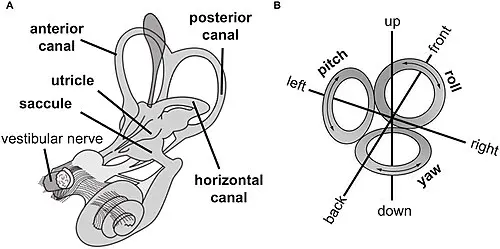

The most widely accepted explanation for motion sickness is the sensory conflict, or neural mismatch, theory, which the U.S. Centers for Disease Control and Prevention cites in its guide for travelers. Read a book in a car, and your eyes report a page that isn’t moving while your inner ear keeps reporting bumps, turns and acceleration. The two accounts don’t agree.
The Japanese society explains that when unfamiliar motion keeps stimulating the inner ear, the brain becomes confused and sends abnormal signals through the autonomic nervous system. The result is yawning, cold sweats, a pale face, cold hands and feet, nausea and, eventually, vomiting. Up-and-down motion, it says, is the most likely to make people sick.
No inner ear, no seasickness
One striking experiment shows how central the inner ear is. In 1965, researchers from the U.S. Naval School of Aviation Medicine and NASA put 10 men whose balance organs did not work and 20 healthy men aboard a small ship. They sailed from North Sydney, Nova Scotia, to the French island of St. Pierre, off Newfoundland, and back. The return trip was made in an extremely severe storm.
Of the 20 healthy men, 15 vomited, and the other five felt moderately or severely ill. Yet none of the 10 men without working balance organs showed the typical symptoms of motion sickness. They found the storm uncomfortable, and some were frightened, but they did not get seasick. If fear alone could bring on motion sickness, the researchers reasoned, these men would surely have become sick, so the balance organs must play an essential role.
Why nausea?
But why should a sensory mismatch make us want to throw up? In 1977, the British psychologist Michel Treisman offered a bold hypothesis in the journal Science. In nature, he suggested, the main thing that scrambles our senses would be eating something containing a nerve poison. So a system evolved that responds to disturbed senses by vomiting, ridding the body of the toxin. Motion sickness would be an accidental by-product: the same alarm, triggered by motion.
Some experiments seemed to support the idea. In 1983, Money and Cheung reported that when they surgically removed the balance organs from the inner ears of seven dogs, the dogs’ vomiting response to certain poisons was weakened.
The question is not settled, though. In 2012, Charles Oman of the Massachusetts Institute of Technology wrote that the “poison” theory is plausible and often cited as the accepted explanation, but that the supporting evidence is equivocal and some evidence contradicts it. Whether motion sickness serves any purpose, or is simply crossed wiring between systems in the body, is still being debated.
Common in children, and in space
How susceptible we are depends strongly on age. According to the CDC guide, children under 2 rarely get motion sickness; susceptibility peaks between the ages of 7 and 12 and then generally declines. Surveys find that women are more susceptible than men, but this effect is much smaller than the effect of age.
Motion sickness follows us into space, too. In a 1988 report by NASA researchers, 67% of 85 astronauts on their first Space Shuttle flight had suffered from space motion sickness.
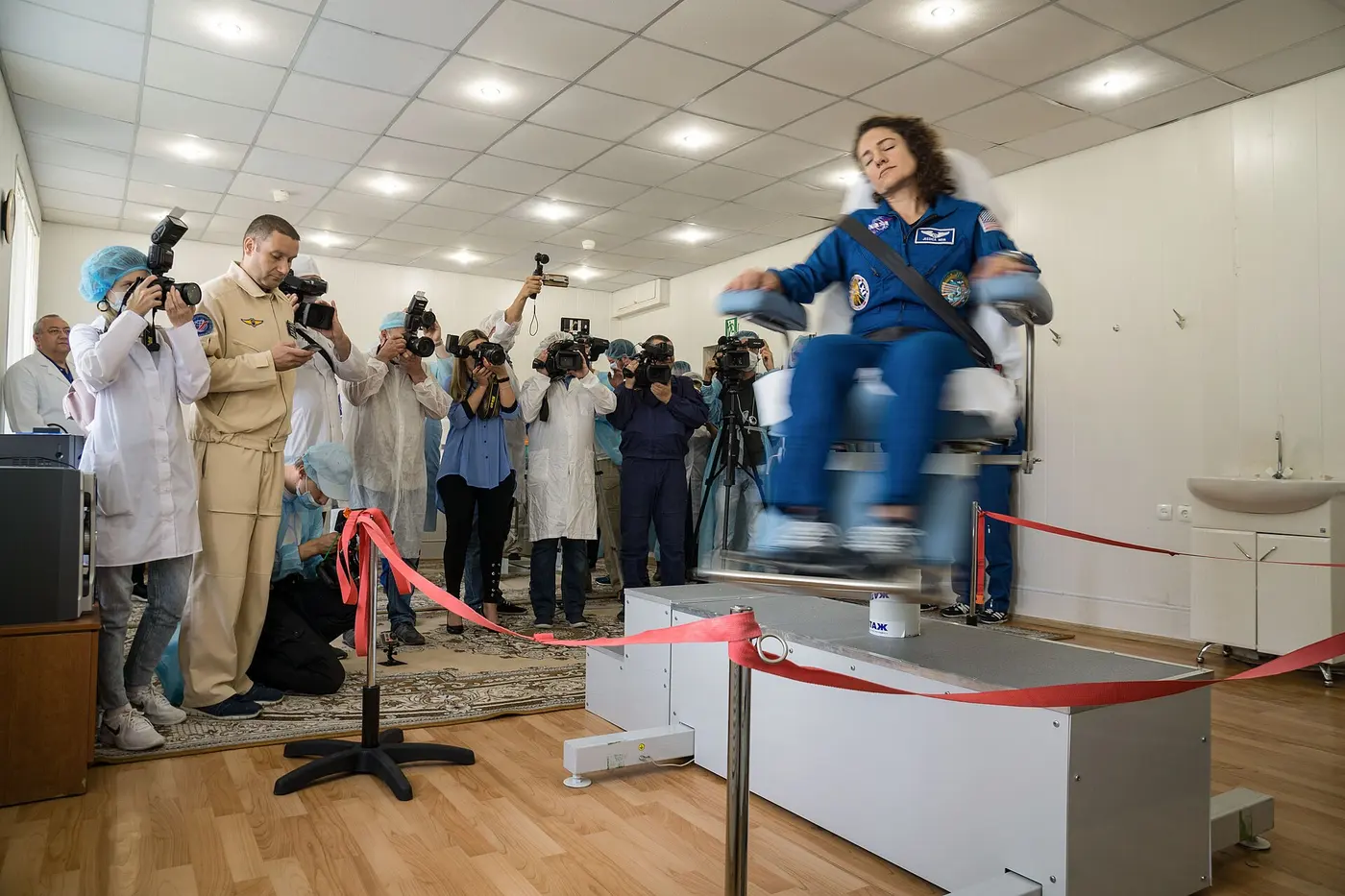

To prevent it, the Japanese society suggests getting a good night’s sleep beforehand, not overeating, sitting about four or five rows from the front of a bus or in the middle of a ship, keeping the air fresh, and looking at distant scenery rather than reading. The CDC likewise recommends keeping the horizon in view and avoiding reading, and says that getting used to the motion is the most effective remedy of all. Motion sickness medicines exist, but they should be used with caution in children, so ask a doctor or pharmacist. If sickness strikes, getting off the vehicle is best; if you can’t, lie down, loosen your belt and clothing, and breathe slowly and deeply from the belly.