Can coconuts float across oceans and wash up on distant shores?
Yes. A coconut can float for more than three months and still sprout. But the coconut palm’s spread around the tropics owes a great deal to people carrying it.
110 days
“From a distant island whose name I do not know, a single coconut drifts ashore.” So begins “Yashi no Mi” (The Coconut), a poem by Shimazaki Tōson, one of the great poets of Japan’s Meiji era (1868–1912). Set to music in 1936 and broadcast nationwide on radio, it is still sung in Japan today.
Coconuts really do drift across the sea and wash up on faraway beaches. Whether they can take root there is another matter. And the coconut palm’s presence on tropical shores around the world is not simply the work of waves and currents.
The coconuts Yanagita saw
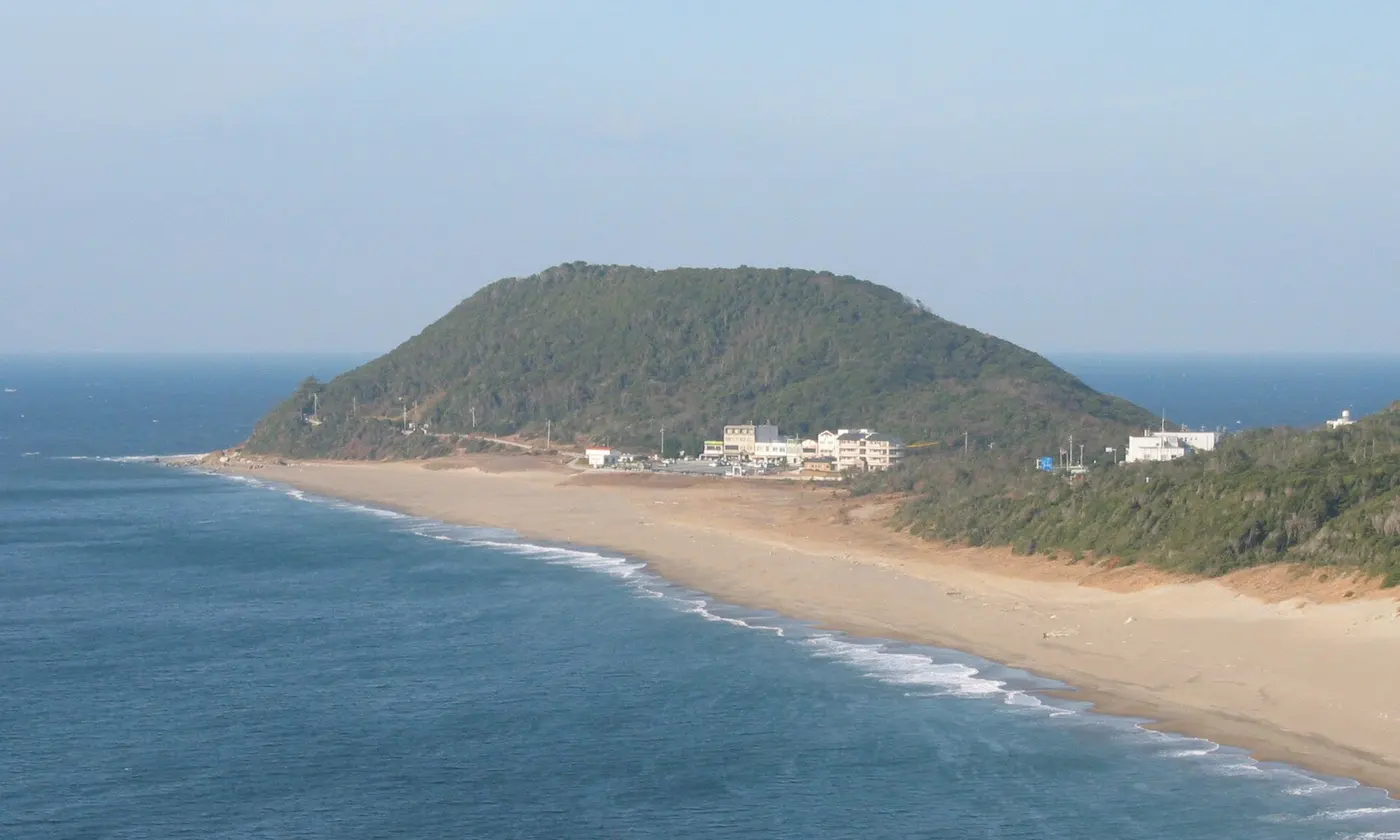
According to the city of Tahara in Aichi Prefecture, the folklorist Yanagita Kunio spent a little more than a month in the summer of 1898 at Cape Irago, the tip of the Atsumi Peninsula. Late in life, in his book Kaijō no Michi (The Ocean Road, 1961), he recalled that time. Every morning he walked around the end of the cape, and three times, on mornings after the wind had blown fairly hard, he found coconuts that had drifted ashore. One had split open to show its pure white flesh; the other two were still in their husks. That they had crossed such a vast stretch of ocean and arrived still looking fresh, he wrote, “was a great surprise to me.” (In the book, Yanagita himself dates the stay to 1897.)
Back in Tokyo, Yanagita told the story to his friend Tōson, who turned it into a poem, published in 1900 and collected the following year in Rakubaishū. According to Yanagita, Tōson later told him, “I took that from you.” Yanagita also noted, however, that some scenes in the poem, such as holding the coconut to one’s chest and feeling the sorrow of a wanderer, reflected neither his own actions nor his feelings. The poet had filled in the rest.

A seed with a built-in float
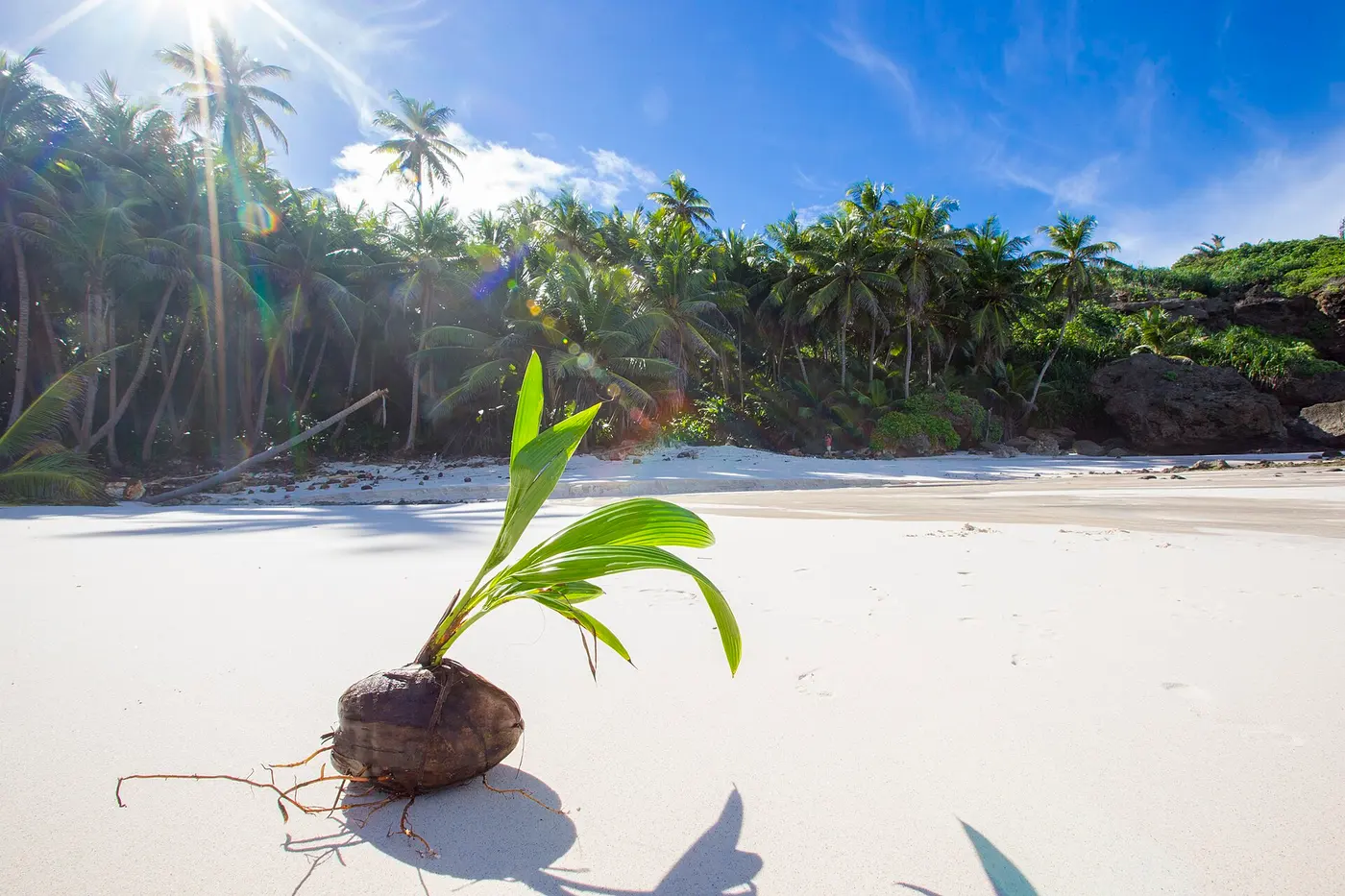
A coconut floats because the hard shell that protects the seed is wrapped in a thick husk packed with fibers. According to the coconut researcher Hugh Harries and a colleague, the husk provides buoyancy, which the hollow inside the nut adds to. The husk also protects the embryo and delays germination, which helps the seed stay alive while it drifts.
How long can a coconut drift? Charles Edmondson, a zoologist at the Bishop Museum in Honolulu, began floating coconuts in the sea off Oahu in 1938. In a 1941 report, he found that coconuts were “capable of developing after having floated in the sea for periods up to 110 days.” With a favorable current, he estimated conservatively, a coconut could travel about 3,000 miles (4,800 km) in that time.
Landing is not the same as taking root
Sprouting takes time, though. In Edmondson’s experiments, coconuts needed anywhere from less than three months to well over a year after their time in seawater to show visible growth. Harries and his colleague point out that on coral islands, a nut thrown up by the waves must germinate and root on bare rock with no soil, under the full glare of the sun.

In Japan, it seems, drifting coconuts never took root. Yanagita wrote that the coconut palm did not suit the climate of Japan and had never once sprouted and grown into a tree there. Even so, he noted, many families in rural southern Kyushu had heirloom liquor flasks and cups made from coconut shells. The coconuts never grew in Japan, but they found their way into people’s lives.
People spread the palm
Coconut palms seem to line every tropical beach. A genetic study published in 2011 by researchers in Australia, France and the United States showed how deeply people were involved in that. Analyzing 1,322 coconut samples from around the world, the team found two clearly separate groups, one in the Pacific and one in the Indian Ocean, and concluded that coconut cultivation began independently in two places: island Southeast Asia and the southern edge of the Indian subcontinent.
As the paper puts it, the coconut fruit is naturally adapted to be carried by sea currents, but “its pantropical dissemination was achieved with the help of humans.” Pacific coconuts reached the Pacific coast of Latin America about 2,250 years ago, before Columbus, most likely carried by Austronesian seafarers from the Philippines. Much later, Europeans brought coconuts from India to the Atlantic coasts of Africa and South America and to the Caribbean.
The shape of the fruit carries traces of human hands, too. Coconuts have long been divided into two main types: elongated nuts with a thick fibrous husk, thought to be the ancestral form shaped by ocean drifting, and round nuts holding more coconut water, thought to reflect selection by people. The round type arose only in the Pacific group.