Was Beethoven the first composer to write metronome marks?
There is no proof he was the very first. But he seized on the newly invented metronome and added its numbers to his symphonies and other works, making him its most eager early champion.
138beats
If a piece of music is marked “♩ = 120,” the players should count 120 quarter notes a minute. The number comes from the scale of a metronome, and it is sometimes written “M.M. = 120,” for “Maelzel’s Metronome.”
Johann Nepomuk Maelzel was a friend of Ludwig van Beethoven, and soon after the metronome came out, Beethoven published numbers for all the symphonies he had written so far. So was he the first composer to give metronome marks?
Not Maelzel’s idea
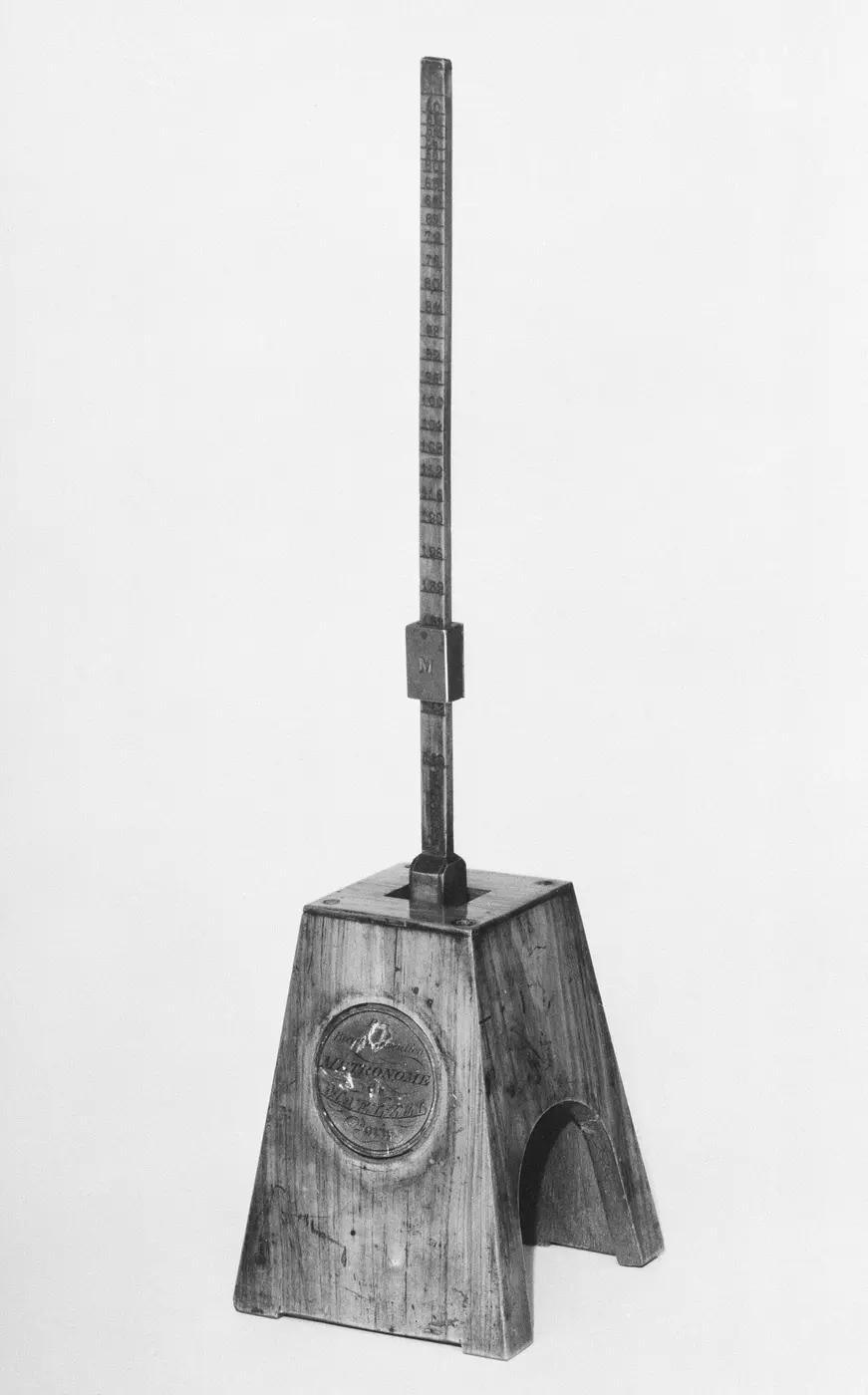
The design of the metronome as we know it, a pendulum with a weight above the pivot as well as below, came from Dietrich Nikolaus Winkel, a German-born clockmaker working in Amsterdam. According to Marc D. Moskovitz’s book Measure, Winkel’s prototype is dated November 27, 1814.
In 1815 Winkel showed his design to Maelzel, a mechanic to the imperial court in Vienna. Maelzel offered to buy it and was turned down. He added a scale of his own, named the device a métronome, and patented it that same year in Paris and London. According to the Neue Deutsche Biographie, a German dictionary of biography, an academy in Amsterdam later confirmed that Winkel had come first, but it made no difference. Maelzel gave away more than 200 metronomes to leading musicians and made numbered tempos the norm.

Goodbye to “allegro”
The two men went back a long way. Maelzel made ear trumpets for Beethoven and talked him into writing Wellington’s Victory for one of his mechanical instruments. The piece led to a bitter quarrel, but they had made up by the end of 1817.
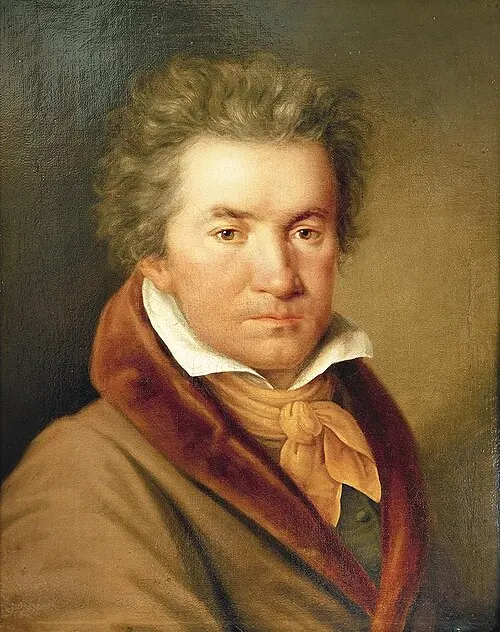
Around then, Beethoven told the court official Ignaz von Mosel that he had long meant to give up such “inconsistent terms” as allegro, andante, adagio and presto, and that Maelzel’s metronome offered the best opportunity of doing so.
On December 17, 1817, the Leipzig Allgemeine musikalische Zeitung published tempo markings for every movement of Beethoven’s first eight symphonies, set by the composer himself with Maelzel’s metronome. In 1818 he and Antonio Salieri, the court’s music director, signed an advertisement recommending the device. According to the Beethoven-Haus in Bonn, Beethoven eventually gave metronome marks to all nine symphonies, his first 11 string quartets, the “Hammerklavier” Sonata and other works.
He is often described as the first well-known composer to make serious use of metronome marks. But Maelzel handed out his machines to musicians from the start, and people had tried to measure musical speed before: back in the 1690s, the French musician Étienne Loulié designed a pendulum device for it. No record lets us name the very first, so “the most eager pioneer” is a fairer title.
Too fast?
Many musicians have found Beethoven’s numbers puzzling. The most famous case is the “Hammerklavier,” which opens at 138 half notes a minute, a speed many pianists consider unplayable.
Hence the theory that his metronome was broken. In a 2020 paper in PLOS ONE, Almudena Martín-Castro and Iñaki Ucar, researchers in Madrid, noted that Beethoven took his metronome to the watchmaker at least twice because it ran unsteadily. The machine itself cannot be examined: it was lost during an exhibition in Vienna in 1921.
The pair analyzed recordings of the symphonies by 36 conductors, from the 1940s to the 2010s. On average, every one of them played slower than Beethoven’s marks, conductors in the older Romantic tradition by about 13 beats a minute, and even those aiming for historically informed performance by about 6. The researchers put the gap down to a misreading. According to the pair, the sliding weight on the earliest metronomes was a downward-pointing triangle about 15 mm (0.6 inch) tall. Read the scale at its lower edge instead of its upper edge, and you get a number about 12 beats too fast. On the first page of his manuscript of the Ninth Symphony, Beethoven wrote “108 or 120,” two numbers exactly 12 apart. Still, this is a hypothesis, and the debate goes on.

Whose “tick-tock”?
The second movement of the Eighth Symphony trips along over a steadily ticking accompaniment, and it has long been said to imitate a metronome. Supposedly, at a gathering for Maelzel in 1812, Beethoven made up a little canon to the words “Ta ta ta, lieber Mälzel” (“dear Maelzel”), and the movement grew out of it.
But the Eighth Symphony was begun in the summer of 1812 and first performed in February 1814, and the metronome was not patented until the following year. According to the Beethoven-Haus, the canon was the invention of Anton Schindler, who acted as Beethoven’s secretary late in his life, and no manuscript in Beethoven’s hand exists. Schindler published it in 1844 and even forged entries in Beethoven’s conversation books to support his tale. He disliked fast tempos and used the story to argue for slower ones.