How do mangroves grow in seawater?
They keep salt out of their bodies, each species in its own way: some filter it out at the roots, some pump it out through their leaves, and some lock it away in old leaves and then drop them.
95%
Along tropical and subtropical coasts, there are forests whose roots are flooded with seawater every time the tide comes in. These are mangroves.
There is no single tree called a mangrove. According to Shingo Taniguchi of the University of the Ryukyus in Okinawa, the word is a collective name for trees that grow in the tidal wetlands of the tropics and subtropics, where seawater and fresh water mix. Estimates of how many species there are run from about 70 to about 100, depending on which plants are counted. Even the seven species native to Japan belong to several different families, from three members of the mangrove family Rhizophoraceae to the nipa palm.
Seawater is poison to most plants
Seawater is about 3.5 percent salt on average. According to a review by Yoshifumi Kawana and colleagues in the journal of the Society of Sea Water Science, Japan, most plants cannot grow even in water that is less than 1 percent salt. Salty surroundings make it hard for roots to take up water, and when too much sodium gets inside, it disrupts the workings of the cells. Taniguchi notes that mangroves face a second challenge as well: their roots sit in waterlogged mud that is short of oxygen.
Different mangroves meet these challenges in different ways.
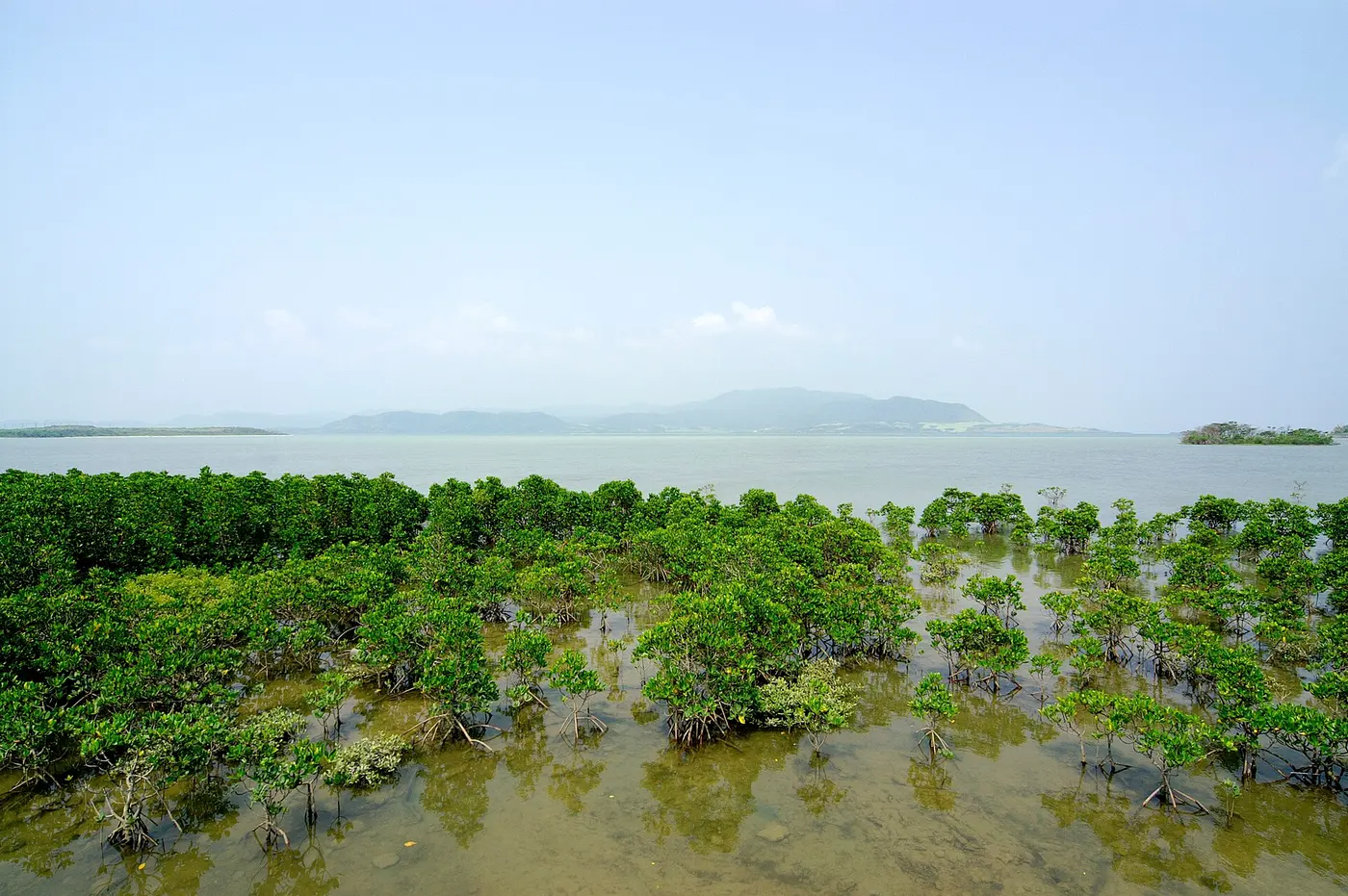

Filter it, pump it out, or throw it away
The first strategy is to keep salt out at the roots. Mangroves of the Rhizophoraceae family, such as Japan’s ohirugi, mehirugi and yaeyama-hirugi, work this way. A 2015 review by the Australian researchers Ruth Reef and Catherine Lovelock reports that mangrove roots remove 90 to 99.6 percent of the salt from the water they take up, 95 percent on average across the species studied. When a South Korean team examined the roots of Rhizophora stylosa (yaeyama-hirugi) in 2016, they found a three-layered structure of tiny pores in the root’s outer skin, with most of the sodium stopped by the outermost layer. The root itself works as a seawater filter.
The second strategy is to get rid of salt through the leaves. The best-known example is the gray mangrove, Avicennia marina, whose leaves have salt glands that push sodium and other salts out. According to Kawana and colleagues, the salt crystallizes on the leaf surface, leaving it dotted with specks. Salt glands are found in only some mangroves, though, Reef and Lovelock’s review shows.
The third strategy is to store salt and then dump it. According to Taniguchi, some species pack salt into the vacuoles of their cells and into the tissues of leaf stalks and branches, and leaves loaded with salt are shed. Old leaves serve as the tree’s salt bins. Some species, like Rhizophora stylosa, combine more than one strategy.
Roots that breathe, seeds that sprout on the tree
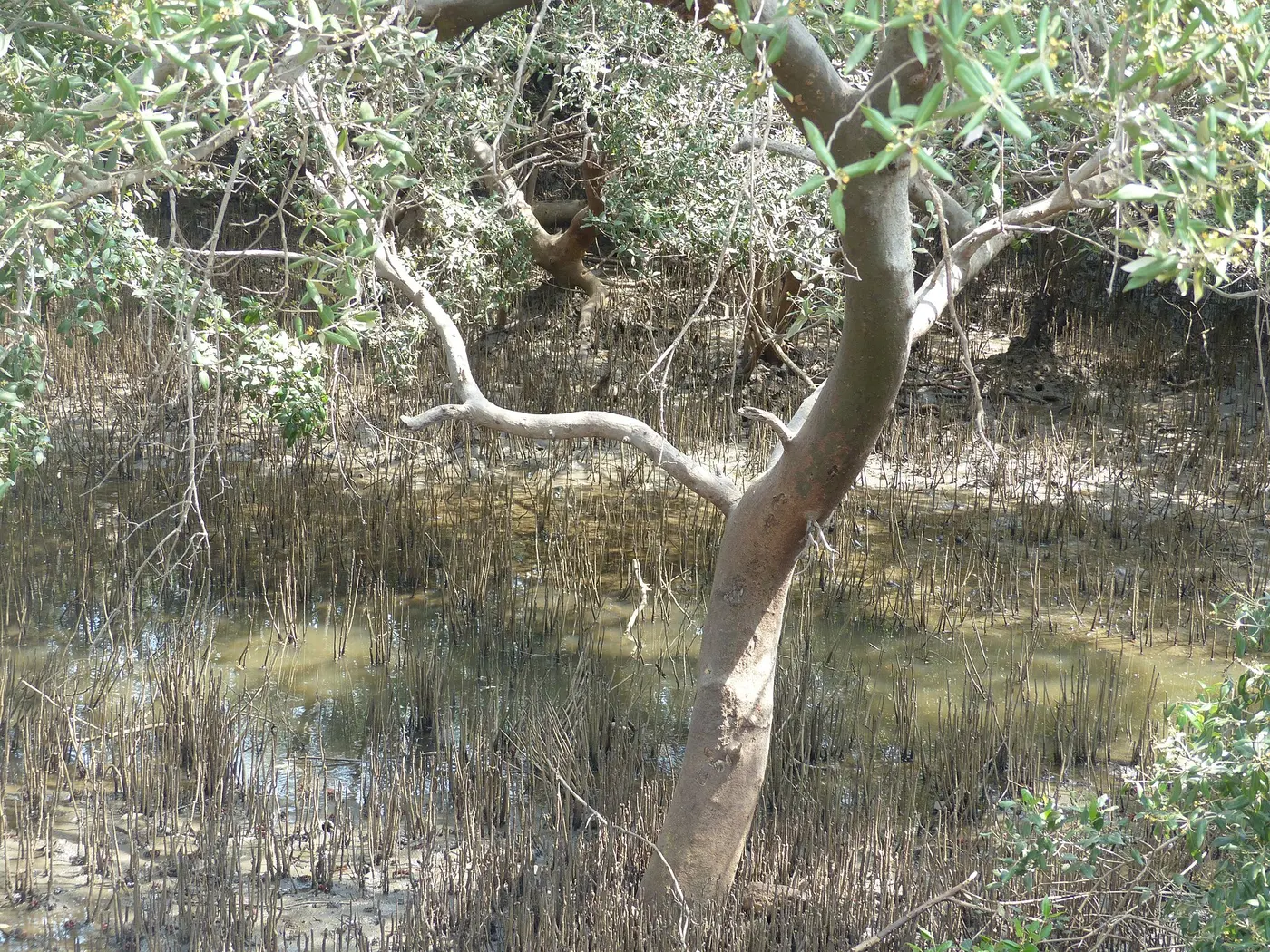
The lack of oxygen shows in the trees’ shapes. Gray mangroves send up rows of pencil-like breathing roots from roots that run under the mud. According to Taniguchi, these are made of spongy tissue full of air spaces and take in air at low tide. Bruguiera species grow roots that rise 5 to 20 centimeters (2 to 8 inches) above the ground like bent knees, and Rhizophora trees prop themselves up on the soft mud with arching stilt roots, like the legs of an octopus. In a study in Okinawa, the stilt roots of Rhizophora stylosa amounted to 60 percent of the mass of its trunk.

Their way of reproducing is unusual too. The seeds of the Rhizophoraceae do not rest once they are ripe. They sprout while the fruit is still on the parent tree, a habit called vivipary. According to the Japanese encyclopedia Nipponica, the seedling grows into a green, rodlike stem 20 to 40 centimeters (8 to 16 inches) long before it drops. If the water is shallow, its pointed tip spears into the mud and it takes root on the spot; at high tide, it floats away to settle somewhere else. Taniguchi notes that seedlings pushed into the mud start growing roots in about ten days.
Japan’s mangroves
In Japan, mangroves grow wild on islands in Okinawa and Kagoshima Prefectures. The farther south you go, the more species there are, and Iriomote Island, in Okinawa’s far southwest not far from Taiwan, has all seven. According to Japan’s Forestry Agency, the mangrove forest along Iriomote’s Nakama River is the largest in the country.
Heading north, the species drop out one by one until only the most cold-tolerant, mehirugi (Kandelia obovata), remains. According to Japan’s Agency for Cultural Affairs, the northern limit of naturally growing mangroves in Asia is said to be Tanegashima, an island south of Kyushu, and in 2015 the mangrove forests on two of its rivers were designated a national natural monument.