Why do lotus leaves repel water?
Their surface is packed with tiny bumps coated in wax crystals that trap air, so water beads up into balls and rolls off, taking dirt with it.
Look into a pond after a shower and you may see water sitting on the broad leaves of a lotus in silvery balls. Tilt a leaf slightly and the balls roll to the edge and drop off, leaving hardly a trace of wetness behind.
The lotus roots itself in mud, and yet its leaves always look clean. Zhou Dunyi, a Chinese philosopher of the Song dynasty, wrote nearly a thousand years ago in his short essay “On Loving the Lotus” that it “rises from the mud but is not stained by it.” People have admired this purity for centuries, but a proper explanation came only near the end of the 20th century.
Water that carries dirt away
Scientists measure water repellency by the contact angle, the angle between a surface and the edge of a droplet sitting on it. Water that spreads out flat has an angle near 0 degrees; a perfect sphere would have 180. A 2011 paper by researchers at the University of Bonn and other German institutions gives 163 degrees for the upper side of a lotus leaf. The droplets are nearly round, barely touching the leaf.
As the beads roll, specks of dust and soil stick to the water more readily than to the leaf, so the droplets pick them up and carry them away. Every rain shower cleans the leaf. This self-cleaning is called the lotus effect.
Confusingly, water lilies are sometimes called lotuses too, but their leaves do not repel water. The star of the lotus effect is the sacred lotus, Nelumbo nucifera.
Bumps and wax
Under an electron microscope, the surface of a lotus leaf turns out to be a dense field of tiny bumps, each one a single cell of the leaf’s outer skin. According to the 2011 paper, there are about 3,400 of them per square millimeter. The bumps themselves are covered with thin, tube-shaped crystals of wax, each only about a ten-thousandth of a millimeter wide.
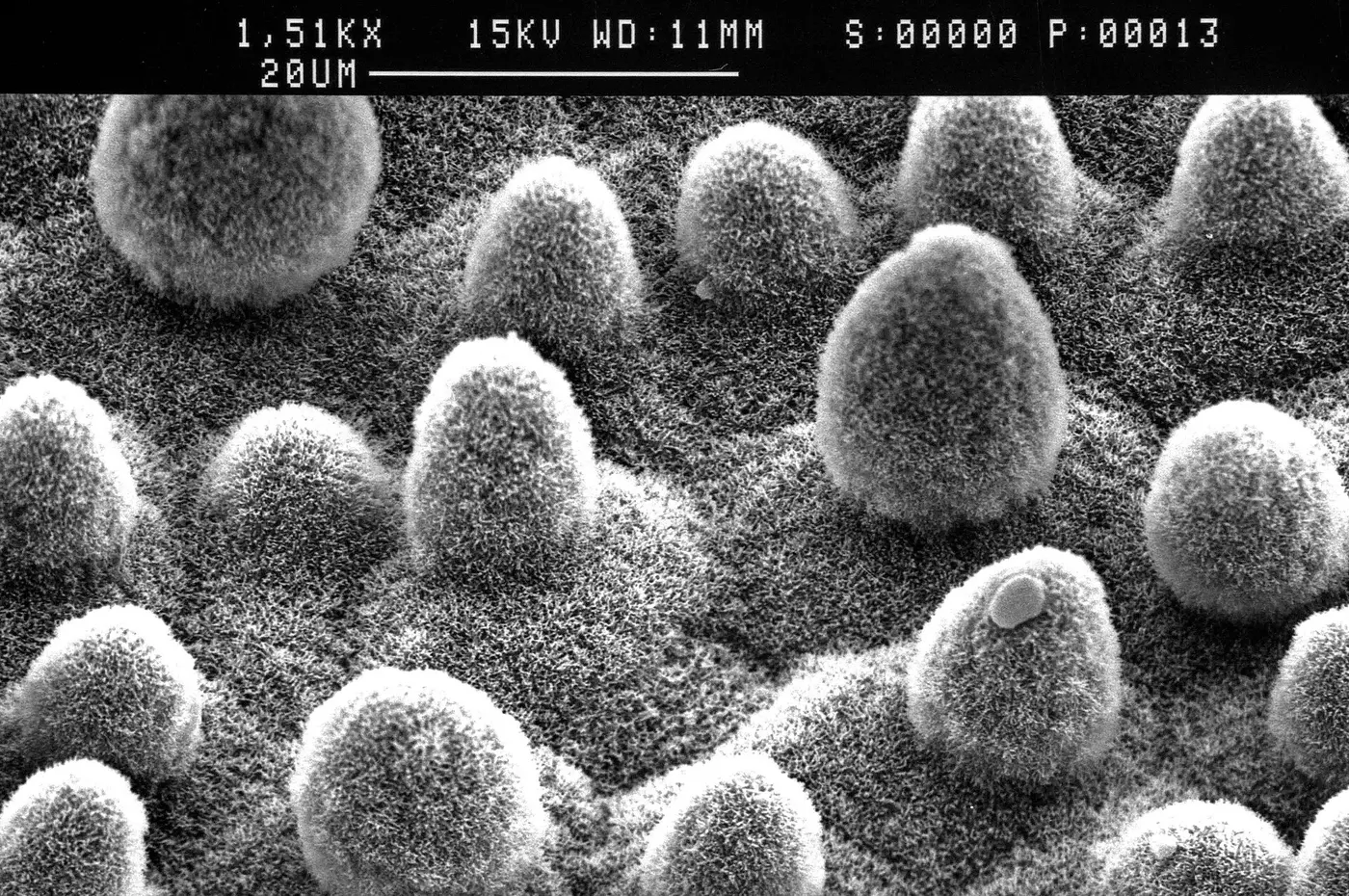

Water does not mix with wax, and air gets trapped in the gaps between the bumps. So a droplet touches only the tips, almost floating on a cushion of air. With so little contact, the slightest tilt sends it rolling. The leaves of taro, a starchy root crop, bead water in a similar way.
Lotus leaves also have their stomata, the tiny pores used to exchange gases, on the upper side, an arrangement suited to leaves that sometimes float on the water. The researchers think this is why the upper surface evolved such thorough protection against rain and grime.
“Only in the fantasy of the authors”
The lotus effect was worked out by the German botanist Wilhelm Barthlott. In a personal account published in the journal Planta in 2026, he recalls that his research began in 1971, when he was a doctoral student at Heidelberg University. Studying plant surfaces with the scanning electron microscope, then a new tool, he noticed in 1974 that in the botanical garden, water-repellent leaves were usually cleaner than wettable ones. He and a colleague described the effect in 1977, but hardly anyone noticed; they assumed physicists had known about it all along.
When he realized they had not, Barthlott, by then at the University of Bonn, coined the term “Lotus Effect” in 1992. Four journals then rejected his paper in 1994 and 1995. According to his account, one reviewer wrote that “the so-called Lotus Effect exists only in the fantasy of the authors.” Planta turned it down in 1996 as well, but the editor-in-chief, who had followed the experiments, intervened. In 1997 the journal published “Purity of the sacred lotus,” by Barthlott and Christoph Neinhuis. It became one of the two most cited papers in the journal’s hundred-year history.
From walls to yogurt lids
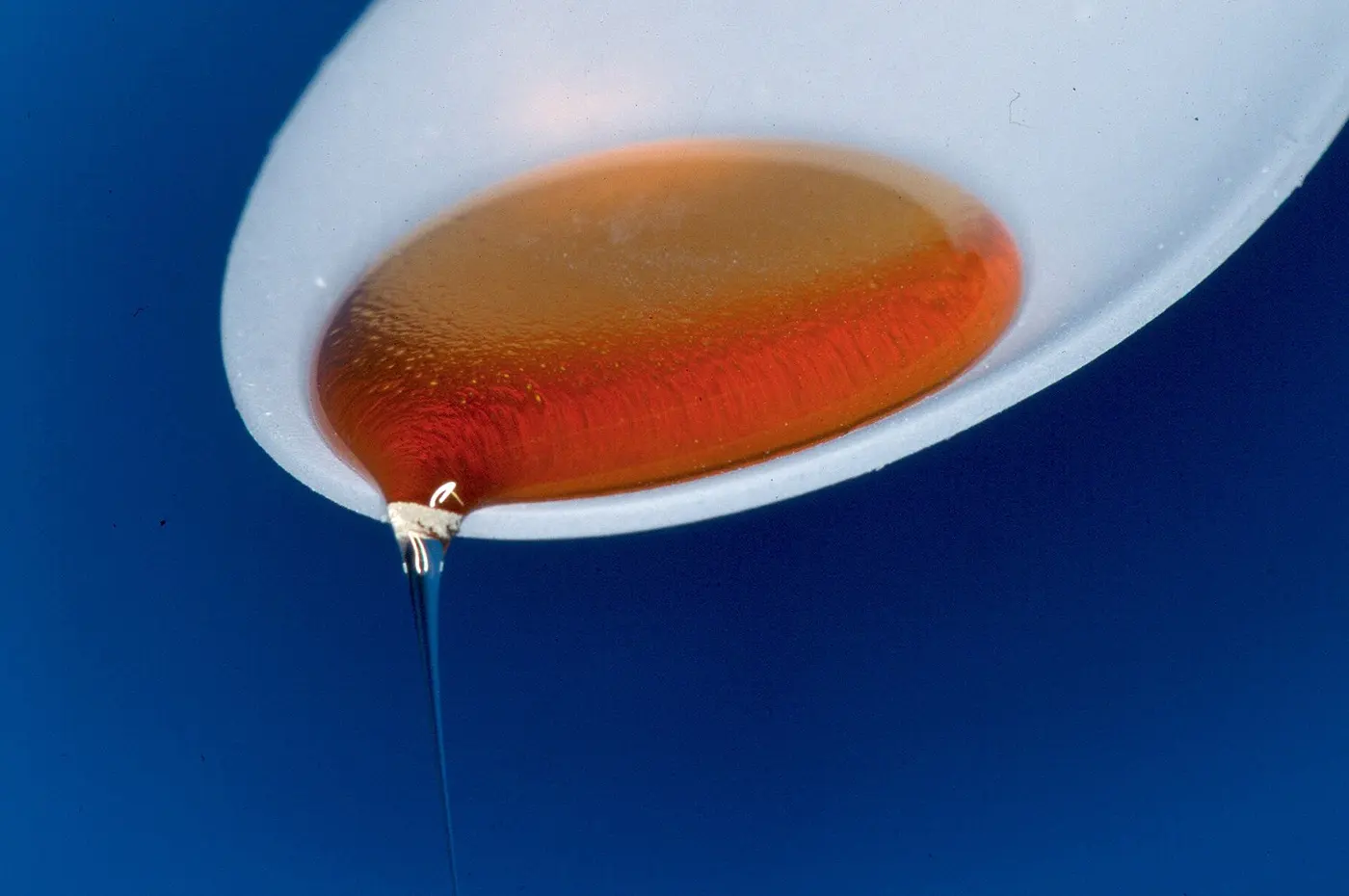
Barthlott recalls that industrial labs at the time assumed a clean surface had to be smooth; a rough surface that stayed clean was unthinkable. Only after his team produced a prototype in 1994, a spoon off which honey slid without leaving a trace, did companies start to work with them. “Lotus-Effect” was registered as a trademark and put to use in products such as Lotusan, a facade paint made by the German company Sto that lets rain wash dirt off buildings.

You may have met the idea at breakfast, too. In February 2010, the Japanese dairy company Morinaga Milk began using water-repellent foil lids on its yogurt so that it would not cling to the underside. The packaging material, developed with Toyo Aluminium, goes by the name TOYAL LOTUS. Its inner surface is covered with countless nanoscale bumps, so yogurt that touches it simply slides off.