Why do red spider lilies line Japan’s rice paddies?
Japan’s red spider lilies can’t make seeds, so they can’t spread far on their own. People are thought to have planted and moved their bulbs, for reasons that range from keeping out rodents to famine food.
33
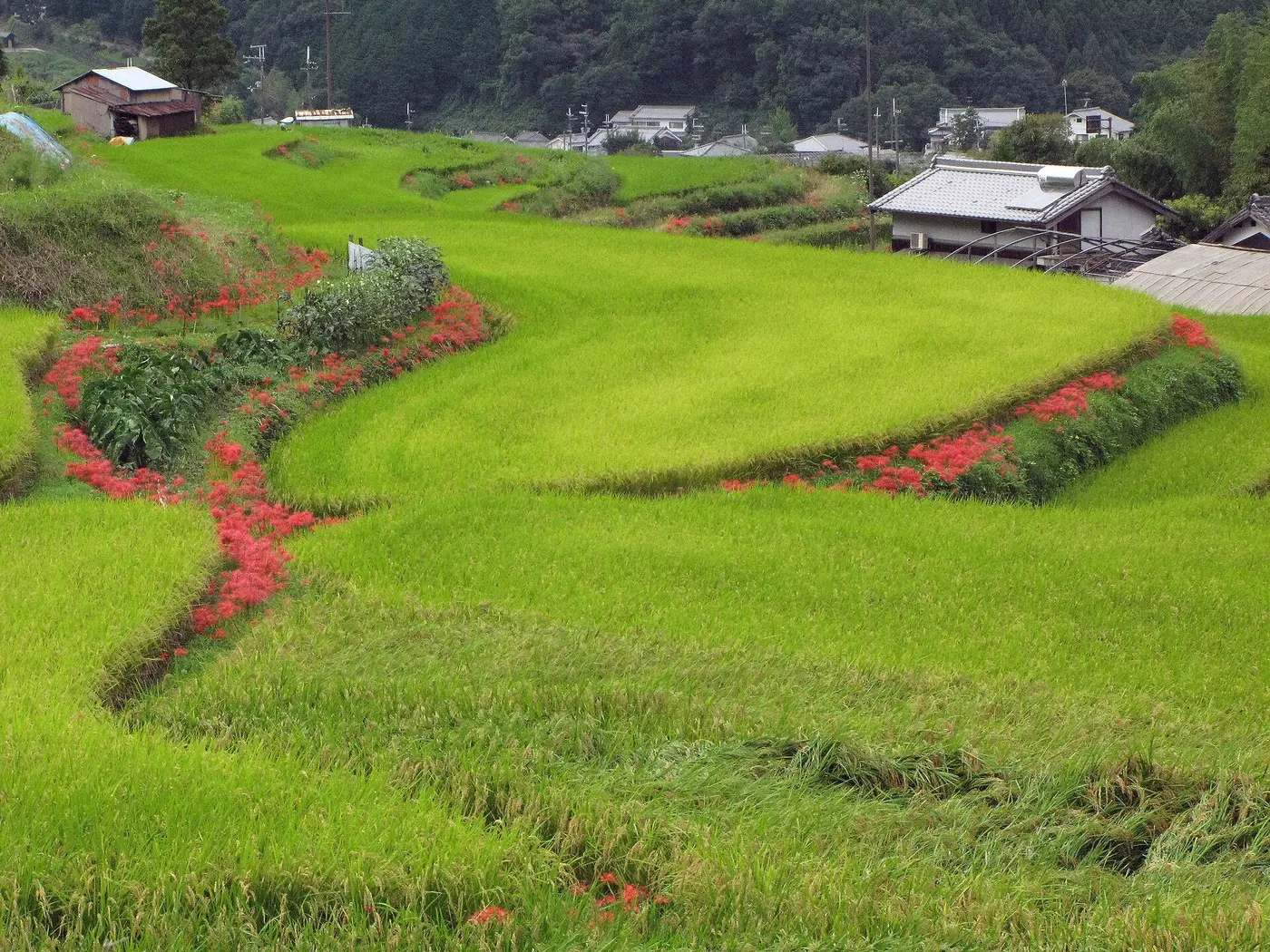
As the autumn equinox approaches, leafless stalks shoot up from the banks between Japan’s rice paddies and burst into bright red flowers. This is higanbana, the red spider lily, named for higan, the Buddhist week around the equinox. In a 1980 paper, Michihiko Takahashi of Shikoku Gakuin University listed where it grows in clusters: embankments, roadsides, canals, paddy banks, temples and graveyards. Every one is a place shaped by people.
There is a reason the flower sticks so close to people: in Japan, it cannot spread far on its own.
A flower without seeds
In 1944, the botanist Sukeo Inariyama reported that the cells of Japan’s red spider lilies carry 33 chromosomes, three times the basic number: they are triploid. All of Japan’s red spider lilies, he wrote, must have arisen from a diploid ancestor, and he went on to examine plants from China. They are thought to have been brought over from mainland China, though estimates of when range from prehistoric times to the 12th or 13th century.
Triploid plants usually cannot produce normal seeds, so the flowers bear no fruit. Instead, the red spider lily multiplies underground, its bulbs splitting into new ones. When Takahashi surveyed 80 sites in Shikoku, he found clumps 30 to 50 centimeters (12 to 20 inches) across, each packed with about 150 bulbs on average.
With no seeds for wind or birds to carry, the plant can reach a new place only if its bulbs are moved. Takahashi found isolated plants only in spots such as old road construction sites or along mountain streams below collapsed slopes, where bulbs had apparently washed down. The neat lines along paddy banks are therefore thought to mark where someone planted bulbs. Yoshiharu Fujii, a researcher who studies the chemical effects plants have on other organisms, wrote in 2008 that farmers’ ancestors planted the lily along paddy banks and in graveyards “with a purpose.”

A poisonous bulb
The key to that purpose may be the bulb’s poison. Red spider lily bulbs contain lycorine and several other alkaloids, and eating them causes vomiting.
The most common explanation is that the plants kept out rats and moles, which dig holes in the banks that let water leak out of the paddies. Noting that many books made this claim but none had tested it, Takahashi experimented with laboratory mice. Mice dug through a plain wall of soil in about 27 minutes on average. But through soil densely planted with bulbs and their roots, only 1 of 10 mice got through, and it took 62 hours. Mice crossed soil sprinkled with bulb juice but never lingered, and only 1 to 4 of 25 mice passed through the thicket of flower stalks on a paddy bank. Takahashi concluded that the lily probably offers a mild deterrent effect against rodents.
Moles, on the other hand, eat mainly earthworms and insects, not bulbs. Whether the lily keeps them away was not part of the experiment.
Famine food
The poisonous bulb has another side: it is full of starch. Hisayoshi Iwata and colleagues, who studied bulbs from field banks in Kyoto during the food shortages after World War II, reported in 1954 that fresh bulbs contain about 20 percent crude starch and can be eaten once the poison is removed. According to Fujii, lycorine dissolves easily in water, and in times of famine people dug up the bulbs and washed out the poison before eating the starch. There are even records of the bulbs being sold at market in northeastern Japan during great famines. Removing the poison is not simple, and trying it at home is dangerous.
Takahashi’s interviews with local people point to another way the plant may have spread. Before the bulbs were boiled with slaked lime or similar substances to remove the poison, their tops and bottoms were cut off, and small amounts of these scraps were tossed onto paddy banks and roadsides. The bottom ends could still grow roots and form new bulbs, so the lilies may have spread from kitchen scraps as well.
A plant made for paddy banks
The red spider lily has other traits that suit paddy banks. After flowering, it sends up leaves that last through the winter and wither in late spring, so it is gone from sight by summer, when the rice is growing. In Takahashi’s experiment, pots without the lily sprouted 5.5 times as many weeds as pots with it. On the banks he examined, the bulbs and their roots reached about 30 centimeters (12 inches) below the level of the paddy.


Fujii credits the plant with several roles: strengthening the banks, suppressing weeds, adding to the scenery and serving as emergency food. But as he notes, the real reasons people planted it have been forgotten. Rodent control and famine food are explanations pieced together from folklore and circumstance, and there may never have been just one.