Why do we need leap seconds?
To keep the time kept by atomic clocks within 0.9 second of time based on Earth’s rotation. But it has now been decided that no more will be added from 2027.
27
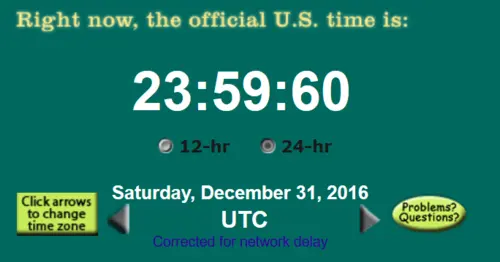
On the last day of 2016, official clocks around the world did something unusual. After 23:59:59 Coordinated Universal Time, they ticked over not to midnight but to 23:59:60, and only then to 00:00:00. In Japan, nine hours ahead, the extra second appeared on the morning of New Year’s Day as 8:59:60 a.m. This was a leap second, announced months in advance.
Clocks were given an extra second that day because the time we live by is a compromise between two different clocks.
The atomic clock and the Earth clock
According to Japan’s National Institute of Information and Communications Technology (NICT), the second used to be defined in terms of Earth’s rotation and its orbit around the Sun. In 1967 it was redefined in terms of atoms: one second is the duration of 9,192,631,770 cycles of a particular radiation given off by cesium-133 atoms. The time scale made by averaging atomic clocks around the world is called International Atomic Time.
Our daily lives, however, are tied to the Sun. We want the Sun to be high in the southern sky around noon, so timekeeping also has to keep an eye on Earth’s rotation.
The trouble is that the Earth is not nearly as precise a clock as an atomic one. NICT explains that Earth’s rotation speed changes, partly because of friction from the tides. As a result, atomic time and time based on Earth’s rotation slowly drift apart. So the world’s standard time, Coordinated Universal Time (UTC), runs on atomic clocks but is adjusted by adding or removing a second now and then, so that it never differs from Earth-rotation time by 0.9 second or more. That extra second is the leap second.
Twenty-seven extra seconds
The first leap second was added at the end of June 1972. By January 1, 2017, there had been 27. According to NICT, all of them were added seconds, none subtracted, which is why UTC is now 37 seconds behind International Atomic Time.

Whether to add a leap second is decided by the International Earth Rotation and Reference Systems Service (IERS), which monitors Earth’s rotation and announces its decisions about six months ahead. A leap second can be added after the last second of June or December, UTC.
A headache for computers
Even a single second can cause trouble for computers. In 2022, engineers at Meta described some of the problems leap seconds had caused. In 2012, a leap second made the website Reddit inaccessible for 30 to 40 minutes. In 2017, a bug at Cloudflare, rooted in “the belief that time cannot go backward,” took down part of its service. Some big tech companies avoid the jump altogether by “smearing” the extra second, slowing their clocks very slightly over many hours.
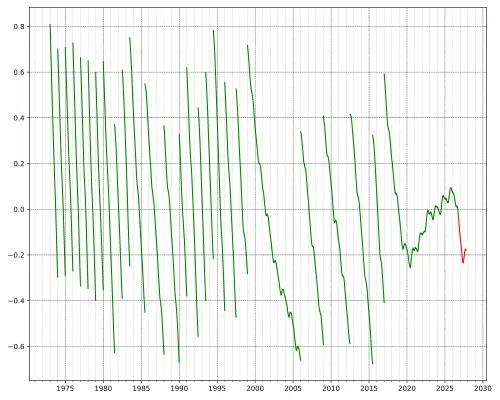

An even bigger worry was a negative leap second, a second taken away. The Meta engineers warned that it had never been tested on a large scale and could wreak havoc on software that relies on timers. In 2024, Duncan Agnew of the Scripps Institution of Oceanography predicted in Nature that under the current rules, a negative leap second would be needed by 2029. The rotation of Earth’s liquid core has been slowing, he explained, steadily speeding up the rest of the planet. He also found that melting ice in Greenland and Antarctica, by putting the brakes on Earth’s spin, had pushed that date back by about three years.
The end of the leap second
All this pushed the world toward dropping leap seconds. In 2022, the General Conference on Weights and Measures decided to raise the maximum allowed difference between Earth-rotation time and UTC by 2035. Then, in October 2026, the 28th General Conference set the new limit at 3,600 seconds, one full hour, and decided that UTC will become continuous from May 20, 2027. That should keep UTC free of jumps for several centuries. The IERS has already announced that no leap second will be added at the end of December 2026. If things go as planned, the leap second of January 1, 2017, will turn out to have been the last.