Will the Big Dipper always look the same?
No. All seven of its stars are moving, and within tens of thousands of years the shape will fall apart. The middle five travel together as siblings, but the two at the ends are heading another way.
80light-years
Seven bright stars form a great dipper, or ladle, in the northern sky. From mid-northern latitudes and farther north, the Big Dipper is visible almost all year, and for ages people have used it to find the North Star and to tell the time at night.
It looks like the very model of an unchanging sky. It isn’t. The Big Dipper is slowly coming apart.
The “fixed stars” move
Stars were long known in English as the “fixed stars,” and the Japanese word for a star, kōsei, literally means a “constant star.” The whole sky might wheel overhead each night and shift with the seasons, but the stars’ positions relative to one another were thought never to change.
Then in 1718 the English astronomer Edmond Halley compared the positions of bright stars such as Sirius and Arcturus with those in the star catalog of the ancient Greek astronomer Ptolemy, and found they had shifted. The stars were moving through space. This apparent motion is called proper motion. It is different from the slow wobble of Earth’s axis that hands the job of North Star from one star to another: that changes how the whole sky is oriented, while proper motion is the movement of each individual star.
The motion is tiny. According to measurements by the European Space Agency’s Hipparcos satellite, the Big Dipper’s stars move about 0.1 arcsecond a year (an arcsecond is 1/3,600 of a degree). At that pace, it takes each of them roughly 13,000 to 20,000 years to travel the width of the full Moon. Nobody would notice in a lifetime, but over tens of thousands of years the pattern changes unmistakably.
Five siblings in the middle
In 1869 the English astronomer Richard Proctor, studying the Big Dipper’s proper motions, reported that five of the seven stars, all but the two at the ends, were moving at nearly the same speed in the same direction. As the Japanese astronomer Junichi Watanabe of the National Astronomical Observatory of Japan has explained in a column, these five appear to be siblings born together from the same cloud of gas.
The five, along with related stars scattered around the sky, are known as the Ursa Major Moving Group. A 2003 study listed nearly 60 assured members. Hipparcos puts all five Big Dipper members about 80 to 86 light-years away, practically next door on a cosmic scale. A 2015 study estimated the group’s age at about 414 million years, and a study published in 2026 also arrived at about 400 million years.
Stars born together, Watanabe explains, stay bunched in a cluster for a while. Once the parent cloud is blown away, tiny differences in speed and direction slowly pull them apart. The five Big Dipper stars are siblings in the middle of drifting apart.
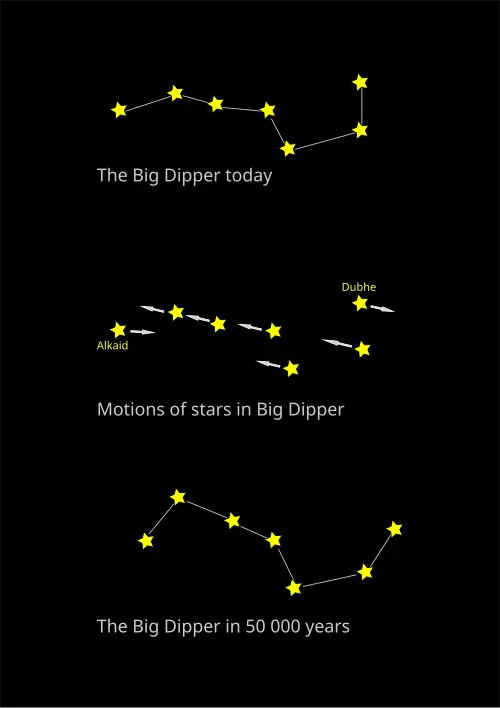

Two outsiders at the ends
The two end stars, Dubhe at the lip of the bowl and Alkaid at the tip of the handle, are not members of the group. Hipparcos places Dubhe about 120 light-years away and Alkaid about 100, both farther than the five siblings. And across the sky they are moving in nearly the opposite direction.
So the Big Dipper will change shape. Dubhe will pull away from its neighbor Merak, stretching the bowl out sideways, while Alkaid swings around toward the same side as the bottom of the bowl, putting a sharp bend in the end of the handle. Calculations based on the proper motions measured by Hipparcos suggest that in 100,000 years the dipper will be hard to recognize, while 100,000 years ago its handle was much longer and straighter.

In Watanabe’s words, the Big Dipper looks like a dipper “only for these few tens of thousands of years.” We just happen to be around at the right time.