Do the colors of kabuki face makeup mean something?
Yes. As a rule, red stands for justice and strength, indigo for evil and vengeful ghosts, and brown for demons and monsters. But there are exceptions, and the number and shape of the lines matter too.
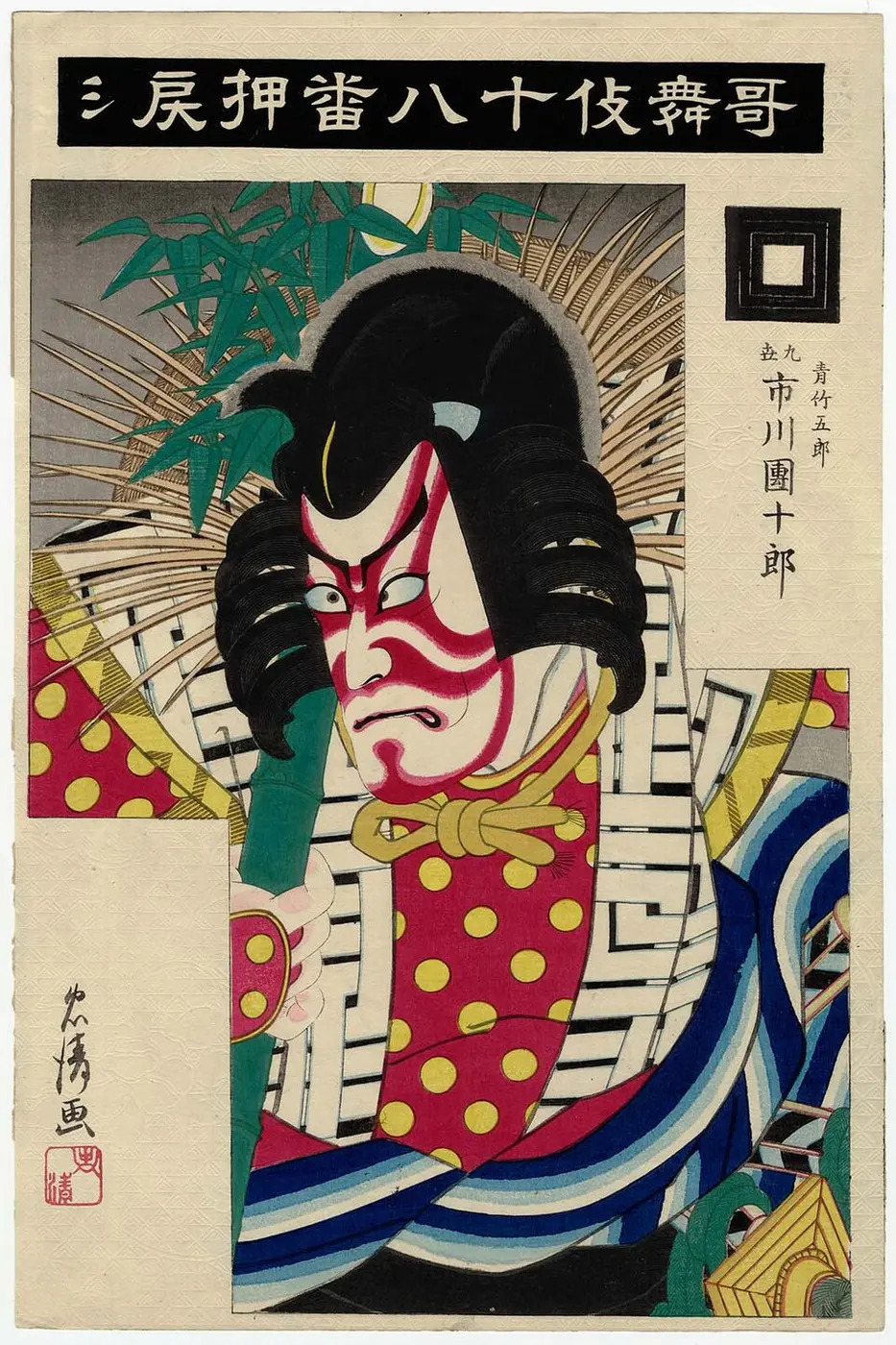
A face painted white, with thick red lines sweeping up from the eyes toward the forehead. In the kabuki play Shibaraku (“Wait a moment!”), the hero Kamakura Gongorō strides on with this face to stop a gang of villains in their tracks, and for many people it is the very image of kabuki. The makeup is called kumadori.
Kumadori colors are often said to have set meanings: red for justice, blue for evil, brown for demons and monsters. Japanese reference works largely agree. But color is not the whole story.
Painting with shadows
According to the Japanese encyclopedia Nipponica, kuma means a hidden recess or a shaded place. Kumadori lines follow the bones of the face and are blurred at one edge, so that they suggest muscles and the shadows between them. Applying it is called “taking the kuma.”
According to notes from the National Theatre of Japan, the red lines of the suji-guma style represent the bulging muscles and swelling veins of a fierce, righteous hero. The red on white is, in effect, a way of making furious strength visible.
Chinese opera has a painted-face makeup too, known as lianpu. Nipponica says that while some think kumadori was inspired by it, most theories point instead to the influence of carved masks, such as those of Noh theater, and the angry faces of Buddhist statues. The National Theatre notes one key difference: kumadori lines are shaded off, while lianpu lines are not, because lianpu is at heart a mask. Kumadori lets the actor’s own expressions show through.
Did Danjūrō I invent it?
Kumadori is usually credited to Ichikawa Danjūrō I, the actor who established aragoto, the bold, larger-than-life style of acting that became the hallmark of kabuki in Edo, now Tokyo. According to the encyclopedia Sekai Daihyakka Jiten, the standard story says that in 1673, at his stage debut at 14, he played the boy hero Sakata no Kintoki with his whole body painted red and his face lined in red and black. But a Japanese history dictionary published by Yamakawa points out that the 1673 date comes from a later chronicle; actor critiques from the time treat a 1685 role as the beginning of aragoto.

Nipponica, too, says that no one knows exactly when kumadori began, only that it existed by the Genroku era (1688–1704) and that Danjūrō I is said to have created it. The technique of drawing red over white face powder and blurring the lines is credited to Danjūrō II, while his contemporaries Nakamura Denkurō and Yamanaka Heikurō worked out other basic patterns. Rather than one man’s invention, kumadori looks like the product of a whole generation of actors.
Red for good, blue for evil
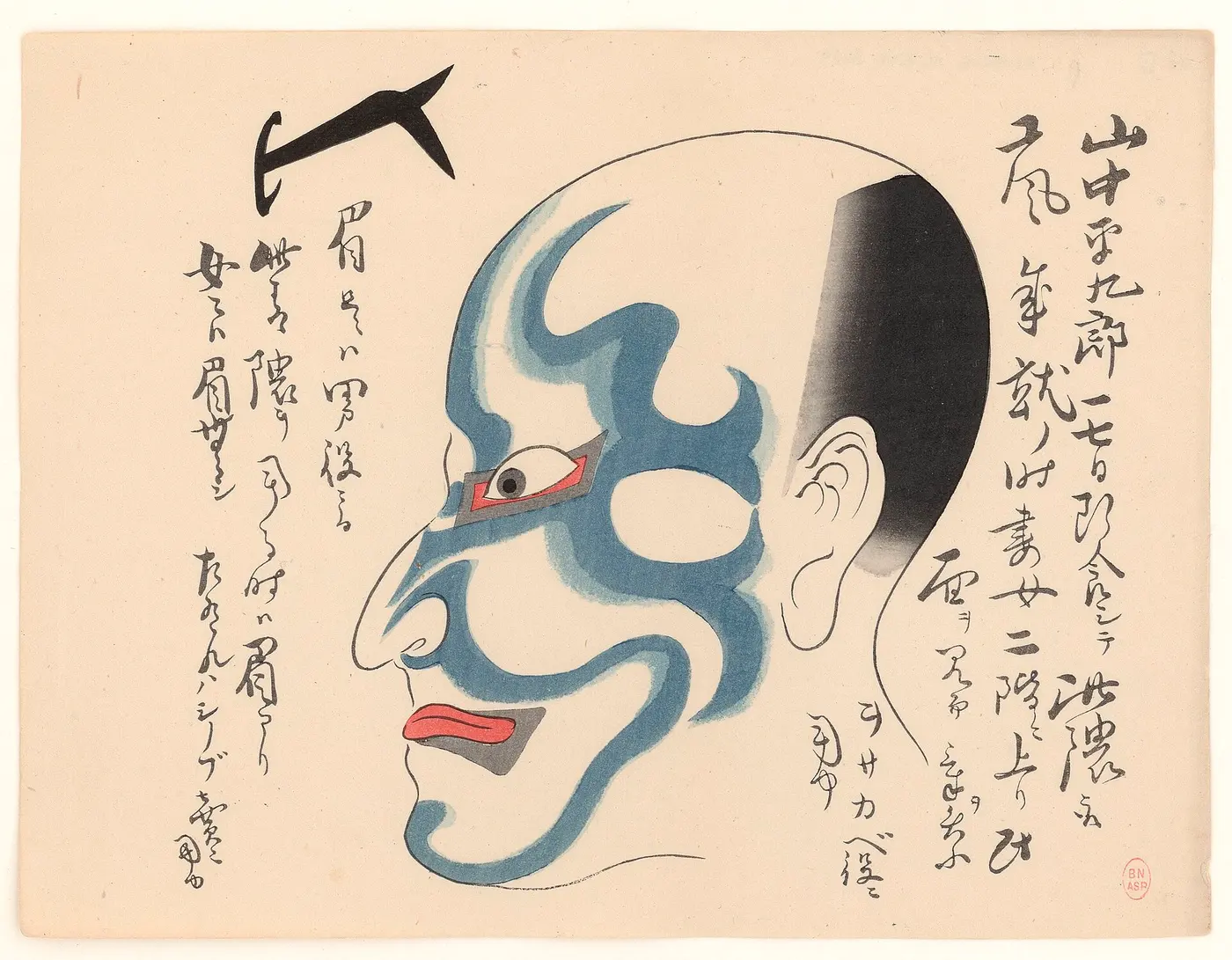
Kumadori falls into two broad families. According to Nipponica, red kumadori stands for “positive” qualities such as justice, strength and passion, while indigo and taisha (a reddish brown) stand for “negative” ones: evil, vengeful spirits and demons.
In Shibaraku, for example, the red-lined hero faces the chief villain, Kiyohara no Takehira, who wears an indigo style called kuge-are. According to the National Theatre, kuge-are marks princes and courtiers scheming to seize the throne, and because this sinister blue face is set against the hero’s red one, the role is known as the uke, the one who “receives” the hero’s challenge. Brown is used for monsters and shape-shifters, such as the spider spirit in Tsuchigumo.
There are exceptions. In Fudō, the god Fudō Myōō wears the brown normally used for monsters, though he is a guardian deity, not an evil one. Demons do not always wear brown either: the demon woman in Momijigari (“Maple Viewing”) wears indigo. Some styles, such as the one for the warrior Kagekiyo, mix red and indigo. The color meanings are less a strict code than a basic grammar for telling the audience who is who.

Counting the lines
Even within red kumadori, the pattern of lines changes the character. According to the National Theatre, the four typical styles for aragoto heroes are mukimi-guma, ippon-guma, nihon-guma and suji-guma. The simplest, mukimi, named for its resemblance to a shucked shellfish, signals a young, hotheaded hero, such as Sukeroku. As the lines multiply, the character grows weightier and more powerful, up to the most elaborate, suji-guma.
The difference is easiest to see in the “Kurumabiki” (“Pulling the Carriage”) scene from Sugawara denju tenarai kagami. Of the triplet brothers, Umeōmaru wears suji-guma, Matsuōmaru nihon-guma and Sakuramaru mukimi, while their enemy, the courtier Fujiwara no Shihei, wears indigo kuge-are. The National Theatre calls this short scene “a moving sample book of kumadori.”
Sekai Daihyakka Jiten counts about 50 kinds of kumadori; Nipponica puts the number as high as 100. Some are purely comic, like the “monkey” style with rows of lines across the forehead, or the catfish style, complete with whiskers.