Where does Japan’s spring “yellow dust” come from?
From the Taklamakan and Gobi deserts and the Loess Plateau, deep in the Asian interior. Westerly winds high in the sky carry it thousands of kilometers to Japan.
15.8days
On some spring days in Japan, the sky takes on a yellowish haze, and distant mountains and buildings fade into a blur. A fine layer of dust settles on balcony railings and car roofs. This is kōsa, “yellow sand,” blown across the sea from the Asian mainland.
Where does it start, and how does it reach Japan? Follow it back, and you find faraway deserts and strong westerly winds high in the sky.
From deserts and yellow earth
The Japan Meteorological Agency (JMA) defines yellow dust as large amounts of sand and dust whipped up by strong winds from the deserts of East Asia, such as the Gobi and Taklamakan, and from the region of loess, or wind-blown yellow soil, then carried by winds aloft and gradually falling as it drifts. A pamphlet from Japan’s Ministry of the Environment names the main sources as the Taklamakan Desert, the Gobi Desert and the Loess Plateau in the interior of China. Winds loft the dust thousands of meters into the air, and the westerlies carry it to Japan.
The Taklamakan lies in the Xinjiang Uyghur Autonomous Region in western China, and the Gobi stretches across northern China and Mongolia. From the middle of the Taklamakan to Tokyo is roughly 5,000 kilometers (3,100 miles) as the crow flies. Even from the Gobi, it is about 3,000 kilometers (1,900 miles).
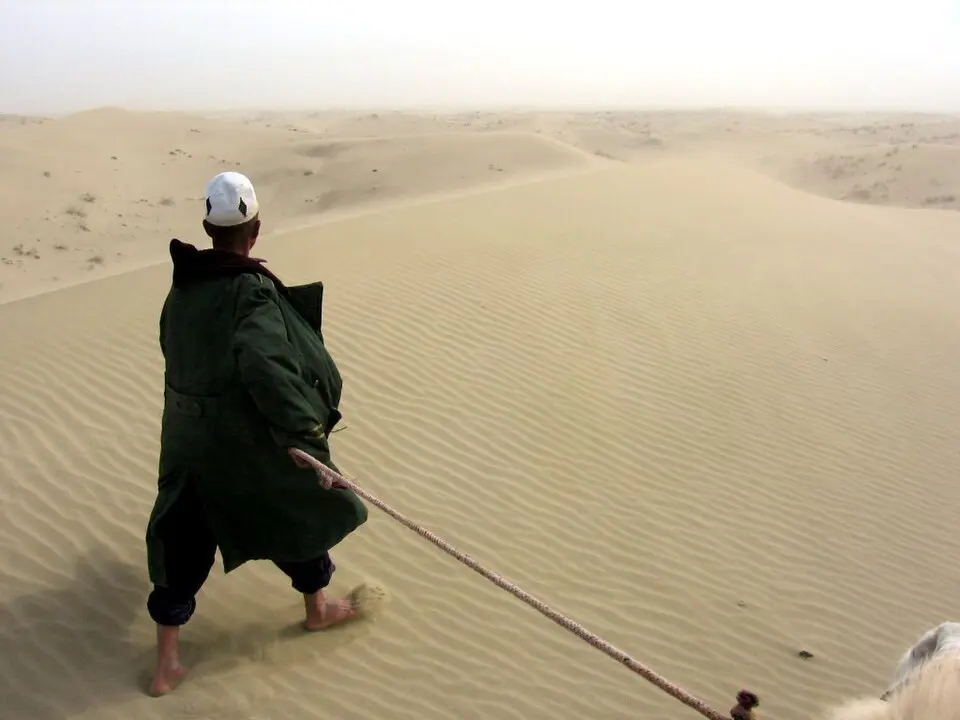

Not everything that rises into the air reaches Japan. According to JMA, relatively large particles, 10 micrometers (0.01 millimeter) across or more, quickly fall back to the ground, and only particles a few micrometers or smaller are carried long distances. The Ministry of the Environment says the yellow dust reaching Japan is most often about 4 micrometers across, made largely of rock-forming minerals such as quartz and feldspar along with mica and clay minerals.
Why spring?
According to JMA statistics, the 30-year average (1991–2020) number of days per year on which yellow dust was observed at one or more of its weather stations is 15.8. Of those, 4.4 fall in March, 6.2 in April and 2.7 in May, so more than 80 percent come in just those three spring months.
JMA explains the spring peak by the state of the ground where the dust comes from. From summer through fall, plants cover the land, and in winter the soil is frozen or blanketed with snow, so little dust can rise. In early spring, the snow and frozen ground are gone but the plants have not yet grown. According to the Ministry of the Environment, when strong winds from low-pressure systems blow across this bare, drying ground, the dust takes to the air.
Yellow dust is not limited to spring, though; if the source areas are dry and the winds aloft blow toward Japan, it can arrive in other seasons too. The amount also varies greatly from year to year. In 2001, the worst year on record at JMA’s 11 long-term stations, yellow dust was observed on 38 days. In March 2002 it reached Sapporo, in the far north, where it had rarely been seen before, and made national news.
Measured by the human eye
Surprisingly, JMA’s yellow-dust observations rely on human eyes. Weather station staff record “yellow dust” when they see the air turn hazy with floating dust, noting when it began and ended and how far they can see.
For many years these observations were made at 11 stations: Sapporo, Sendai, Tokyo, Niigata, Nagoya, Osaka, Hiroshima, Takamatsu, Fukuoka, Kagoshima and Naha. At the end of March 2024, however, the nine stations other than Tokyo and Osaka stopped observing it. JMA now also uses ground-based instruments and data from its Himawari geostationary weather satellite to track how yellow dust spreads.
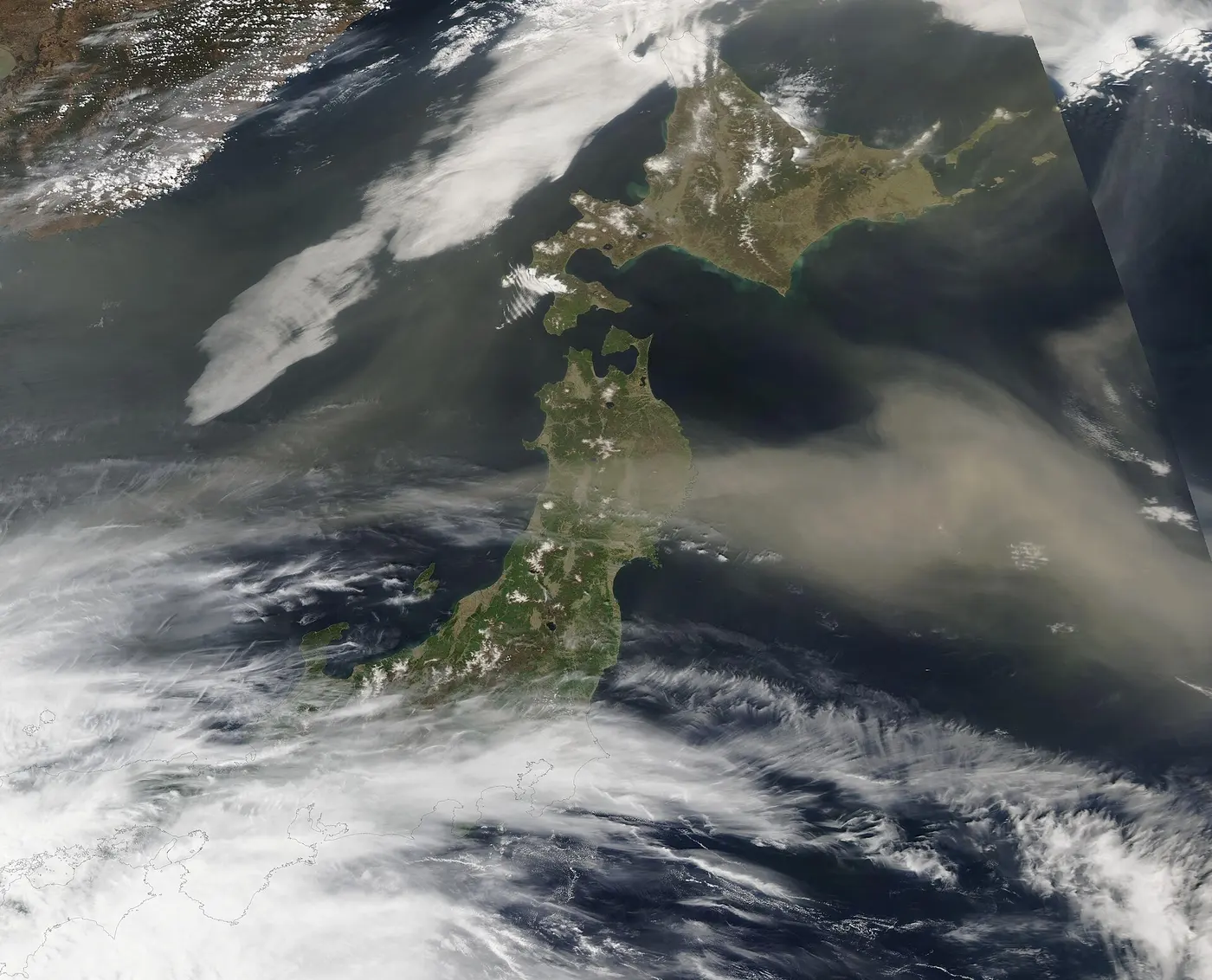

There are forecasts, too. A JMA computer model simulates how dust is lifted, carried and deposited, predicting concentrations up to 96 hours ahead, and forecast maps based on it are published daily.
The season when “earth rains down”
Yellow dust has been recorded since ancient times. According to the Ministry of the Environment, a term meaning “dust rain” appears in Chinese historical writing from around 1150 BCE. In Korea, a record from the Silla kingdom describes “earth rain” in the year 174. In Japan, the Honchō nendaiki, a chronicle compiled in the Edo period (1603–1868), records that “red snow,” snow tinted by dust, fell in the northern provinces in 1477.
In Japanese haiku, yellow dust is a word for spring. It can be written with the old character 霾 and read tsuchifuru, literally “earth falls,” describing soil and sand blown up by the wind and raining down. The great dictionary Nihon Kokugo Daijiten cites a line from Matsuo Bashō’s travel journal The Narrow Road to the Deep North, “as if earth were raining down from the edge of the clouds.” The poet Nakamura Teijo wrote a haiku in which a perfectly round evening sun sinks into the falling dust.