Was the kilogram once defined by a lump of metal?
Yes. From 1889 to 2019, a kilogram was the mass of a metal cylinder kept near Paris: the International Prototype of the Kilogram.
50μg
Produce sold by weight, parcel delivery fees, the reading on your bathroom scale: our lives are full of kilograms. Scales around the world agree on what a kilogram is because they can all be traced back, step by step, to one reference.
Until 2019, that reference was a single piece of metal. Of all the base units of the International System of Units, the kilogram was the last one still defined by a human-made object.
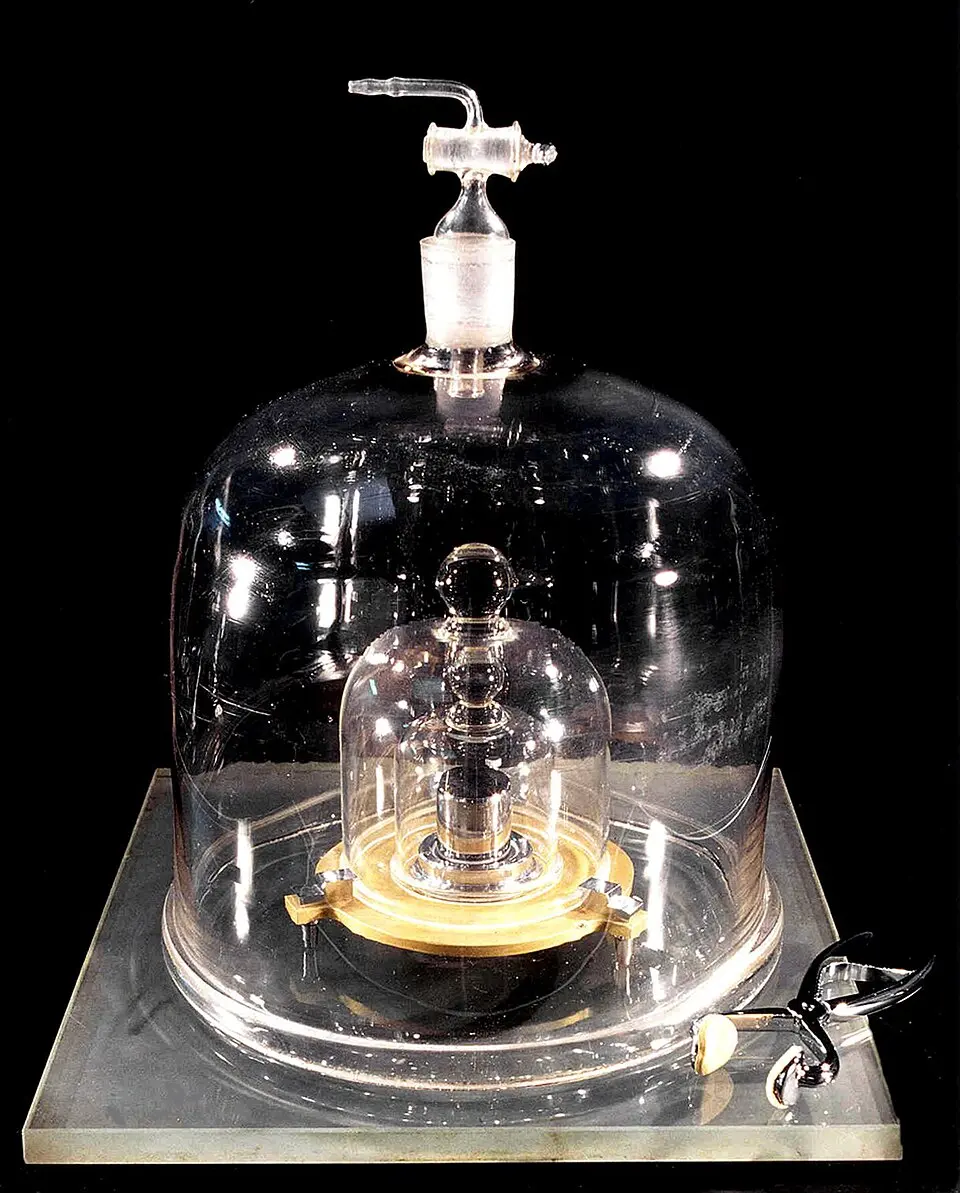
“Le Grand K” outside Paris
In 1875, 17 countries signed the Metre Convention and set out to create shared units of measurement. At the first General Conference on Weights and Measures in 1889, the kilogram was defined as the mass of the International Prototype of the Kilogram. The prototype is a cylinder 39 millimeters (about 1.5 inches) tall and 39 millimeters across, made of an alloy of 90 percent platinum and 10 percent iridium, chosen because it is harder and wears less than pure platinum.
The prototype has been kept under tight security at the International Bureau of Weights and Measures (BIPM) in Sèvres, just outside Paris, and is nicknamed “Le Grand K,” French for “the big K.” At about the same time, some 40 copies of nearly the same mass were made and distributed to member countries. Japan, which joined the Metre Convention in 1885, was assigned copy No. 6, which arrived in 1890. Today it is kept by the National Institute of Advanced Industrial Science and Technology (AIST) in Tsukuba, northeast of Tokyo.

Fifty micrograms in a century
Every few decades, the prototype and its copies were gathered at the BIPM and compared. Comparisons in 1946 and again from 1989 to 1992 revealed that the masses of the international prototype and its copies were slowly drifting apart. Over a century, it seemed, the prototype had become about 50 micrograms lighter than its copies. Contamination of the surfaces is thought to be among the causes.
Fifty micrograms is five hundred-millionths of a kilogram, equivalent to being off by about 2 meters over the roughly 40,000-kilometer (25,000-mile) circumference of the Earth. Tiny, yes, but too large to ignore in the most precise measurements.
There was a deeper problem, too. By definition, the international prototype always weighed exactly one kilogram. There was no way to tell whether it was the prototype or the copies that had changed.
From an object to a constant
The meter had already given up its prototype in 1960, switching to a definition based on a wavelength of light and later on the speed of light. Could the kilogram also be tied to a constant of nature that is the same everywhere in the universe? Metrology institutes around the world settled on the Planck constant, a fundamental number from quantum physics that links the energy of light to its frequency and, through Einstein’s famous equation, to mass.
On November 16, 2018, the 26th General Conference on Weights and Measures voted to redefine the kilogram by fixing the Planck constant at exactly 6.62607015 × 10⁻³⁴ joule-seconds. The new definition took effect on May 20, 2019, World Metrology Day.
To settle on that number, laboratories measured the Planck constant with unprecedented precision, mainly in two ways: the Kibble balance, which balances the gravitational pull on a mass against an electromagnetic force, and a method that counts the atoms in a sphere of crystalline silicon.
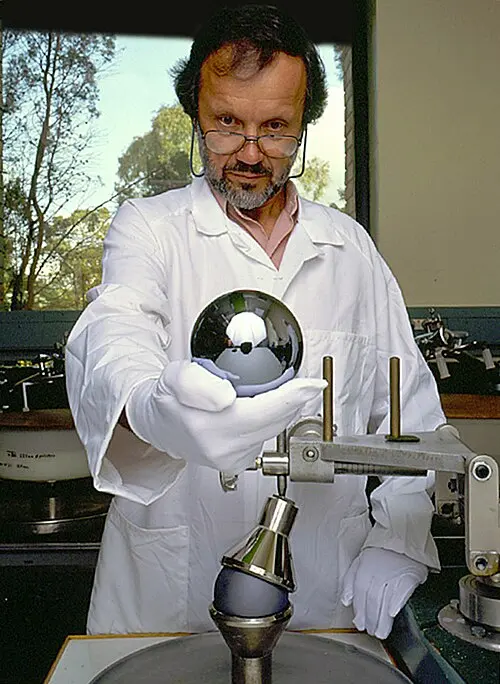

AIST in Japan took the second route. Using a sphere made for the International Avogadro Project, about 94 millimeters (3.7 inches) across and weighing about 1 kilogram, its researchers measured the diameter to within 0.6 nanometers, roughly the spacing between the silicon atoms. Of the eight measurements used to fix the value in the definition, AIST was involved in four. According to AIST, it was the first time a country outside Europe and North America had played such a decisive role in defining an international unit. Today the institute uses silicon spheres whose mass is determined from the Planck constant as the basis for Japan’s mass standards.