Can a domino knock over a bigger domino?
Yes. A domino can topple one about 1.5 times its own size, so a chain that grows a little at each step can go from a fingernail-size tile to a 45-kilogram slab.
1.5×
Line up a row of dominoes, tap the first one, and they clatter down one after another. When the last tile falls, it’s hard not to applaud.
But what if the domino being knocked over is bigger than the one doing the knocking? Can a small domino topple a larger one?
Why a nudge is enough
It doesn’t take much to knock over a standing domino. Tip the thin slab just far enough that its center of mass passes over the edge of its base, and gravity does the rest. To get there, the center of mass has to rise only a tiny fraction of the domino’s height. It helps, too, that a push near the top tips it more easily than a push near the bottom, and a falling domino strikes the next one high up.
A falling domino, meanwhile, drops its center of mass from about half its height almost to the floor. In doing so it releases far more energy than it takes to tip over the next domino. That surplus is what allows a domino to topple one bigger than itself.
Scale a domino up in height, width and thickness alike, and its weight grows with the cube of its size. The energy it releases as it falls grows faster still, with the fourth power, since the height its center of mass falls from grows too. A domino 1.5 times bigger packs about five times the energy.


The 1983 “chain reaction”
The physicist Lorne Whitehead of the University of British Columbia in Canada demonstrated the idea in 1983. In a short note titled “Domino ‘chain reaction’” in the American Journal of Physics, he described a row of dominoes, each 1.5 times larger than the one before, toppling one after another.
The best-known version is a 2009 video by Stephen Morris, a physicist at the University of Toronto. According to Physics World, the magazine of Britain’s Institute of Physics, Morris lined up 13 dominoes, each 1.5 times the size of the last. The energy needed to tip the first, fingernail-size domino was amplified about two billion times, and the chain ended with a 45 kg (100-pound) block crashing to the floor. At that growth rate, the 13th domino is about 130 times as tall as the first. “If I had 29 dominoes,” Morris said, the last one “would be as tall as the Empire State Building.”
Twice as big, in theory
Is 1.5 the limit? In 2012 a Dutch science quiz asked how many dominoes it would take to topple a domino as tall as the Domtoren, the 112-meter (367-foot) cathedral tower in Utrecht. The question prompted J. M. J. van Leeuwen, a physicist at Leiden University, to work out the maximum growth factor. His answer: in theory, each domino could be up to twice the size of the one before.
According to Physics World, starting with a standard domino 4.8 centimeters (1.9 inches) tall, it would take 20 dominoes to reach the Domtoren at a growth factor of 1.5, but only 12 at a factor of two. That calculation, however, assumes ideal conditions, such as dominoes that never slip on the floor and no friction where they touch one another. Van Leeuwen admitted that real dominoes don’t behave that way.
Four and a half million dominoes
According to van Leeuwen, a falling row of dominoes travels at something like a meter per second (about 2 miles per hour). For dominoes of the same proportions and spacing, the speed scales with the square root of their height, so taller dominoes topple in a faster wave.
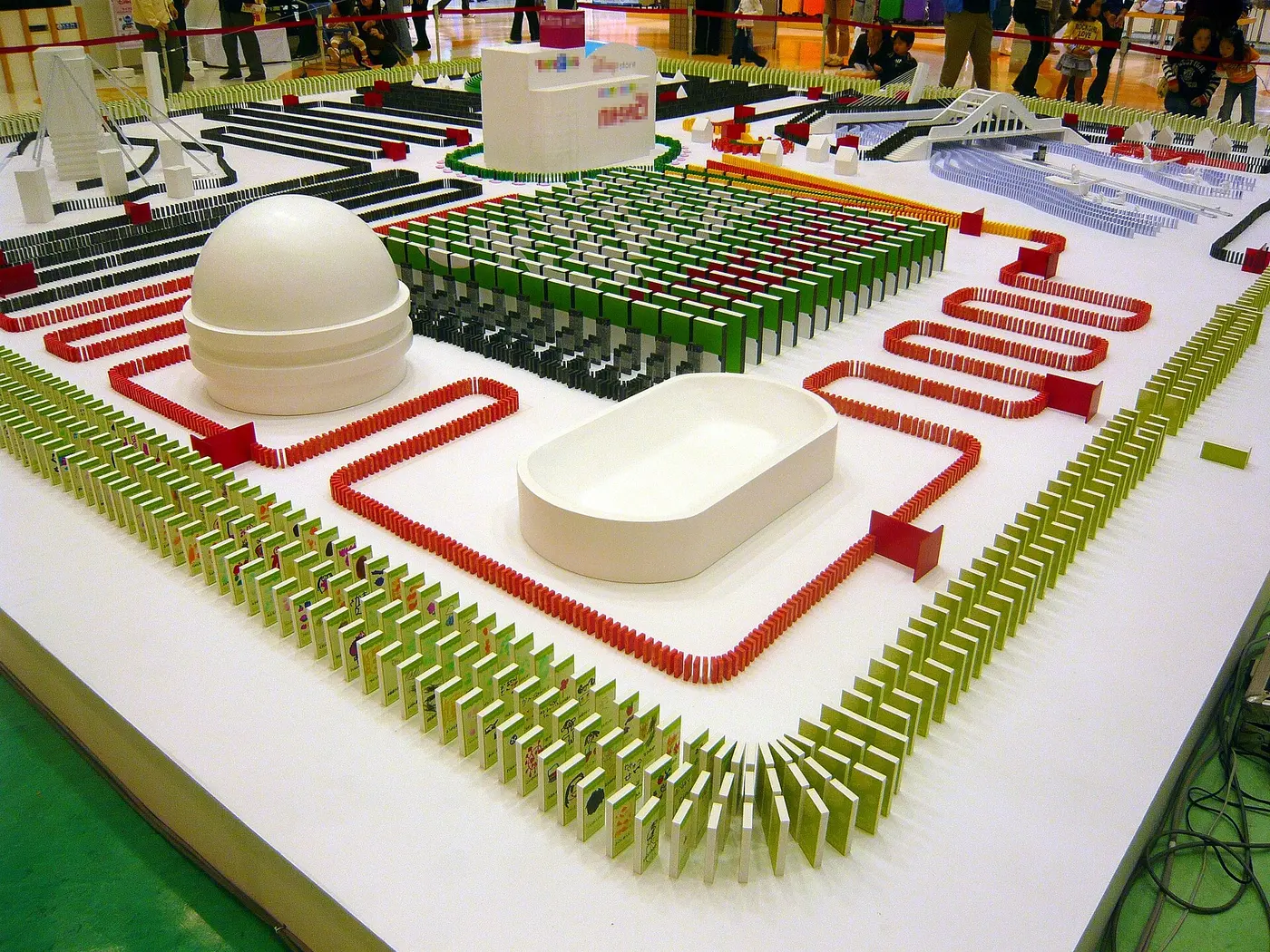

People have long competed to make the biggest topple of all. According to Guinness World Records, the record for the most dominoes toppled by a group was set at Domino Day 2009 on November 13, 2009, in an exhibition center in Leeuwarden, the Netherlands, where 4,491,863 dominoes fell. They were set up by 89 builders.