How do you play kemari, Japan’s ancient court football?
A group of players kick a deerskin ball into the air and pass it among themselves, trying to keep it from touching the ground. There are no goals and no opposing team.
Kemari, also read shūkiku and in older Japanese kuemari, is a ball game once played by Japan’s court nobility. According to the Digital Daijisen dictionary, several players wearing leather shoes kick a deerskin ball with the tops of their feet, passing it among themselves without letting it fall.
It is played with the feet, like soccer, but there are no goals and no opposing team. So what is the point?
A game from the continent
Ball-kicking games began in China. According to the Heibonsha World Encyclopedia, one existed before 221 BCE and was played as military training under the Han dynasty. By the Tang dynasty there was even a soccer-like version with two goals. But there was also a style in which the aim was simply to keep the ball up, and a Song dynasty manual describes an eight-player form said to be the one that reached Japan.
It is thought to have reached Japan in the Asuka period (roughly 550–710), and any history of kemari in Japan soon comes to one famous scene.
A prince loses his shoe
The Nihon Shoki, an official chronicle completed in 720, describes, under the first month of 644, how Nakatomi no Kamako (later Fujiwara no Kamatari) befriended Prince Naka no Ōe, the future Emperor Tenji.
Kamako had been seeking a way to approach him. One day, under a zelkova tree at the temple of Hōkōji, the prince joined a group playing a ball game, and his leather shoe flew off with the ball. Kamako picked it up, knelt and respectfully offered it back. The prince knelt in turn to receive it, and from then on the two were close. The next year the two killed the powerful Soga no Iruka, paving the way for the Taika reforms.
The Nihon Shoki’s actual word for the game, though, is dakiku, which literally means “striking the ball.” According to the Nihon Kokugo Daijiten dictionary, an early manuscript of the chronicle, the Iwasaki copy, glosses it as a word meaning “kicking the ball.” And a biography of the Fujiwara family written around 760, the Tōshi Kaden, describes the same scene as taking place in a “kemari garden.” How closely the game the prince played resembled the later court sport is not clear.
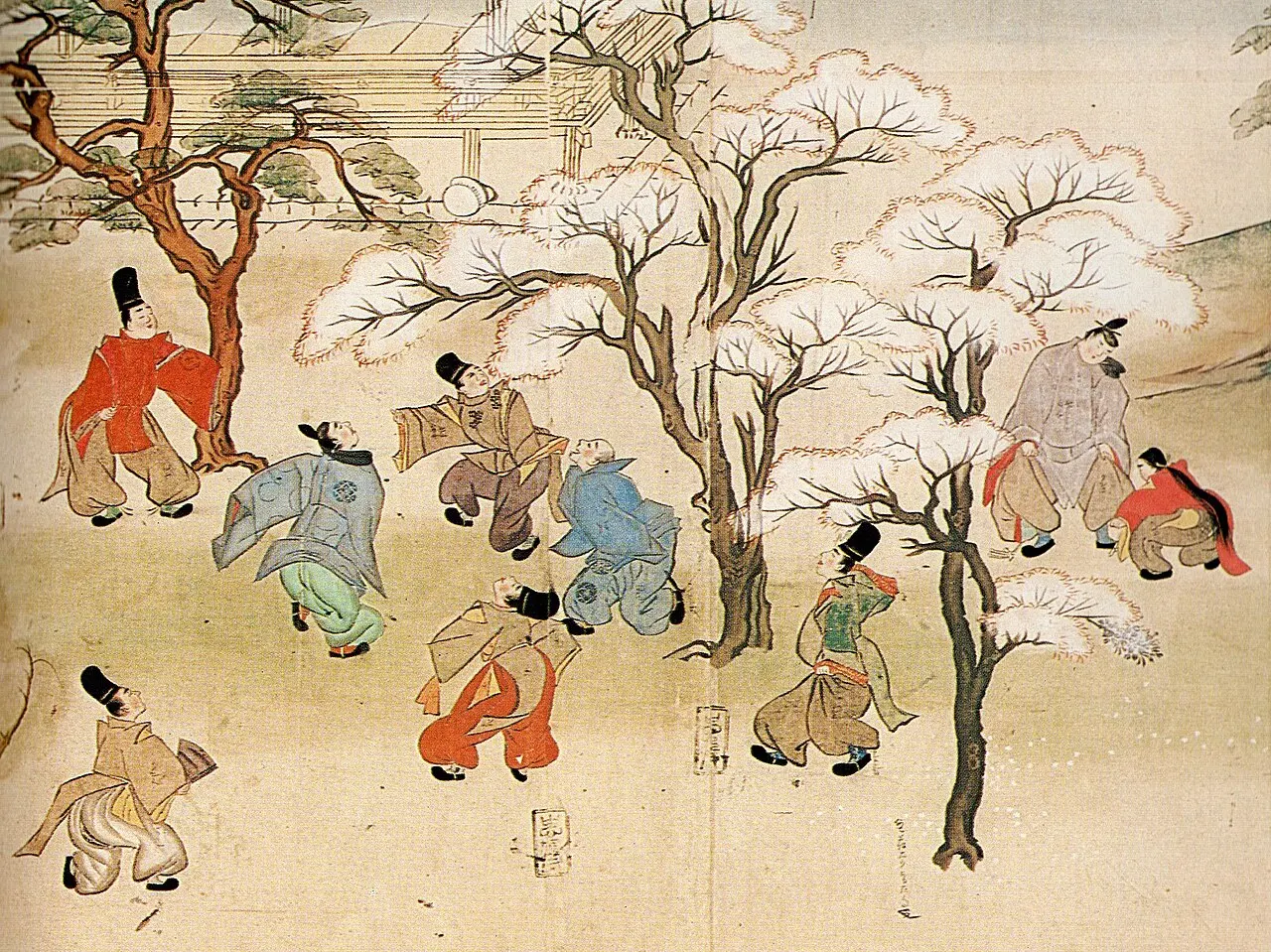

Masters and kemari families
According to the Nihonica encyclopedia, kemari was popular among the nobility by the early 10th century, and in the 12th century masters such as Kamo no Narihira and Fujiwara no Narimichi refined its techniques and etiquette. At its height, in the 12th and 13th centuries, it spread even to the samurai of the Kamakura shogunate.
In the early Kamakura period (1185–1333), kemari became a hereditary family art. Two brothers, Munenaga and Masatsune, grandsons of the celebrated player Fujiwara no Yorisuke, founded the Nanba and Asukai schools. By the Muromachi period (1336–1573), kemari was ranked alongside poetry as a courtly accomplishment, and both families served as instructors to the shoguns. The Nanba school later faded, and the Asukai family kept the tradition until the Meiji era (1868–1912).
Under the four trees
Formal kemari is played on a court called a kakari. According to the Nihon Kokugo Daijiten, it measured about 14 meters (46 feet) on each side, with a cherry tree planted at the northeast corner, a willow at the southeast, a maple at the southwest and a pine at the northwest. There are usually eight players, called mariashi, two under each tree, and the most skilled player, standing under the pine, kicks first. Each player who receives the ball kicks it three times, with a call, before passing it on. There are three calls: “Ari,” “Yaa” and “Ō.”
The ball is made of deerskin, about 20 centimeters (8 inches) across, turned inside out and stitched together with leather from a horse’s back.
So who wins? The Nihon Kokugo Daijiten says players vied over the number of kicks as well as the arc of the ball and the grace of the kicker. Yet the head of the Kemari Preservation Society, which keeps the game alive today, said in a Kyodo News report in January 2026 that “kemari has no winners or losers.” The idea is to send each other easy balls and keep the rally going.
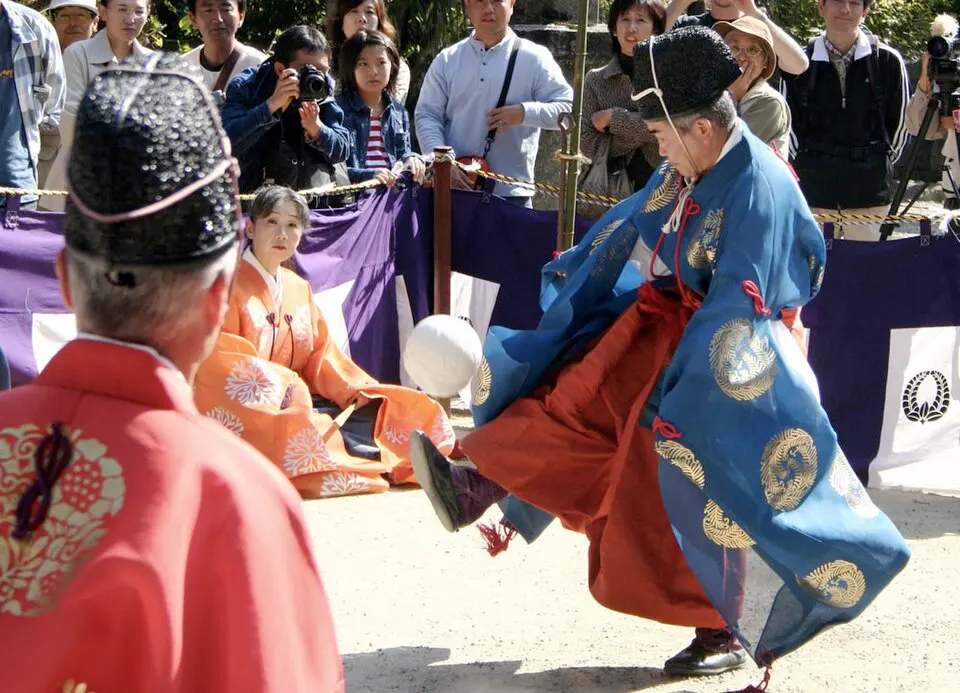

Kemari declined after the Meiji Restoration, but the Kemari Preservation Society, founded in 1903 at the command of Emperor Meiji, has carried it on. It can still be seen at events such as the first game of the year, held on January 4 at Shimogamo Shrine in Kyoto. At Tanzan Shrine in Nara, which enshrines Kamatari, kemari festivals are held on April 29 and November 3 in honor of the famous meeting.