When did the rank of yokozuna begin?
Licenses to wear the yokozuna rope began in 1789; it became an official rank only in 1909.
1789
Before the top-division bouts of a grand sumo tournament, the yokozuna performs his ring-entering ceremony. With a thick white rope tied around his waist, he stamps his feet and slowly rises from a deep crouch, carrying a weight that no other wrestler has. Yokozuna is the highest rank in sumo, and once a wrestler is promoted, he can never fall back to ōzeki, the rank below, however badly he performs.
Yet the word “yokozuna” did not start out as the name of a rank. It literally meant the tsuna, the rope worn around the waist.
The top rank used to be ōzeki
On the ranking sheets (banzuke) of the Edo period (1603–1868), the highest rank listed was ōzeki. There was no yokozuna anywhere on the sheet.
So what was a yokozuna? It was a privilege granted only to exceptional ōzeki: the right to perform the ring entrance wearing a white hemp rope. The rope was said to carry the same purifying meaning as the shimenawa ropes hung at Shinto shrines, and zigzag strips of white paper called shide dangle from it. A wrestler wearing it was regarded as a special presence who purified the ring.
The privilege was granted by the Yoshida family of Higo (today’s Kumamoto), a house that held authority as keepers of sumo’s customs and protocol. In 1789, the Yoshida family issued yokozuna licenses to two Edo ōzeki, Tanikaze Kajinosuke and Onogawa Kisaburō. These are the first yokozuna licenses on record, and they are regarded as the de facto beginning of the yokozuna system.
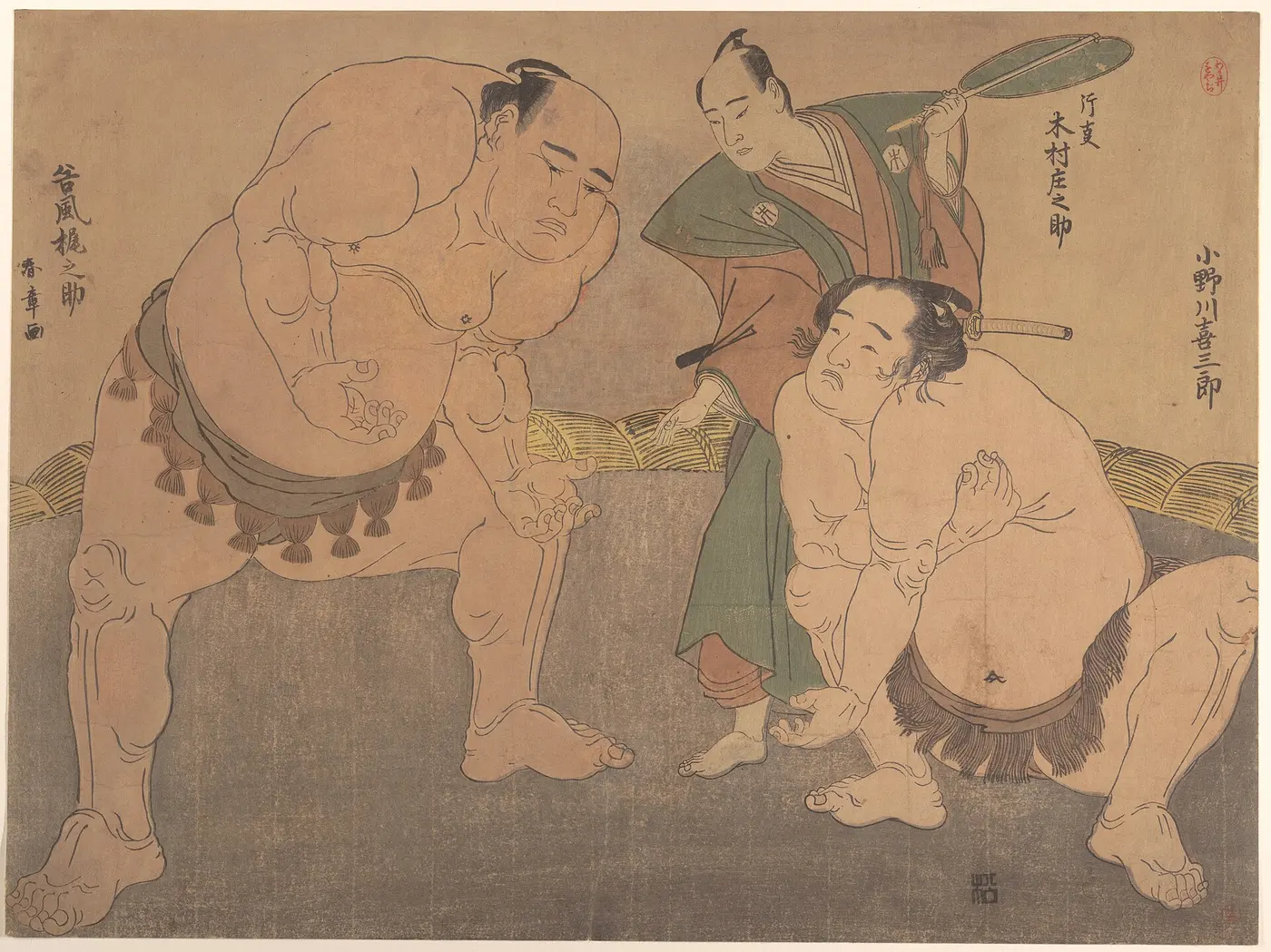

Tanikaze stood about 189 centimeters (6 feet 2 inches) tall and recorded a winning streak of 63 bouts in the official records, a true superstar of Edo sumo. The official line of yokozuna is counted from “the first, Akashi Shiganosuke,” which makes Tanikaze the fourth. But the first three, Akashi among them, are poorly documented, both as people and as license holders, and are regarded as semi-legendary figures. The usual view is that Tanikaze was, in practice, the first yokozuna.
The day “yokozuna” appeared on the banzuke
For a long time afterward, yokozuna remained a title held by certain ōzeki. The word first appeared on a banzuke in the May tournament of 1890.
The trigger was a complaint from the 16th yokozuna, Nishinoumi Kajirō. He had received his yokozuna license that year, but because two other wrestlers already filled the ōzeki slots, he was to be listed as a “haridashi ōzeki,” with his name sticking out beyond the frame of the sheet. Nishinoumi objected: having won the highest honor, why should he be left in the margin? As a result, “yokozuna” was written on the banzuke for the first time, and listing yokozuna on the sheet became the custom from then on.
Then, in February 1909, sumo’s regulations were revised and yokozuna was formally established as a wrestler’s rank. That June, the first Kokugikan arena opened in Ryōgoku, Tokyo. The yokozuna at the time were Hitachiyama Taniemon and the second Umegatani Tōtarō.
Chosen by a council
In 1950, after the war, the Yokozuna Deliberation Council was established. Until then, licenses from the Yoshida family had played a large part in making a yokozuna; from that year on, the Japan Sumo Association decided promotions after consulting a council of outside experts. The first wrestler promoted under this system was Chiyonoyama.
Since 1958, the guideline for promotion has been “two consecutive tournament wins as ōzeki, or an equivalent record.” Even so, there is no strict numerical threshold, and besides results, a yokozuna is expected to show the dignity befitting the rank.
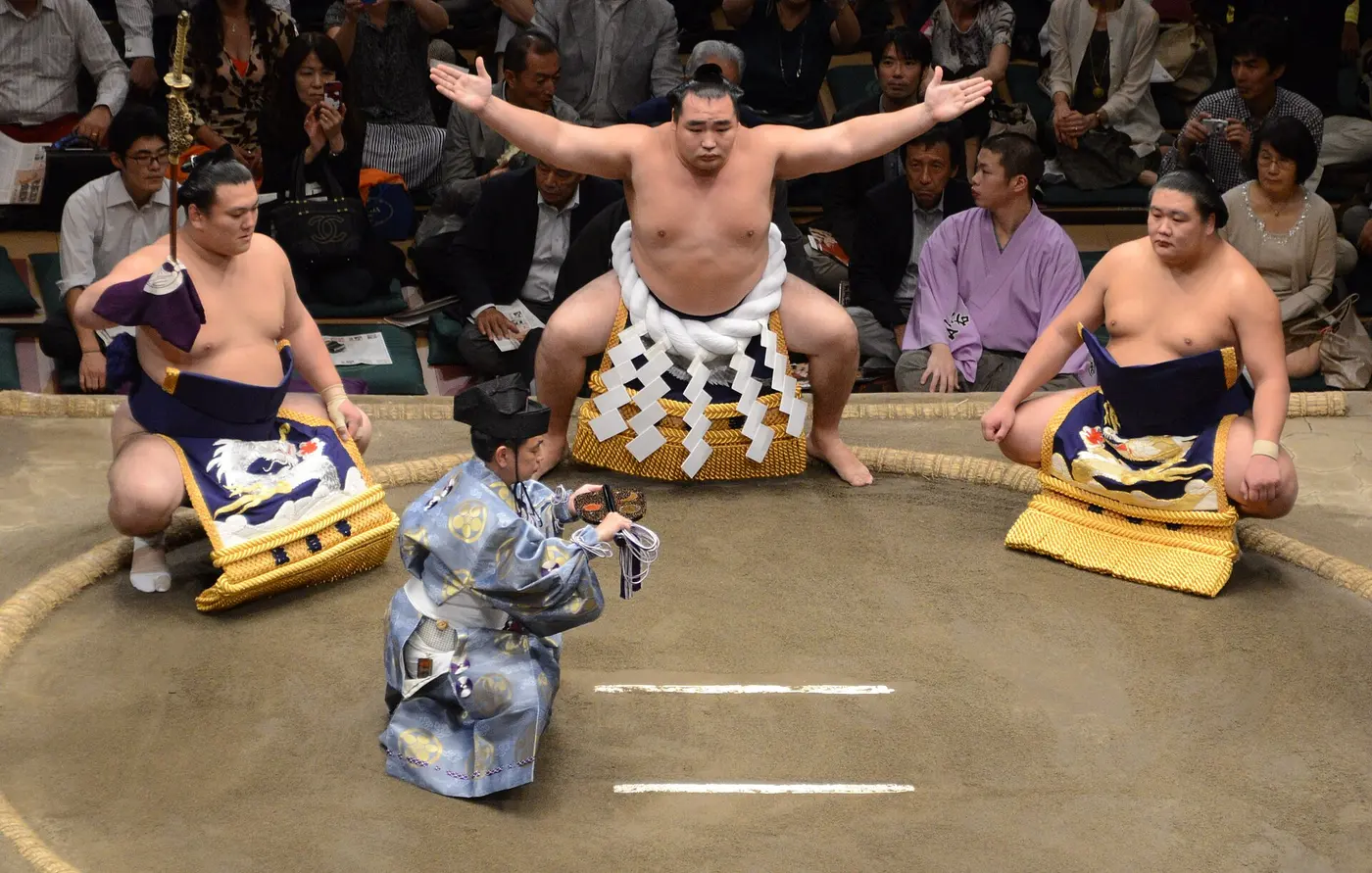

When a new yokozuna is born, his stable holds a tsuna-uchi, a rope-making session. The wrestlers twist hemp that has been softened by kneading it with rice bran together with cotton and a core of copper wire, finishing it into a single rope. Ropes in the Edo period are said to have been slender, about 5 centimeters thick and weighing around 2 kilograms, but they grew thicker from the Meiji era (1868–1912) onward, and during the Heisei era (1989–2019) one rope reached 20 kilograms (44 pounds). Still, a yokozuna wears the rope only for the ring entrance; he fights his bouts in his mawashi belt alone.
A rank with no way down
A yokozuna cannot be demoted. Since the rank became official in 1909, not a single yokozuna has dropped back to ōzeki. When his results decline, the only path left is retirement. The Yokozuna Deliberation Council may issue a struggling yokozuna an “encouragement,” a “warning,” or a “recommendation to retire.” That severity, the lack of any way down, is part of what gives the rank its weight.
Ōnosato, promoted in 2025, is the 75th yokozuna. It has been 236 years since Tanikaze and Onogawa received their licenses. The single rope tied on for the ring entrance has been handed down, unchanged in meaning, since the days of Edo.