Was imitation crab invented in Japan?
Yes. It was born in Japan in the early 1970s and is now eaten around the world, especially in France.
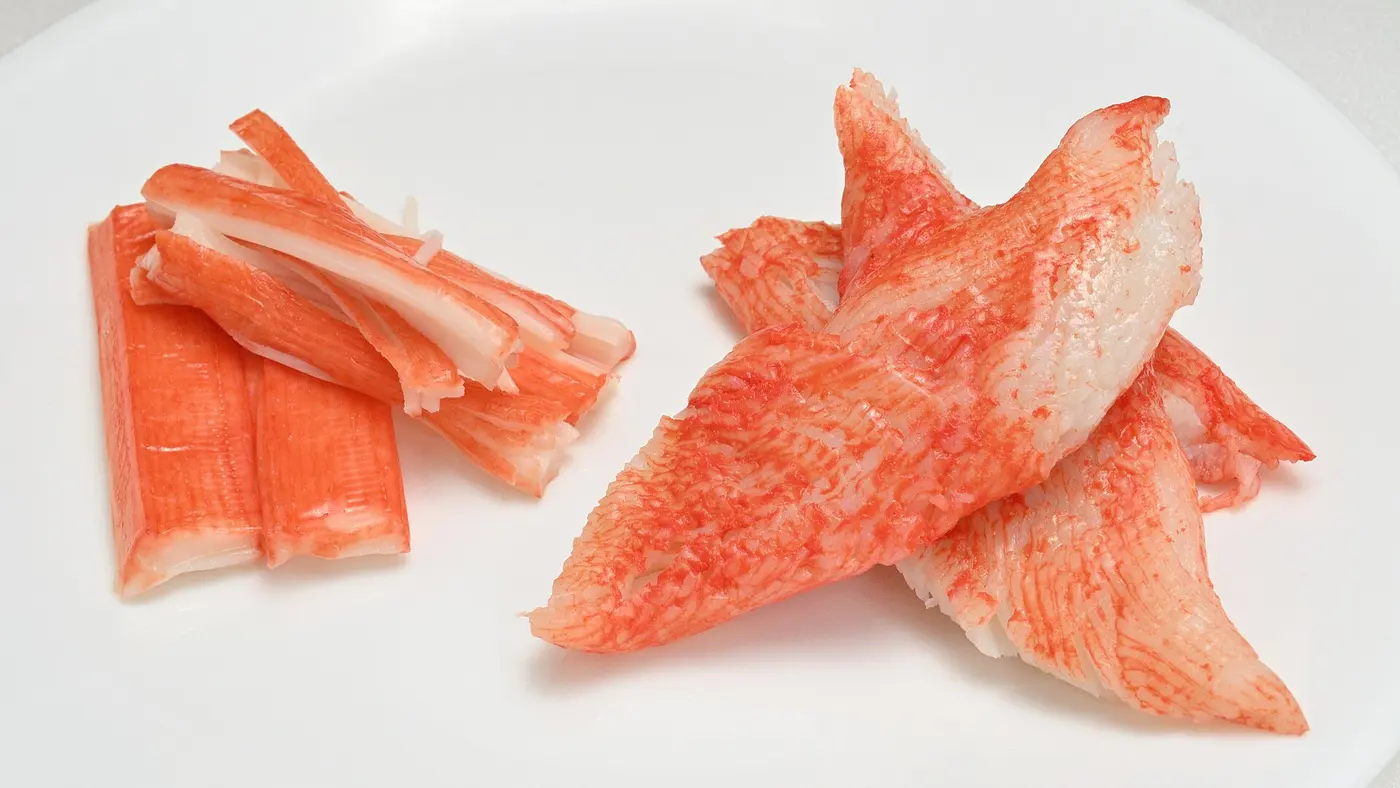
Red and white stripes, and flesh that pulls apart in thin strands. Imitation crab, known in Japan as kanikama, has become a fixture in salads, lunch boxes and hand-rolled sushi. Yet there is no crab inside. Its main ingredient is surimi, a paste made by grinding white fish such as Alaska pollock.
In Japan, foods made by kneading and cooking fish paste, such as kamaboko fish cakes and tube-shaped chikuwa, are called nerimono. Kanikama, short for “kani kamaboko” (crab fish cake), is one of them. Because it is so common abroad, some people assume it came from somewhere else. It was born in Japan, though, and from research that had nothing to do with crab.
A failed artificial jellyfish
The first company to sell imitation crab was Sugiyo, a seafood processor in Nanao, Ishikawa Prefecture, on the Sea of Japan coast. In the early 1970s, strained relations between Japan and China sharply cut imports of Chinese jellyfish, a delicacy used in Chinese cooking. Sugiyo set out to develop an artificial jellyfish to fill the gap, using alginic acid, a substance found in seaweeds such as kelp.
The result looked and crunched like jellyfish, but it fell apart once soy sauce was added, among other problems, and never became a product. Then the company’s head at the time tasted some chopped-up samples and noticed that the texture was a lot like crab meat.
Taking the hint, the development team turned to the company’s core business, fish paste, and set about recreating crab meat. The result went on sale in 1972 as “Chinmi Kamaboko Kaniashi” (crab-leg fish cake delicacy), a flaked product resembling shredded crab leg meat.

The stick comes from Hiroshima
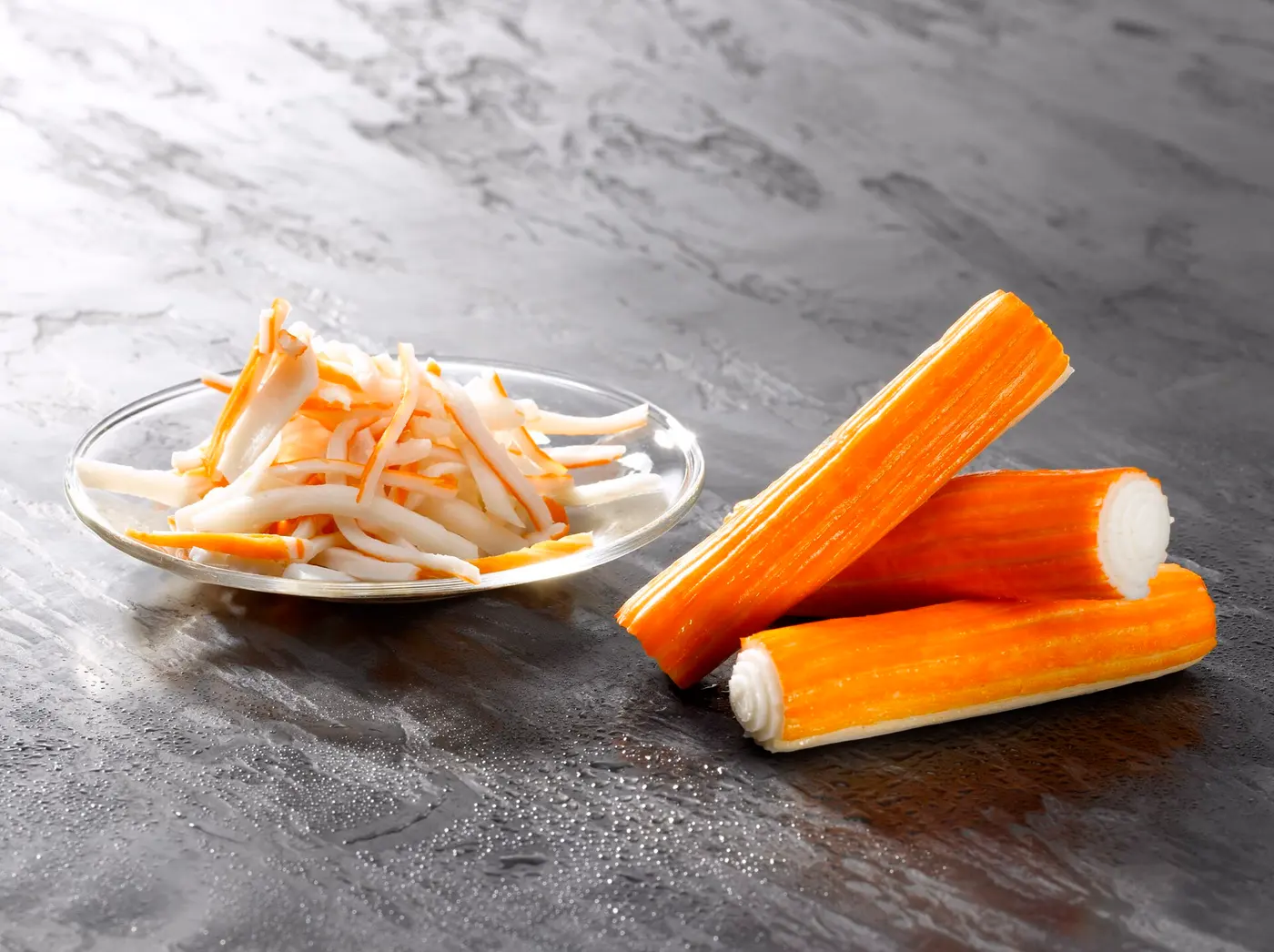
The familiar stick shape was popularized by Osaki Suisan of Hiroshima. In September 1974 it launched “Kani Stick” (later renamed “Fish Stick”), made by bundling fish paste into thin strands and coloring the outside red.
Other companies also claim they got there first, so there is no single agreed-upon “original.” Every version of the story agrees, however, that imitation crab appeared in quick succession in Japan in the early 1970s.
Osaki Suisan applied for a patent on the stick, but it was not granted, partly because of opposition within the industry. As a result, many companies were free to make it. In 1979, Yanagiya, a food machinery maker in Yamaguchi Prefecture, developed equipment for producing imitation crab, and it later came to hold roughly 70 percent of the world market for such machines.
Officially, “crab-flavored fish cake”
With no crab inside, the package can hardly just say “crab.” In 1990, Japan’s national food standards (the Japanese Agricultural Standards) created a category called “flavored kamaboko,” and imitation crab must be labeled along the lines of “flavored kamaboko (crab flavor).”
To make it, fish paste is flavored with crab extract or flavoring, cooked into a thin sheet, scored with fine cuts, then bundled or rolled and colored red on the outside. Those cuts are what let it pull apart in strands like real crab.
In France, it is just “surimi”
Imitation crab was being exported from the mid-1970s, and in the United States it caught on under names such as “imitation crab” and “krab.” It is especially popular in Europe, and in France it is so well established that people simply call it “surimi.”
According to Kibun Foods, a major Japanese fish cake maker, Japan and France each ate about 50,000 tonnes of imitation crab a year as of 2021. France has only about half Japan’s population, so per person the French eat more. Worldwide consumption is estimated at more than 500,000 tonnes a year.

Today it is made all over the world, across Asia, Europe and the Americas, and Lithuania in Eastern Europe is home to one of the largest imitation crab factories anywhere. Born from a failed artificial jellyfish, this humble fish cake has become one of Japan’s best-known food inventions, served on tables worldwide.