Why do Japanese temples ring their bells 108 times on New Year’s Eve?
The best-known explanation is that 108 is the number of human worldly desires, but other theories exist, and no single origin is settled.
1927
On New Year’s Eve in Japan, a low, booming note drifts from neighborhood temples and from live television broadcasts. This is joya no kane, the ringing of temple bells as the old year turns into the new.
The bell is usually struck 108 times. People will often tell you that 108 is the number of bonnō, the worldly desires and delusions that trouble the human mind in Buddhist thought. Look into why it is 108, though, and you find more than one answer. And the way the custom spread across Japan turns out to be a surprisingly recent story.
Many ways to count desires
The most familiar explanation is that each strike of the bell drives away one of the 108 bonnō, so that you can greet the new year with a clear mind.
Even this explanation comes in several versions. One, described in the Nipponica encyclopedia, starts from the six senses: sight, hearing, smell, taste, touch and the mind. Each can find something pleasant, unpleasant or neutral; each feeling can be tainted or pure; and each can belong to the past, present or future. Multiply them out, 6 × 3 × 2 × 3, and you get exactly 108.
A different theory has nothing to do with desires. The traditional Chinese calendar divided the year into 12 months, 24 solar terms and 72 shorter seasons. Add them up, 12 + 24 + 72, and you reach 108, as if the bell were sounding out the whole year. Japanese people also enjoy a numerical pun on shiku hakku, an expression for all life’s suffering that can also be read as “four nines and eight nines”: 4 × 9 + 8 × 9 = 108.

Roots in Chinese Zen temples
The New Year’s bell is said to have begun in China during the Song dynasty (960–1279). A code of rules for Zen monasteries compiled under the following Yuan dynasty instructs that the great bell be struck in sets of 18 fast and 18 slow strokes, repeated three times, for a total of 108.
The practice reached Japan with Zen Buddhism. Bells were rung almost daily at Zen temples into the Kamakura period (1185–1333), and the ringing later became an event for the night between New Year’s Eve and New Year’s Day. By custom, 107 strokes are made in the old year and the last one after midnight.
Silent bells in 1920s Tokyo
Yet the custom was far from universal. According to the scholar of religion Hiromi Shimada, on New Year’s Eve in 1924 the Tokyo Asahi newspaper asked the longtime bell ringers at two of Tokyo’s best-known temples, Kan’ei-ji in Ueno and Senso-ji in Asakusa, about the year-end bells. Both said they did not ring them, because they rang the bell that tolled the hours instead. In another paper, Awashima Kangetsu, a writer steeped in the culture of old Edo, said the bells that had been popular in the Edo period were now rung by few temples in Tokyo.

Radio spread the sound
What changed things was the new medium of the day: radio. On New Year’s Eve in 1927, Japan’s public broadcaster, NHK, aired a program called Joya no Kane, the forerunner of Yuku Toshi Kuru Toshi, the New Year’s Eve program that still airs today.
According to Shimada, the first broadcasts used a keisu, a bowl-shaped Buddhist bell borrowed from a nearby temple and struck 108 times in the studio. In 1929 the program carried a live broadcast from a single temple, and from 1932 it relayed bells from temples around the country. Once people could hear the bells from home, the custom is thought to have spread well beyond Zen temples.
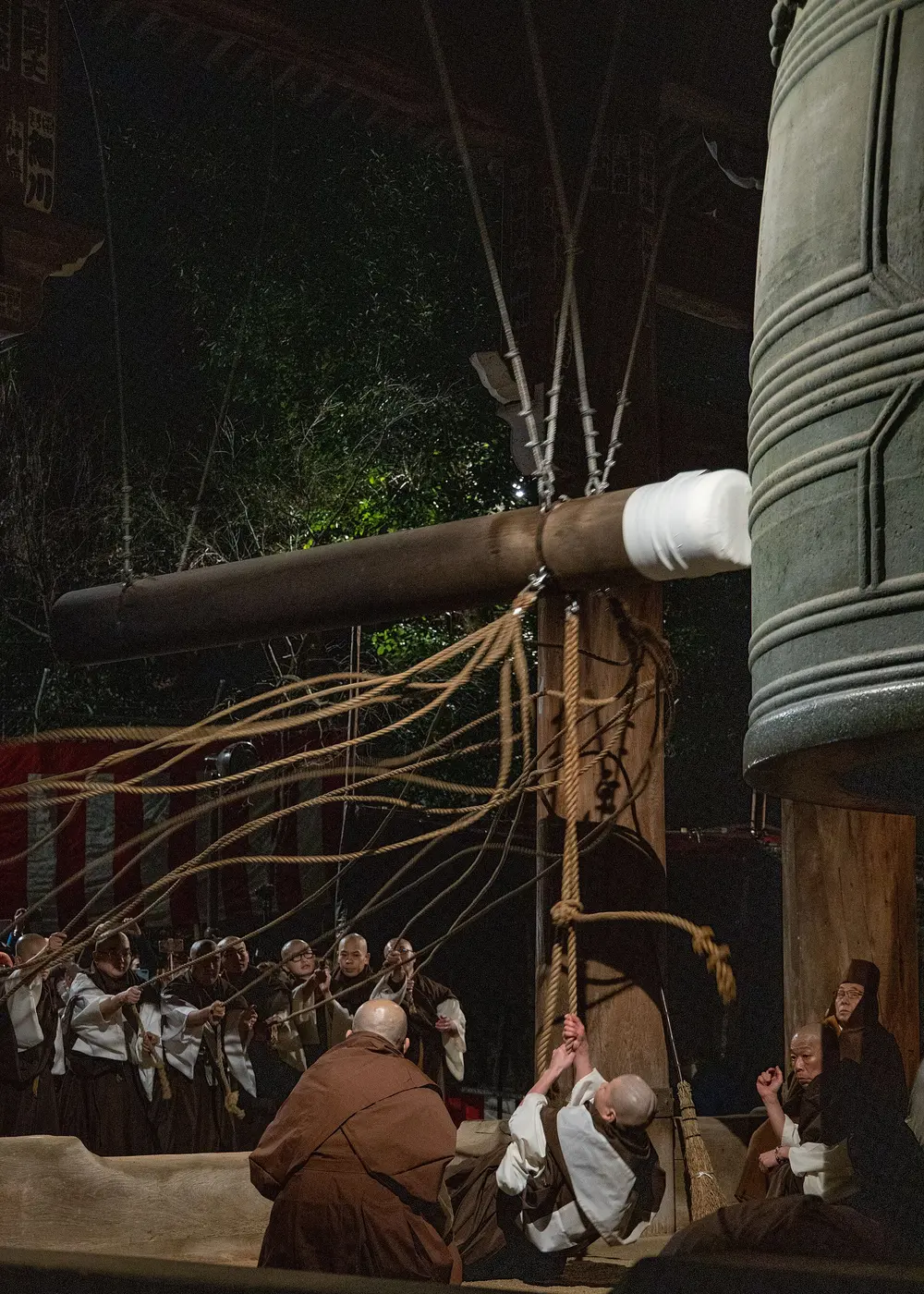
Today the sight of monks heaving on ropes, as at Chion-in, is part of the New Year’s season. In recent years, though, some temples have reportedly moved the ringing to the daytime or early evening, or stopped altogether, after noise complaints.