Why does helium change your voice?
The pitch itself barely changes. Sound travels about three times faster in helium, which changes how your throat and mouth resonate.
Breathe in from a can of party gas, start talking, and your voice suddenly goes thin and squeaky while everyone around you dissolves into laughter. Helium “voice-changer” gas is a familiar trick at parties and on TV variety shows.
The natural assumption is that helium makes your voice higher, in other words that it raises its pitch. Ask a physicist, though, and you will hear that this is not quite right. The part of you that sets the pitch of your voice hardly changes at all.
A voice is a sound source plus resonance
Your voice is made in two stages.
First, the vocal folds in your throat vibrate rapidly as air is pushed up from the lungs. That vibration is the source of the sound, and the number of vibrations per second sets the pitch. How fast the folds vibrate depends on their tension, mass and shape, and hardly at all on what gas is passing through your throat.
The sound from the vocal folds then travels out through the vocal tract, the tube running from the throat to the lips. In an adult it is about 17 centimeters (7 inches) long. Like a wind instrument, this tube strongly reinforces certain frequencies. Those resonances are what make an “ah” different from an “ee,” and they shape how a voice sounds to us. A voice, in short, is the sound of the vocal folds played through the instrument of the vocal tract.


Faster sound, higher resonances
What helium changes is the second stage, the resonance.
Sound travels through air at about 340 meters per second (1,100 feet per second). In helium it goes about three times faster, close to 1,000 meters per second. The frequencies a tube resonates at depend on its length and on the speed of sound inside it. Your vocal tract stays the same length, but if sound moves about three times faster inside it, the resonances shift upward by the same factor.
As a result, the lower parts of your voice are weakened and the higher parts emphasized. The vocal folds are vibrating just as often as before, so the pitch is unchanged, yet the tone color is transformed and the voice comes out thin and squeaky. Researchers at the University of New South Wales in Australia point out that if someone with singing experience breathes helium and sings the same note, the pitch stays the same.
Go the other way with sulfur hexafluoride, a gas about five times denser than air, and sound slows to only about 130 meters per second. Breathe that in and your voice sounds low and booming instead.
A real headache for deep-sea divers
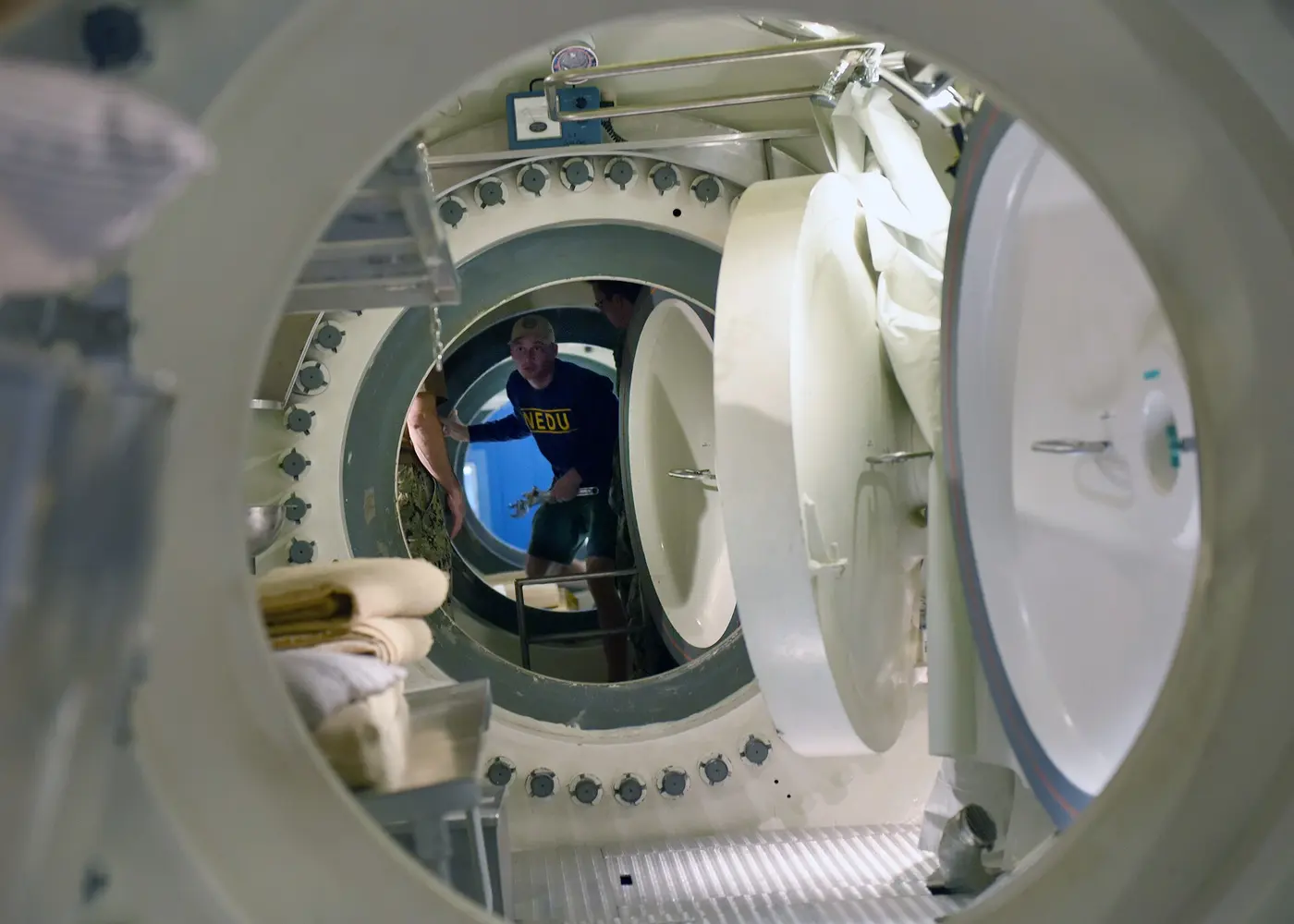
The people who have struggled most with this effect are divers who work deep underwater.
Breathe ordinary air at depth and the high-pressure nitrogen produces a drunk-like state called nitrogen narcosis, which becomes a problem beyond about 30 meters (100 feet). So in saturation diving, where divers live and work for long periods hundreds of meters down, nitrogen is replaced with a mixture of helium and oxygen. In Japan, the Maritime Self-Defense Force completed a saturation dive to 450 meters (about 1,500 feet) in 2008.
In a helium mix, however, divers’ voices become distorted and hard to understand. Special “helium speech unscramblers” have been used to make their speech more intelligible for the team at the surface.

Fun, but handle with care
Party voice-changer gas sold in Japan is not pure helium: about 20 percent of it is oxygen, roughly the same share as in ordinary air, so that breathing it does not starve you of oxygen.
Helium for filling balloons, on the other hand, is almost 100 percent helium. Breathing it means no oxygen reaches your body, which can make you pass out or even suffocate. Never breathe in the gas from a balloon.
Accidents have happened even with oxygen-containing voice-changer gas. In 2015, a 12-year-old girl collapsed after inhaling it during the recording of a Japanese TV show and was diagnosed with a cerebral air embolism, in which air gets into the blood vessels of the brain. The can was labeled for adults. If you use it, follow the warnings on the label.